When a pipe bursts at 11pm, nobody’s asking around for recommendations. They’re on Google, typing “emergency plumber near me” — and they’re calling whoever shows up first.
The plumber getting that call isn’t necessarily the best one in town. They’re just the one Google shows first.
If your business isn’t ranking, you’re not losing to better plumbers. You’re losing to better-optimized ones.
SEO fixes that. It puts your business in front of people who already need a plumber, in your area, right now — without paying for every single click.
This guide covers the real market opportunity, what your customers are actually searching for, how to outrank your local competition, and exactly how M For SEO makes it happen.
Understanding Your Market Potential Through Search Demand
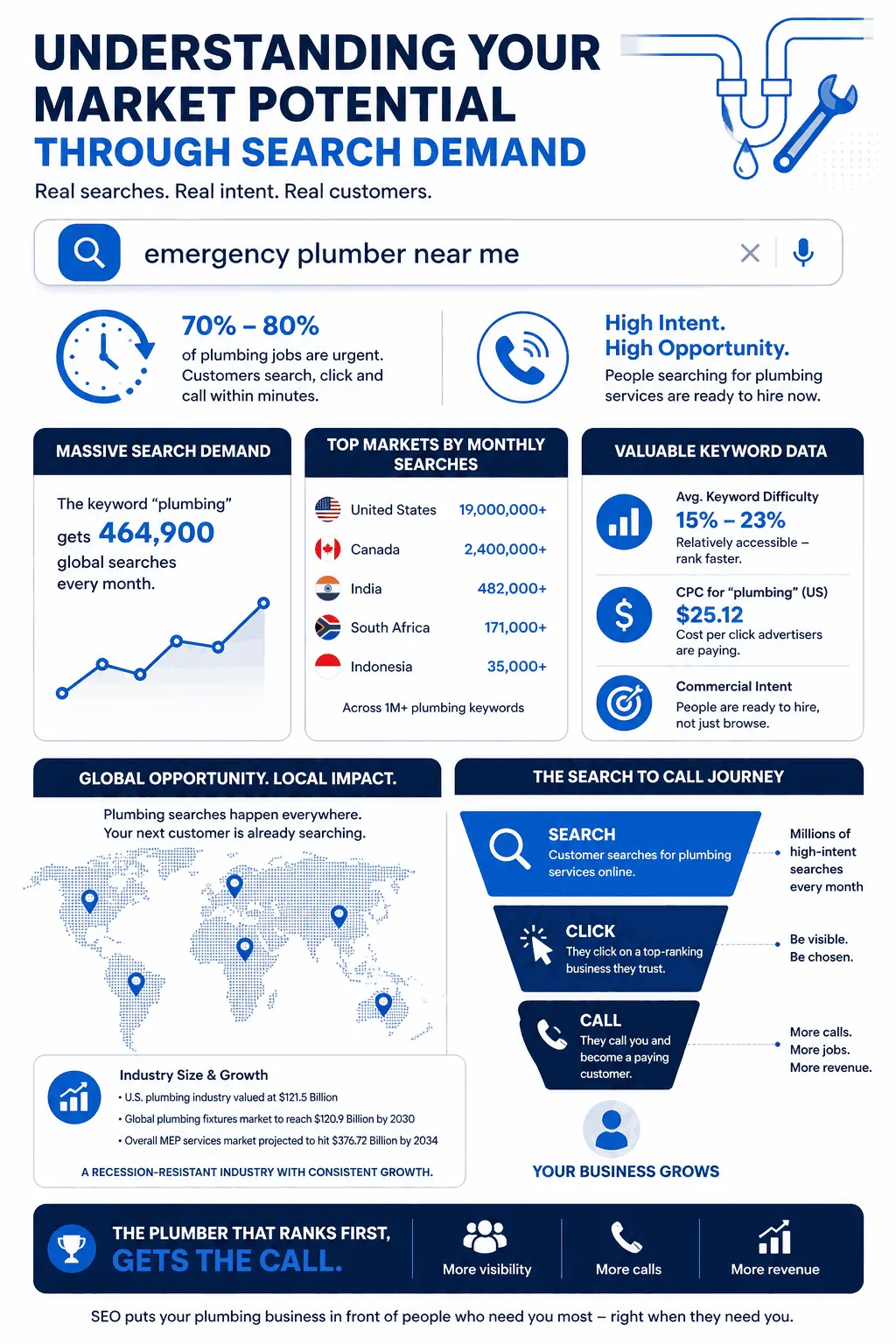
Most plumbing businesses skip this step. They jump straight into SEO without understanding the size of the opportunity or where exactly their customers are coming from. The data tells a clear story.
Plumbing Industry Overview: Market Size and Growth Insights
Plumbing is one of the most recession-resistant service industries on the planet, and the numbers confirm it.
The U.S. plumbing industry is valued at approximately $121.5 billion, with around 112,000 businesses competing for that revenue. The global plumbing fixtures market is projected to reach $120.9 billion by 2030, growing at a CAGR of 4.5%. When you factor in the broader mechanical, electrical, and plumbing services sector, the market is expected to hit $376.72 billion by 2034.
What makes this industry different from most is the nature of demand. Between 70% and 80% of plumbing jobs are urgent — customers are not comparing options. They are searching, clicking, and calling within minutes.
That is exactly why SEO matters more in plumbing than almost any other trade. The businesses ranking at the top of Google are not just getting visibility. They are capturing customers who are ready to book right now.
Measuring Industry Demand Through SEO Data
Market reports tell you the industry is growing. SEO data tells you exactly where the customers are and what they are searching for right now.
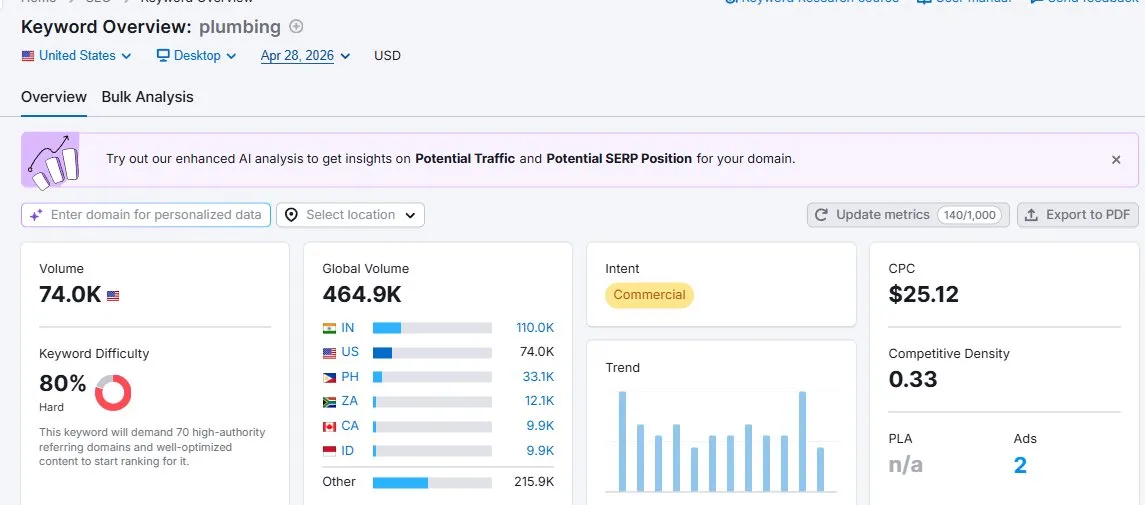
The keyword “plumbing” alone pulls 464,900 global searches every month, with commercial intent — meaning these are people ready to hire, not just browse.
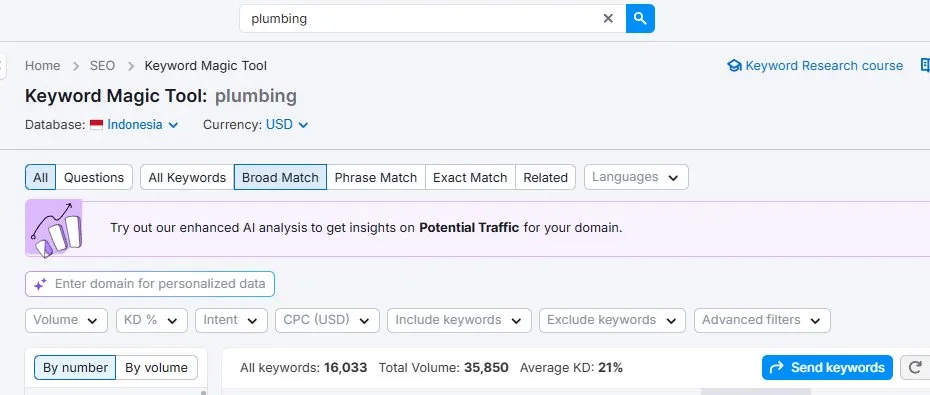
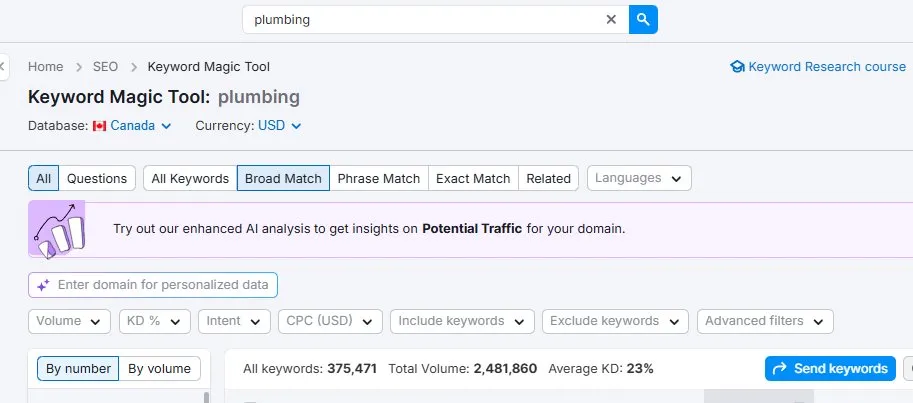
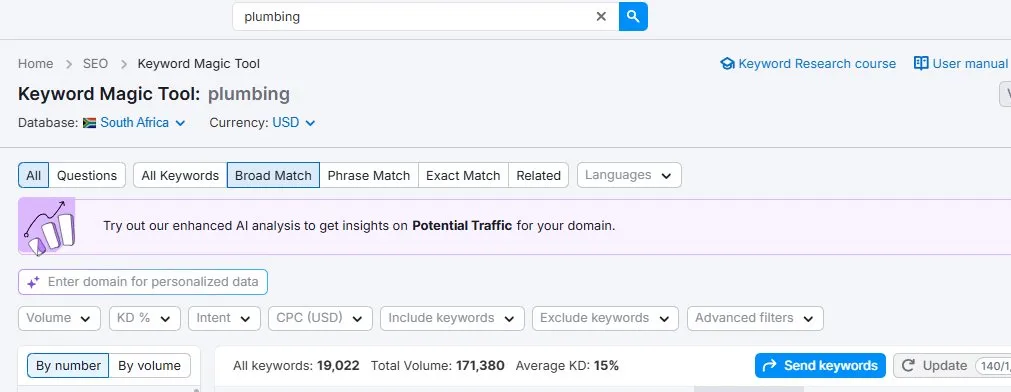
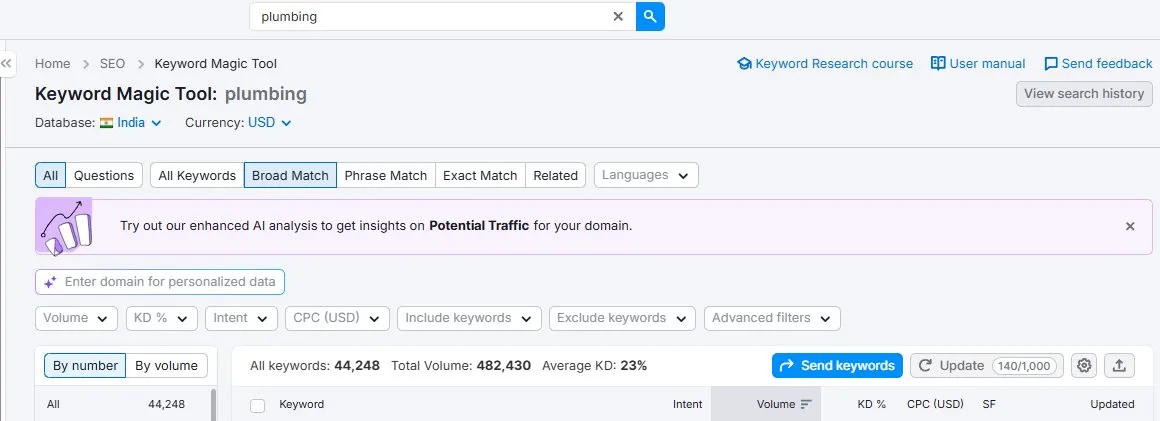
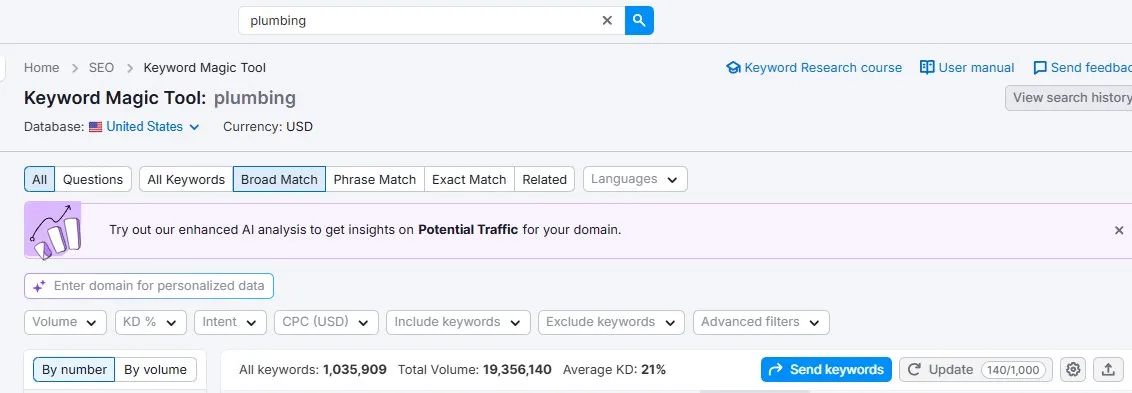
The U.S. leads with over 19 million monthly searches across more than a million plumbing keywords. Canada sits at 2.4 million, India at 482,000, South Africa at 171,000, and Indonesia at 35,000. Every one of these markets is active and searchable.
Average keyword difficulty across all these markets ranges between 15% and 23%. For context, that is relatively accessible — plumbing businesses do not need years of SEO history to start ranking for high-value terms.
The CPC for “plumbing” in the U.S. is $25.12 per click. Advertisers are paying that every single time someone clicks their ad. SEO earns you the same traffic without that recurring cost.
The demand exists in every major market. The businesses showing up consistently in search are the ones converting it.
Analyzing Market Opportunities via SERP Landscape
A Google search for “plumbing services” returns 132,000,000 results. Competing with all of them is not the goal. Finding the gaps is.
The main keyword “plumbing” has a difficulty of 80%. Nobody starts there. The real opportunity sits in the thousands of specific, high-intent searches that competitors have ignored — service-specific queries, problem-based searches, and terms that signal a customer who is ready to call right now.
These keywords have lower competition, real buying intent, and faster ranking potential. That is where rankings are earned quickly and leads follow.
Who We Are: Introducing M For SEO As Your Plumbing SEO Agency
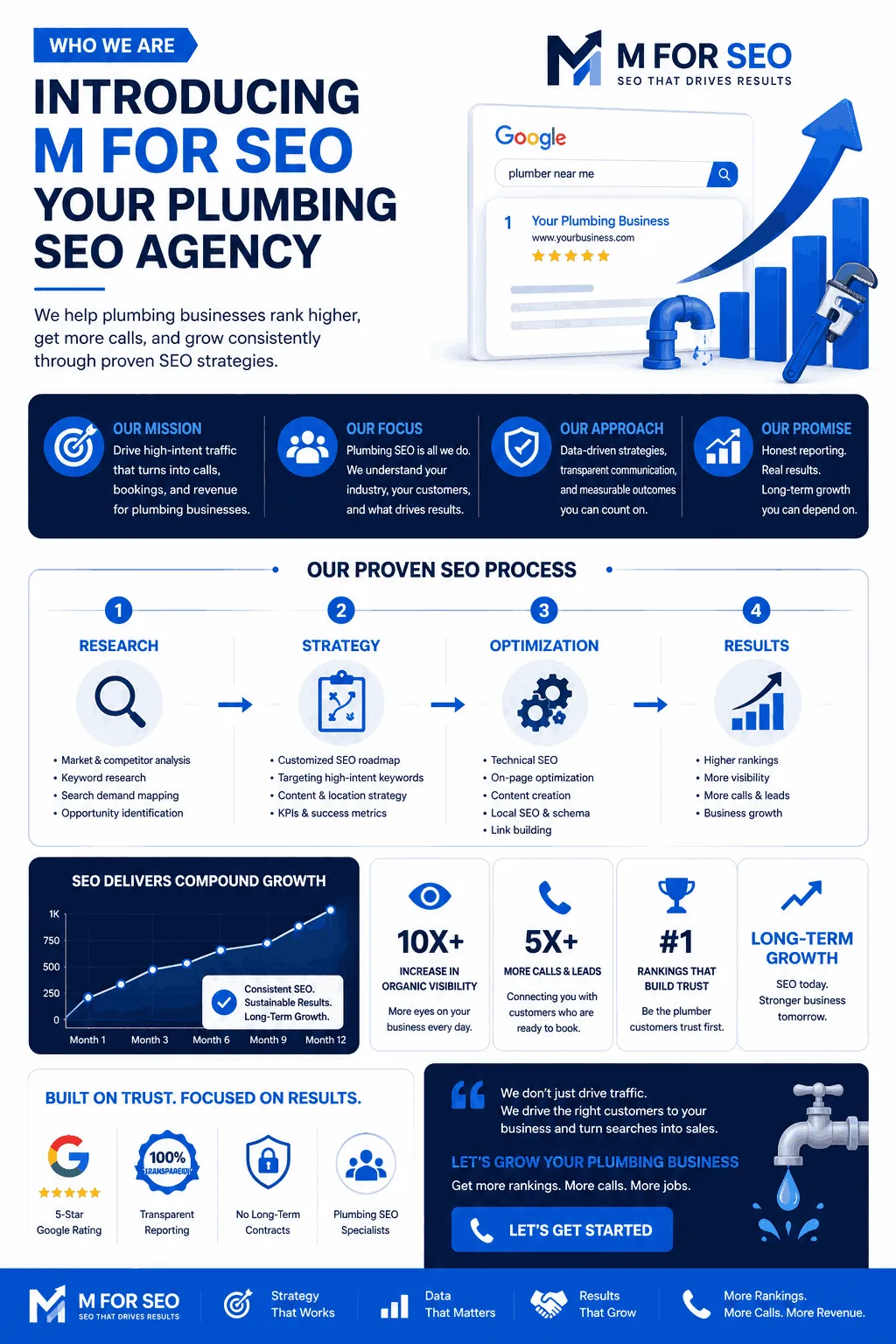
M For SEO is a professional SEO agency specializing in helping service-based businesses grow through organic search. As a dedicated plumbing SEO agency, we work specifically with plumbing businesses to build search visibility that translates into real, booked jobs — not just traffic numbers. Our process starts before we touch a single page on your website. We study your market, analyze what your competitors are ranking for, identify the keyword gaps they have missed, and build a strategy around the searches that actually bring in customers. From on-page optimization and technical SEO to content that targets high-intent plumbing queries, every action we take is intentional and tied to a specific outcome. We do not operate on generic checklists or promise results on timelines that do not exist — we set honest expectations, execute with consistency, and measure everything that matters. Plumbing is a high-intent, urgency-driven industry, and the businesses that dominate search in this space are the ones with the right SEO foundation behind them. That foundation is what M For SEO builds.
Our Core SEO Strategies for Plumbing Businesses
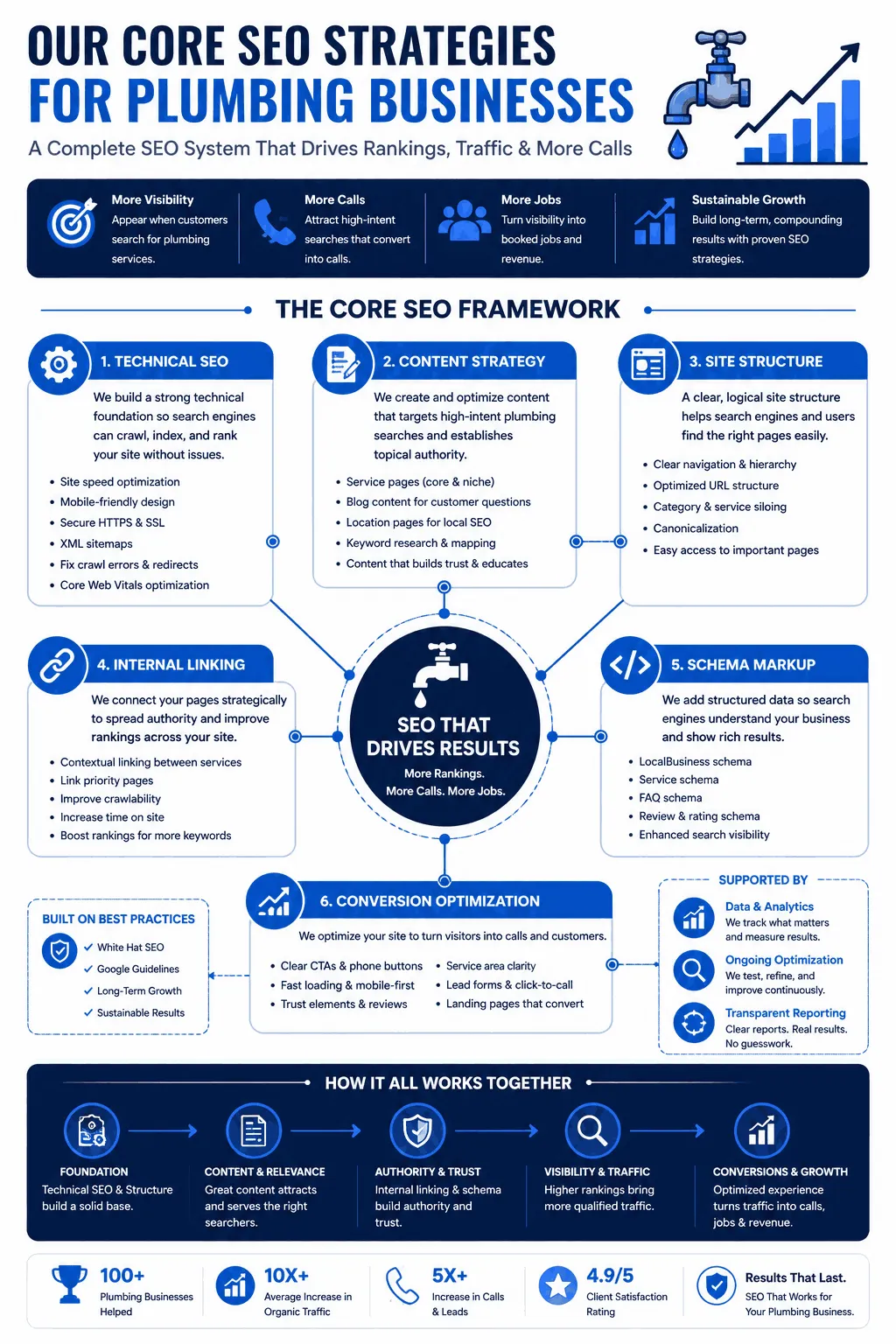
Most plumbing businesses approach SEO the wrong way. They add a few keywords to their homepage, maybe write a blog post or two, and expect leads to follow. When nothing moves, they assume SEO does not work for their industry. The problem is never the industry. It is the absence of a system. SEO for plumbing businesses only works when every part connects to everything else, built in the right order, with the right intent behind each decision.
Here is exactly how M For SEO does it.
The Technical Foundation
Before a single word of content is written or a single page is optimised, we run a fulltechnical audit of your website. We examine how search engines are crawling your site, which pages are being indexed and which are being ignored, and whether anything in the site structure is silently working against your rankings. Plumbing websites commonly have thin service pages that say almost nothing, duplicate location pages that compete against each other, and slow load times on mobile that Google penalises before a potential customer ever sees the site. We fix crawl issues, resolve indexing problems, improve core web vitals, and ensure the mobile experience meets the standard Google actually uses to evaluate your site. None of the work that comes after this step matters if the foundation is broken.
The Intent Map
Plumbing customers do not all search the same way. Someone with a burst pipe searches differently than someone looking to install a new bathroom. A homeowner searching at midnight searches differently than a property manager planning a maintenance job. Each behaviour represents a different type of query and a different page that needs to exist on your website. We map all of it into a structured hierarchy before we touch a single page. Core service pages sit at the top targeting the highest volume terms. Below them sit specific service variation pages. Location-based pages handle area-specific demand. And a content layer of guides, problem-based articles, and educational pieces captures potential customers earlier in their decision. This is how SEO for plumbing businesses moves from ranking a few keywords to owning an entire market segment.
Site Architecture
The way a website is structured tells search engines what matters and what does not. A user landing on your emergency plumbing page should be able to see exactly where that page sits within the broader site — under services, under your main plumbing offering, connected to related pages like pipe repair and drain cleaning. That hierarchy makes navigation intuitive for customers and makes crawling efficient for search engines. We build and optimise the full site architecture including URL structure, breadcrumb navigation, category depth, and internal navigation menus so that every page is easy to find, easy to understand, and positioned to rank.
On-Page Execution
A service page and a blog post are not the same thing and should not be optimised the same way. Service pages target commercial intent with clear structure, strong calls to action, and internal links that move authority where it needs to go. Blog content addresses the questions customers ask before they are ready to call. We align every title, heading, content block, and internal link to the specific job that page is supposed to do. For plumbing websites specifically, we also handle the details most agencies overlook — proper canonicalisation, page structure that matches search intent, and service page depth that actually gives Google something to evaluate rather than three paragraphs and a phone number.
The Content Layer and Topical Authority
Most plumbing websites have content that exists but does not function. It is there but disconnected, not answering real customer questions, and not building any meaningful authority in the eyes of search engines. We build content with a specific purpose at every stage of the customer journey. Problem-based articles, service explainers, cost guides, and comparison pieces that open new areas of search demand. But more importantly, we build it as a connected system designed to establish topical authority. When Google sees that a website covers every meaningful aspect of plumbing — from emergency repairs to installation guides to maintenance advice — it begins to treat that website as a trusted source across the entire category. That trust compounds over time and is what separates plumbing businesses that rank consistently from those that spike and disappear.
Internal Linking
Internal links are not just navigation. They are how authority moves through a website and how search engines understand the relationships between pages. We connect blog content to the service pages it supports, service pages to related services, and location pages to the broader site structure in a way that makes sense to both Google and the customer reading it. A page about drain cleaning connects to pipe repair. A page about water heater installation connects to general plumbing maintenance. This kind of intentional structure is what separates a website that ranks for a handful of terms from one that ranks across hundreds of related searches consistently.
Schema Markup
Most plumbing websites are invisible to search engines at the data level. Schema markup changes that. We implement service schema so Google understands exactly what your business offers and how to categorise it in search results. We add review schema so star ratings appear directly in search listings, increasing click through rates without needing to change rankings. We implement FAQ schema on service pages so your answers appear directly in search results, taking up more real estate on the page and reducing the advantage competitors have over you. These are not optional extras. In a competitive plumbing market they are the difference between a listing that gets clicked and one that gets skipped entirely.
E-E-A-T and Trust Signals
Google does not just evaluate pages. It evaluates the business behind them. For plumbing companies, where customers are inviting someone into their home to handle urgent and often expensive problems, trust is a ranking factor as much as it is a conversion factor. We strengthen E-E-A-T signals across your website by ensuring business information is accurate and consistent everywhere it appears online, that your certifications and licensing are clearly communicated, that real customer reviews are present and structured correctly, and that the overall website reflects the kind of experience and expertise both Google and potential customers need to see before they make a call. An about page that establishes credibility, clear service guarantees, and verified reviews are not just good practice. They are signals that contribute directly to how seriously Google takes your website in a competitive search landscape.
Off-Page SEO and Authority Building
Once the on-site foundation is solid, we build external authority. For plumbing businesses, this means acquiring links from relevant, credible sources — home improvement platforms, trade directories, editorial placements, and content-driven backlink acquisition that signals to Google that your website deserves to rank above the competition. The goal is never to accumulate links for the sake of numbers. It is to build the specific level of authority needed to compete in your market and hold those rankings once they are achieved.
Conversion Optimisation
Traffic without conversion is just a vanity metric. A plumbing customer who lands on your website at midnight with water flooding their kitchen is not browsing — they are deciding in seconds whether to call you or go back and click the next result. That means the page experience has to actively support that decision rather than get in its way. We optimise service page layouts for immediate clarity, ensure your phone number and call to action are impossible to miss, and position trust signals — reviews, response times, service guarantees, and credentials — exactly where they have the most influence on a customer who is seconds away from picking up the phone. This is where SEO for plumbing businesses stops being about rankings and starts being about revenue.
Analytics and Tracking
Every decision in SEO should be backed by data and that requires proper tracking from day one. We set up GA4, Google Search Console, and conversion tracking so every meaningful action on your website is being measured — which pages are driving traffic, which are converting, where users are dropping off, and which keywords are gaining or losing ground. Without this infrastructure the entire strategy operates without feedback. With it, every month of data becomes an opportunity to improve something specific rather than guess at what to do next.
The result is not just a plumbing website that ranks. It is a system that captures demand across every way a customer searches, at every stage of their decision, and turns that visibility into consistent inbound leads over time.
How SEO For Plumbing Services Boosts Online Visibility & Trust
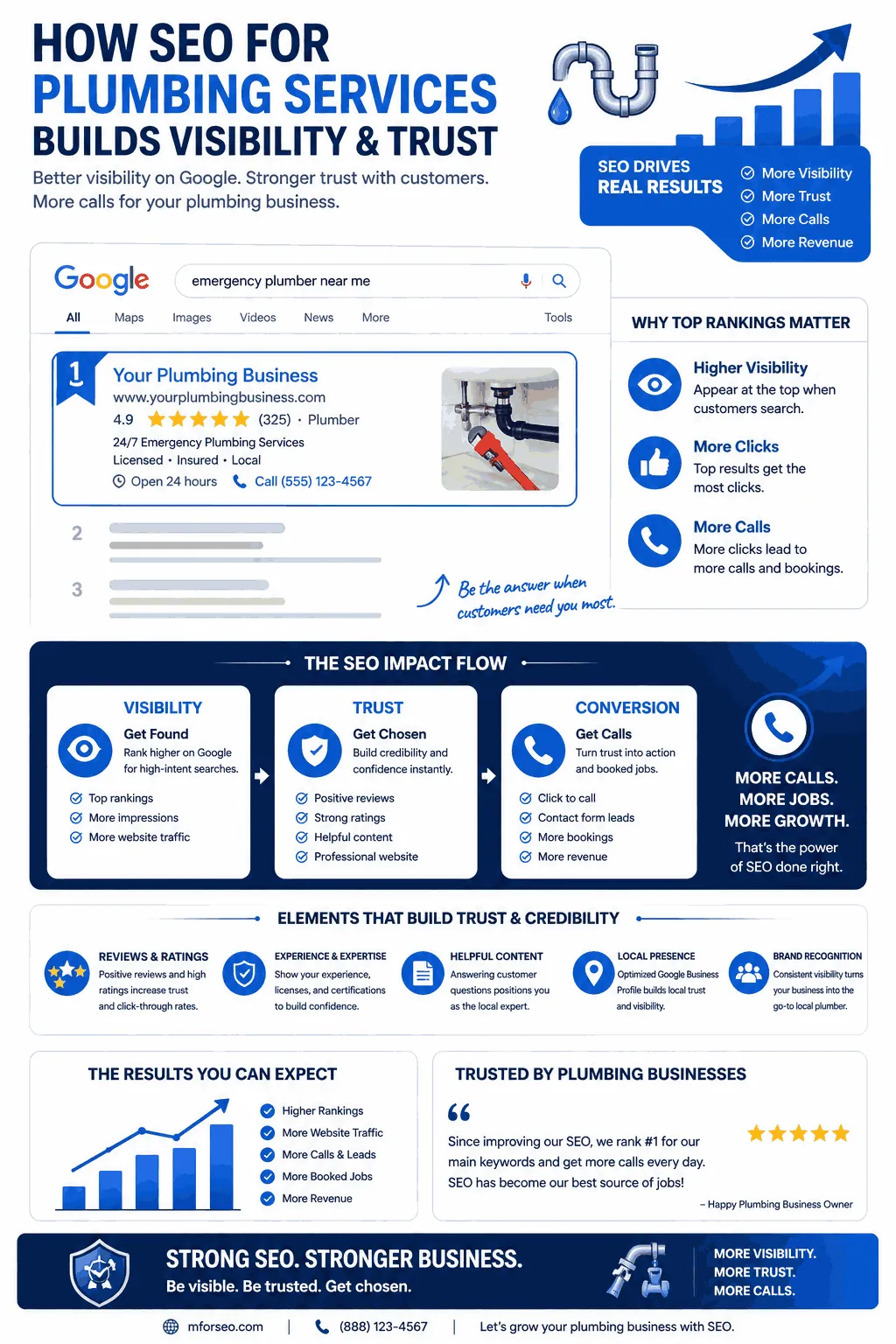
Plumbing is one of the few industries where the customer has already made the decision to hire before they even click a result. A pipe is leaking. A drain is blocked. The boiler has stopped working. They are not browsing — they are searching with intent to act. The only question is which plumbing business they call. That decision comes down to two things: who they find and who they trust. SEO determines both.
Visibility Puts You in Front of the Decision
When a customer searches “plumber near me” or “emergency pipe repair,” they are not scrolling through ten results comparing options. They are clicking one of the first two or three and making a judgement within seconds. A plumbing business that consistently ranks at the top of those results for the services it offers is not just getting more traffic — it is getting in front of customers at the exact moment the decision is being made. That positioning is not luck. It is the result of a website that search engines have evaluated, verified, and chosen to surface above everything else. Every week your business does not rank for those searches is a week of booked jobs going to a competitor who invested in SEO earlier.
Trust Is Established Before the First Word Is Read
The trust a potential customer has in your plumbing business begins in the search results, not on your website. A listing with star ratings visible, a clear and specific page title, and a meta description that directly addresses what they searched for already signals credibility before a single click. When they land on a page that answers their exact question, shows verified reviews, clearly displays your credentials, and makes it effortless to contact you — that trust deepens in seconds. Contrast that with a competitor whose listing looks generic, whose page is thin, and whose site takes four seconds to load on a phone. That customer is gone before they even read a sentence. SEO shapes every layer of that experience, from the search listing to the landing page to the content on it.
Organic Rankings Carry an Authority That Ads Never Will
There is a reason customers instinctively scroll past ads and click organic results. They know ads are bought. They know organic rankings are earned. When your plumbing business ranks organically for a competitive search term, it carries an implied endorsement from Google itself — a signal that your business is relevant, established, and trustworthy enough to be placed above hundreds of other options. That perception directly influences who a customer calls, especially when they are making a decision about letting someone into their home to handle an urgent and often expensive problem. Paid ads generate clicks. Organic rankings generate confidence.
Consistent Visibility Builds Brand Recognition in Your Market
A plumbing business that appears consistently across multiple relevant searches — service pages, blog content, FAQ answers surfaced directly in results — starts to become the familiar name in its market. Customers begin to recognise it across different searches over time. That repeated exposure builds the kind of brand recognition that most plumbing businesses assume requires advertising budgets they do not have. SEO creates it organically, through presence and relevance, and it builds without an ongoing cost per impression. The more searches your business appears in, the more embedded it becomes in the minds of customers in your area — so that when they or someone they know needs a plumber, your name is already there.
The Compounding Advantage
Every optimised page, every authoritative piece of content, every quality backlink your website earns is a permanent asset. Unlike paid ads that stop the moment the budget runs out, SEO builds on itself. A service page that ranks today continues ranking tomorrow. A blog post that answers a common plumbing question continues pulling in traffic months after it was published. A backlink earned from a credible source continues passing authority to your domain indefinitely. The plumbing businesses that invest in SEO consistently are not just winning today — they are building an advantage that becomes progressively harder for late-moving competitors to close. That is not a marketing expense. That is infrastructure.
Mistakes To Avoid While Doing SEO for Plumbers
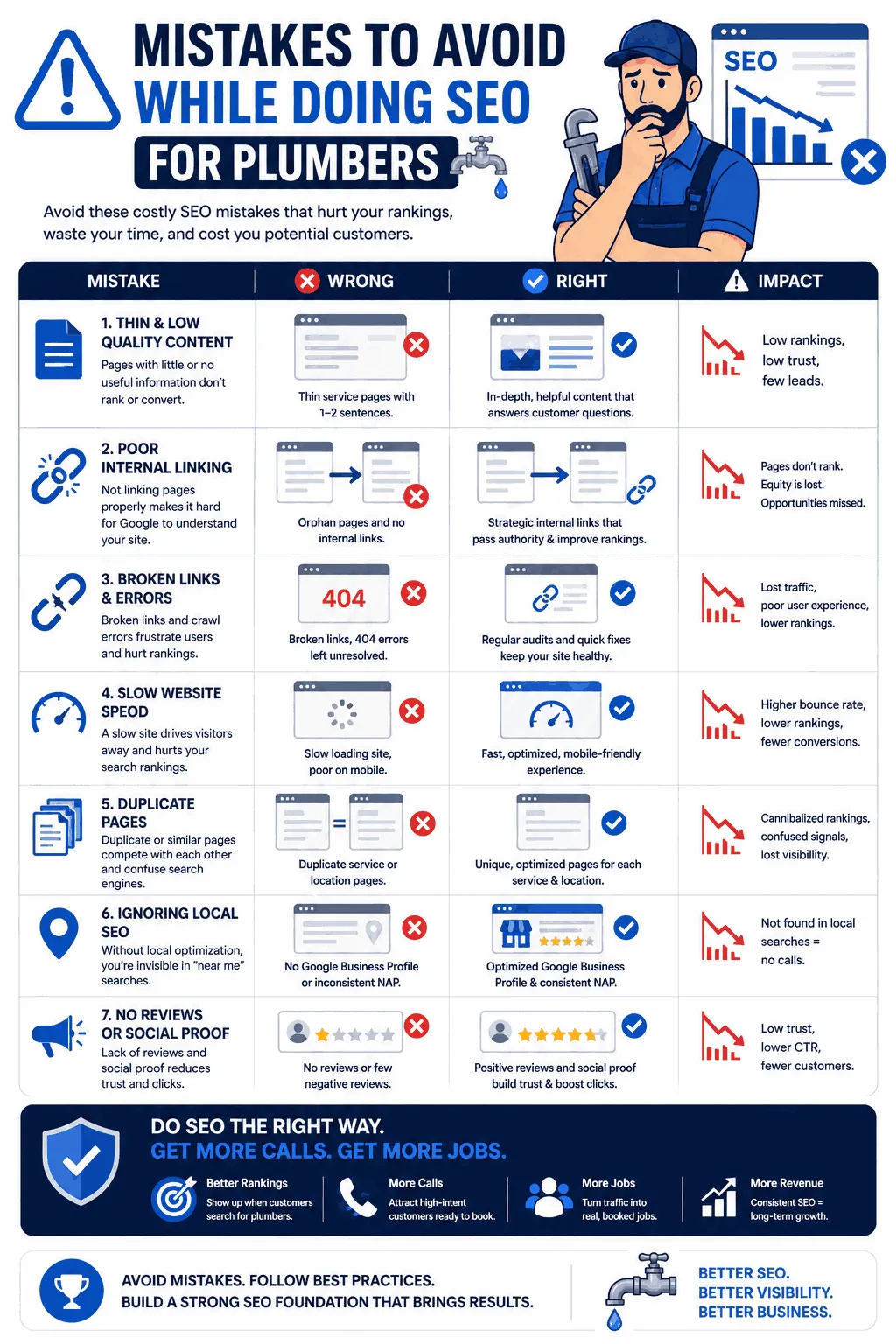
Most plumbing businesses that try SEO and fail are not failing because SEO does not work for their industry. They are failing because of specific, avoidable mistakes that quietly kill results before they ever materialise. Understanding what not to do is just as important as knowing what to do.
Targeting Broad Keywords Without the Authority to Rank for Them
The first mistake almost every plumbing business makes is going after the most obvious keywords immediately. “Plumber” and “plumbing services” are the first terms that come to mind, so they become the first targets. The problem is that these terms carry the highest competition and demand a level of domain authority that a website without an established SEO history simply does not have yet. Targeting them too early produces no results, wastes time, and creates the false impression that SEO is not working. The smarter approach is to build rankings on specific, high-intent, lower competition terms first — earn authority through those wins — and then move up toward the broader terms with the momentum and credibility already in place.
Building Thin Service Pages That Give Google Nothing to Evaluate
A page that says “we offer drain cleaning services in your area, call us today” is not a service page. It is a placeholder. Google evaluates pages based on the depth, relevance, and usefulness of their content, and a page with three sentences gives it almost nothing to work with. Plumbing websites are full of these — one paragraph per service, no explanation of the process, no answers to the questions customers actually search before hiring, no trust signals, no internal links connecting it to the broader site. These pages do not rank because they do not deserve to. Every service page needs to be the most useful, complete, and relevant page on that topic for the customer reading it.
Ignoring Technical Issues That Are Quietly Blocking Rankings
A plumbing business can produce excellent content and build quality backlinks and still not rank if the technical foundation of the website is broken. Slow page speed, pages that are not being indexed, mobile experience issues, duplicate content from poorly structured URLs, and crawl errors are all problems that sit quietly in the background preventing everything else from working. Most plumbing websites have at least two or three of these issues without knowing it. Technical SEO is not optional — it is the infrastructure that everything else runs on, and ignoring it is the equivalent of building on a cracked foundation.
Producing Content Without a Strategy Behind It
Writing blog posts because you feel like you should be publishing content is not a content strategy. It is noise. Random posts about plumbing tips that have no connection to the service pages they should be supporting, no keyword research behind the topics, and no internal linking to guide both readers and search engines do nothing meaningful for rankings or leads. Every piece of content should have a specific purpose — a keyword it is targeting, a stage of the customer journey it is serving, and a page it is connecting authority back to. Content without strategy is the single most common way plumbing businesses waste their SEO budget.
Expecting Results Before the Timeline Is Realistic
SEO is not a switch. It is a process that builds over time, and the timeline varies based on how competitive the market is, how much work the website needs, and how consistently the strategy is executed. Plumbing businesses that abandon SEO after two months because they have not seen a flood of leads are making a decision based on an unrealistic expectation. The businesses that win in search are the ones that understand they are building an asset, commit to the process, and measure progress through ranking improvements and traffic growth before they measure it through leads. Leads follow rankings. Rankings follow consistency. Consistency requires patience.
Copying Competitors Instead of Outstrategising Them
Looking at what competitor plumbing websites are doing and replicating it is not a strategy — it is a guarantee of finishing second at best. If a competitor is already ranking with a certain approach, matching them only puts you at their level. The opportunity is always in finding what they have missed — the keyword gaps they have not targeted, the content they have not produced, the trust signals they have not established, and the technical foundation they have not built properly. Outranking established competitors requires doing what they are doing better, and doing things they have not thought to do at all.
Blogging For Plumbing Business To Convert Readers Into Customers
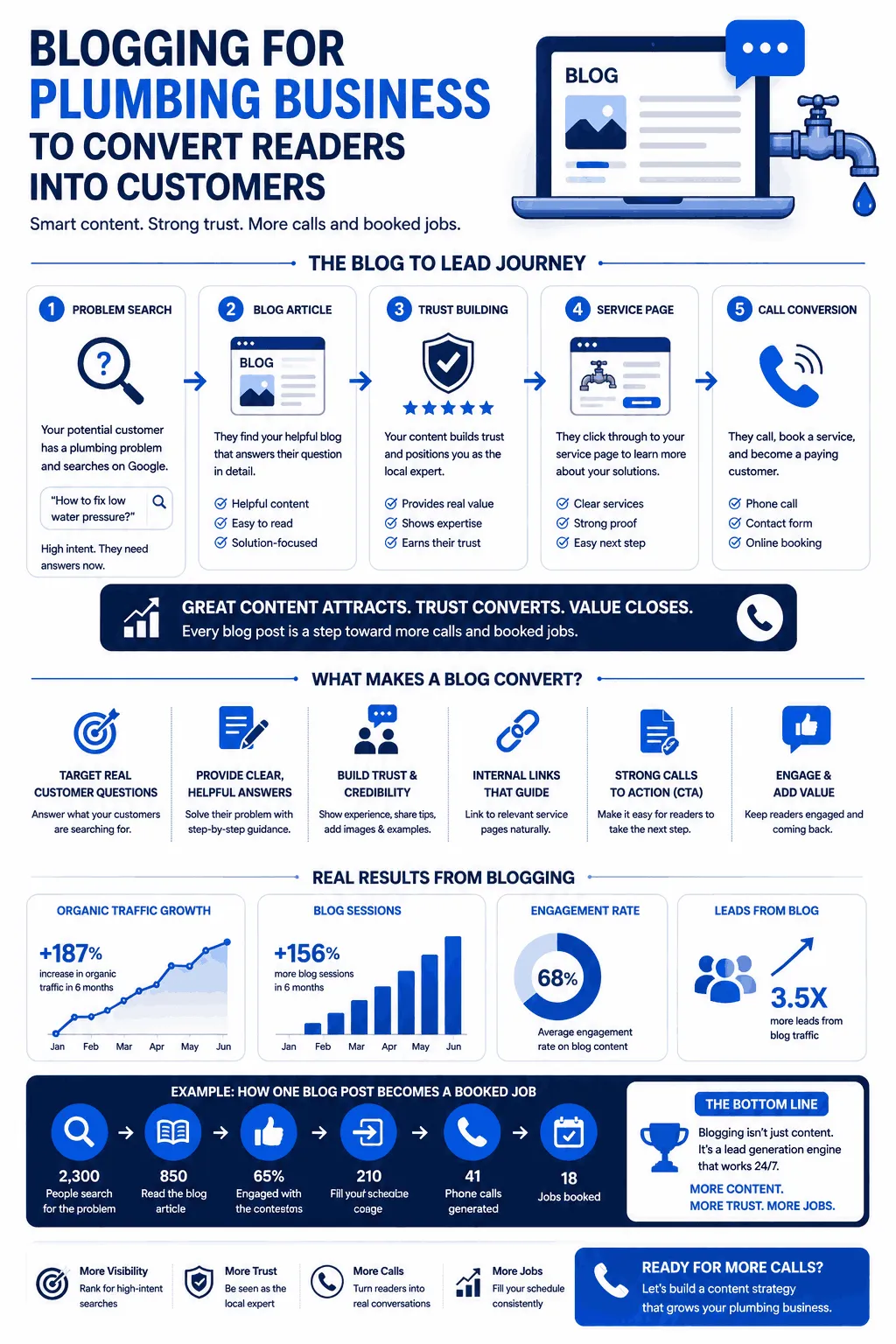
Most plumbing businesses see blogging as optional — something to do when there is spare time, or not at all. That is a costly misread of what blogging actually does for a service business. A blog is not a journal. It is a lead generation system that works around the clock, pulling in customers at every stage of their decision, from the moment they notice a problem to the moment they pick up the phone.
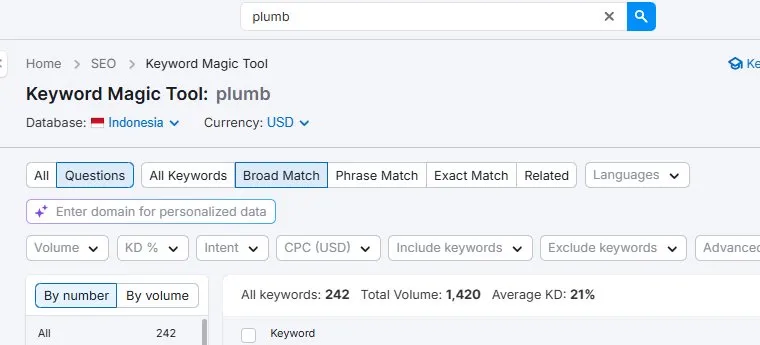
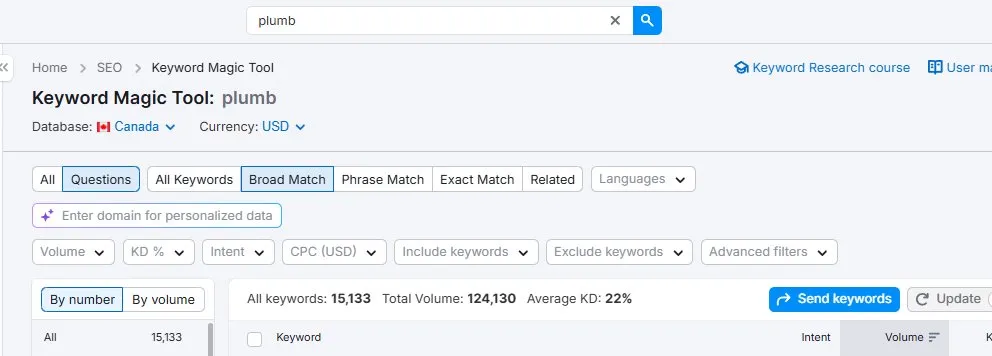
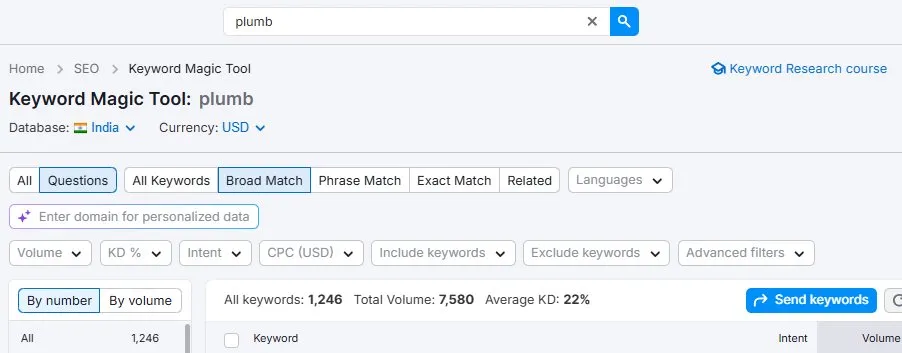
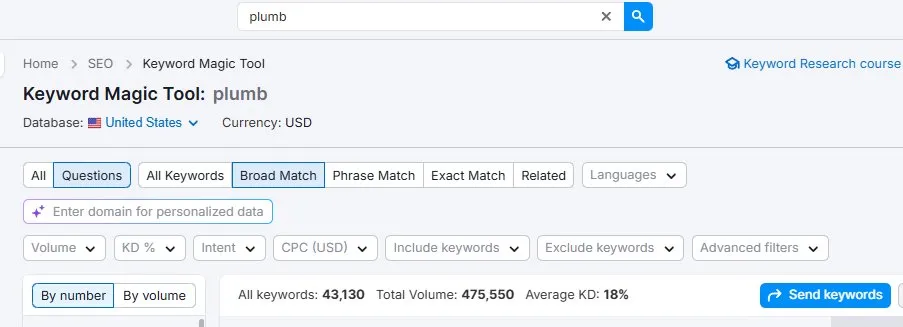
The keyword data makes the case before a single word is written. Question-based plumbing searches generate 475,550 monthly searches in the United States alone across 43,130 keywords, with an average keyword difficulty of just 18%. Canada adds another 124,130 monthly searches across 15,133 keywords at 22% difficulty. India contributes 7,580 searches across 1,246 keywords, and Indonesia adds 1,420 searches across 242 keywords. These are not broad, competitive head terms. These are specific, question-based searches from people who have a plumbing problem right now and are looking for an answer — and the business whose blog provides that answer is the business they call.
There is a direct line between a customer searching “why is my water pressure low” and that same customer calling a plumber. They searched because something is wrong. They landed on a blog post because it promised an answer. If that blog post explains the problem clearly, identifies when it requires professional intervention, and makes it easy to contact the plumbing business that wrote it — the conversion happens naturally. The reader arrived with a problem and left with a solution provider. That is not content marketing in the abstract. That is a sales process built into a webpage.
The most effective plumbing blog content falls into three categories. Problem-based content addresses specific issues customers experience and search for — blocked drains, low water pressure, leaking pipes, water heater failures. These posts capture customers who already have the problem and need a plumber today. Cost and process content answers questions like “how much does it cost to replace a boiler” or “what happens during a pipe inspection” — capturing customers in the research phase who are comparing options before making a decision. Maintenance and prevention content builds trust with homeowners who are not in crisis yet but will need a plumber eventually. Done consistently, this content positions the business as the go-to authority before the urgent need even arises.
A single blog post does one job. A connected library of blog content does something far more powerful — it establishes topical authority. When Google sees a plumbing website that covers every meaningful aspect of plumbing problems, costs, processes, and solutions in depth, it begins to treat that website as a trusted source across the entire category. That trust translates into higher rankings across all content on the site, including the service pages where the actual conversions happen. Every blog post published is not just a standalone piece of content. It is a signal to Google that this business knows its industry, and it is a pathway that pulls a potential customer deeper into the website and closer to making contact.
The difference between a blog that generates leads and one that just generates traffic is what happens at the end of the post. A plumbing blog post that answers a question and then ends with nothing — no call to action, no link to a relevant service page, no easy way to contact the business — has done half the job. The reader got their answer and left. A blog post that answers the question, explains when professional help is needed, links to the relevant service page, and presents a clear and frictionless way to get in touch converts that same reader into a lead. Every blog post published for a plumbing business should have a defined conversion path built into it, because traffic without direction is just numbers.
Local vs. National SEO: Choosing the Right Strategy for Your Plumbing Business
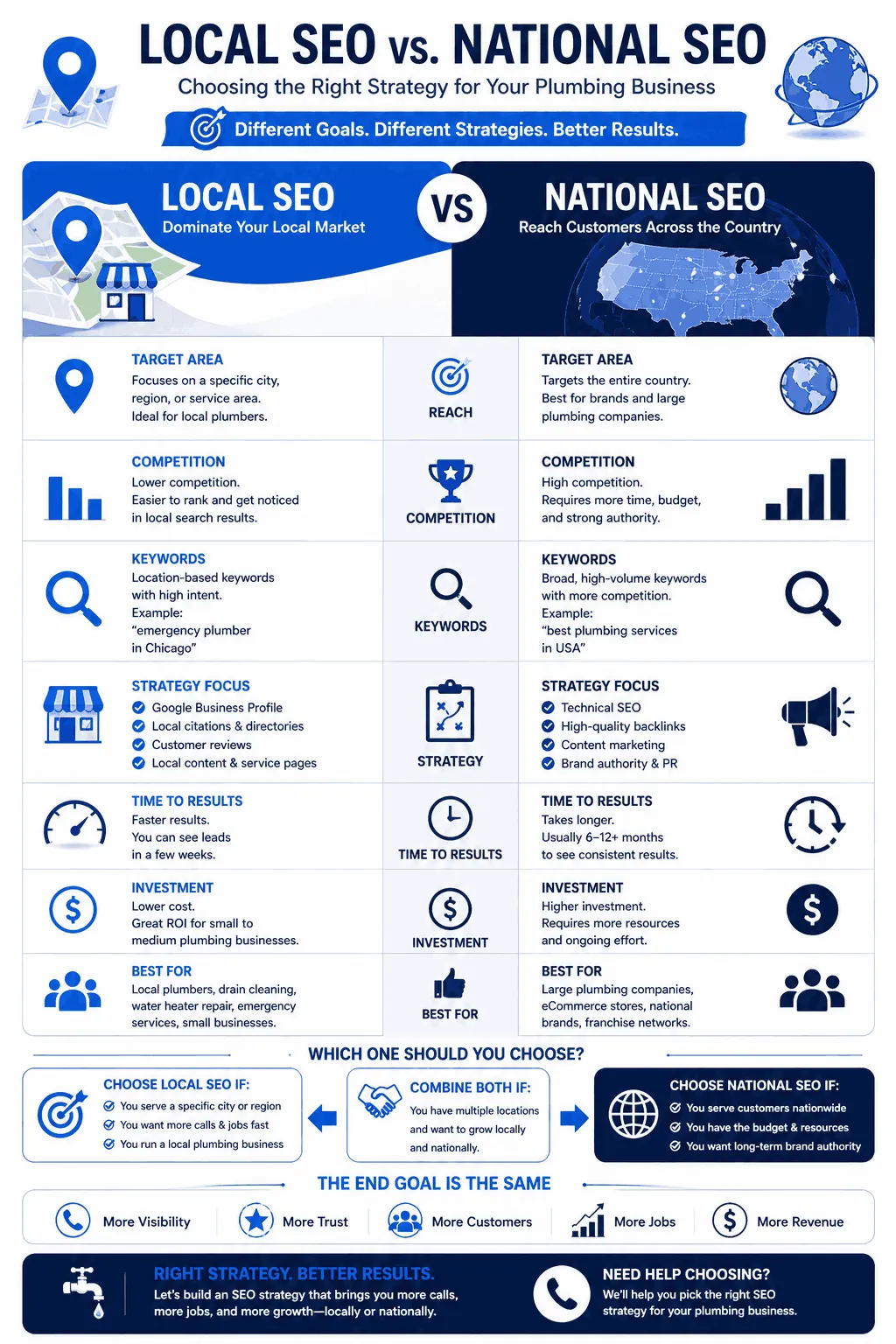
The strategy that works for a plumbing business serving one city is fundamentally different from the one that works for a business operating across multiple locations or an entire country. Getting this wrong does not just slow results — it means spending months building visibility in the wrong direction entirely.
For most plumbing businesses, local SEO is the correct starting point and the highest return investment. Plumbing is an inherently location-dependent service. Customers are not searching for the best plumber in the country — they are searching for the best plumber available to them right now, in their area. That means the entire SEO strategy should be built around capturing demand within a specific geography. Location-modified keywords, area-specific service pages, consistent business information across directories, and locally relevant backlinks are the signals that determine whether a plumbing business shows up when someone nearby needs help. These are not minor details — they are the core of what makes a local plumbing business visible to the customers it can actually serve.
National SEO becomes relevant when a plumbing business operates across multiple cities, runs a franchise model, or offers services that are not confined to a single geography — such as plumbing product supply, trade training, or multi-branch operations competing at scale. At this level the keyword pool expands, competition intensifies, and the authority required to rank increases in proportion. The strategy shifts from location-specific content to broad topical authority, a deeper content architecture, and a backlink profile built from credible national and industry-relevant sources. National SEO takes longer, demands a larger investment, and requires a more sophisticated infrastructure than local SEO. It is not the right starting point for a single-location plumbing business and treating it as one is one of the most common ways SEO budgets get wasted in this industry.
The more complex scenario is the multi-location plumbing business that needs both. A business operating across three or four cities is neither purely local nor fully national — it needs a hybrid approach where each location functions as its own SEO asset with dedicated pages, independent keyword targeting, and location-specific content, while the broader domain builds authority that strengthens all of them simultaneously. The mistake most multi-location plumbing businesses make is creating one generic page trying to serve all locations at once, which ranks for none of them, or duplicating the same content across multiple location pages, which creates keyword cannibalization that suppresses all of them at the same time.
The decision is straightforward once the business model is clear. If your customers have to be in a specific area to use your service, local SEO is the foundation. If you operate across multiple locations, a structured hybrid approach is the only strategy that captures your full market without your own pages working against each other. Choosing the right one before building anything is not a minor strategic preference — it is the decision that determines whether everything that follows produces leads or just produces activity.
Conclusion
The demand is already there. Millions of plumbing searches happen every month across every major market, and the customers behind those searches are not browsing — they are ready to hire. The only thing standing between your business and those customers is visibility, and visibility is a solvable problem.
SEO is how you solve it. Not through shortcuts or generic checklists, but through a system built on the right technical foundation, the right content, and the right authority signals — executed consistently over time. The plumbing businesses dominating search right now did not get there by accident. They got there by investing in the right strategy before their competitors did.
That window is still open. But it does not stay open forever.
If you are ready to stop losing jobs to better-optimised competitors and start building search visibility that compounds over time, M For SEO is ready to make it happen. Get in touch and let us build the SEO foundation your plumbing business deserves.