A homeowner notices a crack running across their basement wall on a Tuesday evening. By 9pm, they are on Google searching “foundation repair near me.” Within three minutes, they have called one of the first three companies that appeared. If your business was not in those results, you did not lose a lead — you were never in the conversation.
That is the reality of foundation repair marketing today. Most homeowners do not ask neighbors, flip through directories, or wait for a flyer. They search Google, they look at the top results, and they call. The companies ranking in those positions capture the majority of inspection requests, estimate calls, and booked projects in their market.
Foundation repair SEO is what puts your business in front of those searches. A well-executed strategy improves your rankings in local search results, strengthens your Google Maps presence, builds credibility before a homeowner ever calls, and creates a consistent pipeline of qualified leads that does not depend on advertising budgets.
This guide covers the search demand behind foundation repair services, the SEO strategies that generate real results for contractors, the local ranking factors that matter most, the mistakes that quietly kill organic growth, and how to choose between local and national SEO based on where your business actually operates.
Understanding Your Market Potential Through Search Demand for Foundation Repair Services
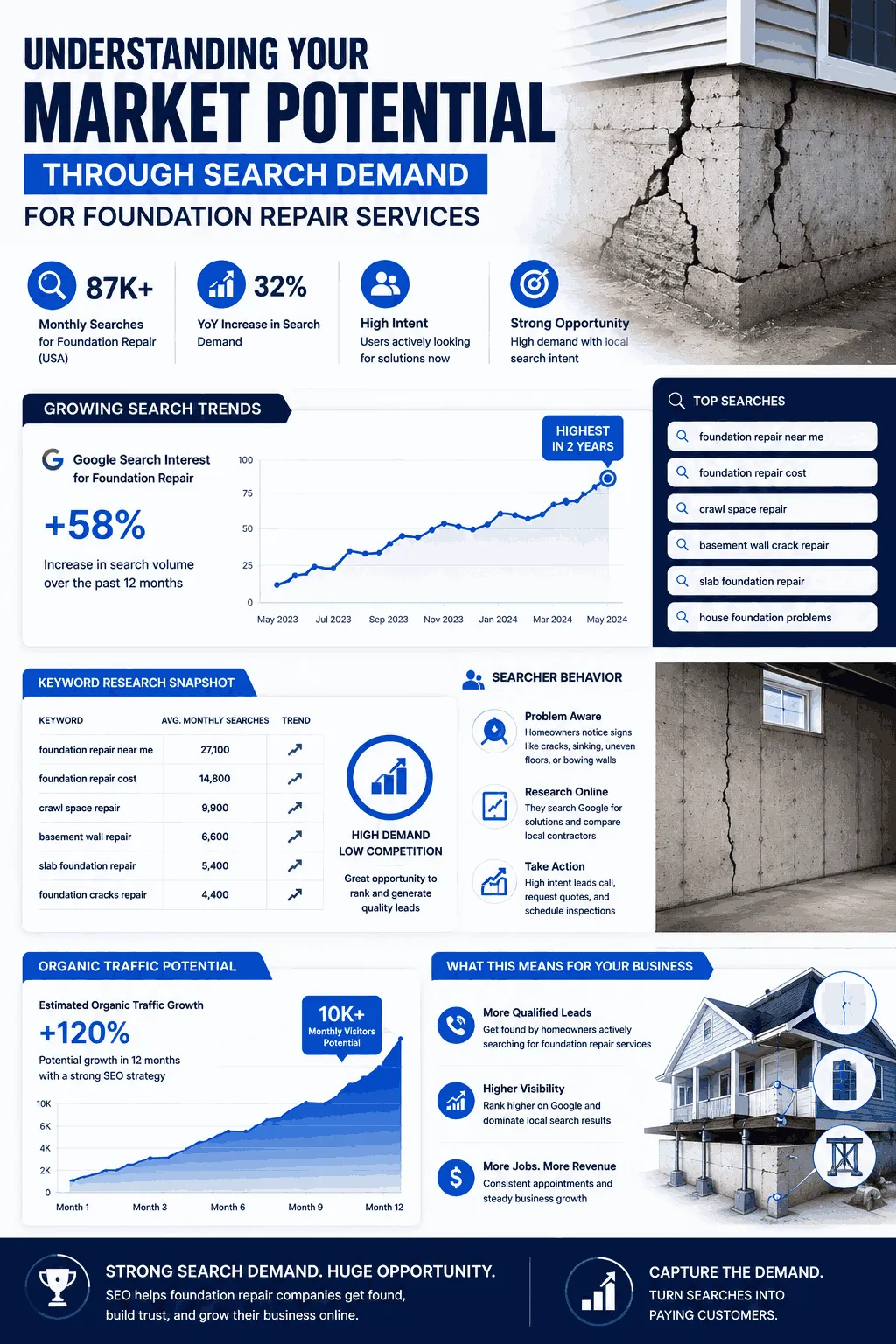
Before investing in SEO, you need to understand the size of the market you are competing in — and what the search data reveals about real buyer behavior. The foundation repair industry is large, actively growing, and heavily driven by organic search. The numbers make a strong case for why organic visibility matters.
Foundation Repair Industry Overview: Market Size and Growth Insights
The foundation repair industry has become one of the fastest-growing segments within the home improvement and structural services market, largely driven by aging residential properties, shifting soil conditions, climate-related structural movement, and rising homeowner awareness about long-term property damage.
According to Persistence Market Research, the global foundation repair services market is projected to grow from approximately $2.8 billion in 2024 to more than $4.1 billion by 2033, expanding at a CAGR of around 4.6% during the forecast period.
Data published by Future Market Insights estimates that residential foundation repair services account for over 60% of total market demand, with North America continuing to dominate the industry due to expansive clay soil regions, older housing stock, and increasing investment in structural maintenance.
Additional research from Business Research Insights shows that increasing urbanization, rising property values, and growing awareness around preventative structural repair are expected to further accelerate market growth over the next decade.
From an SEO perspective, this matters because growing market size directly increases online search demand. More homeowners are searching Google for terms like “foundation repair near me,” “crawl space repair,” “slab foundation repair,” and “basement stabilization contractor” before making a hiring decision. Contractors with strong SEO visibility are positioned to capture a larger share of these high-intent searches, qualified leads, and inspection requests as competition within the industry continues to increase.
Measuring Foundation Repair Industry Demand Through SEO Data
Search data removes the guesswork from market analysis. It shows exactly how many people are searching for your services, what they are searching for, and how much those searches are worth commercially.
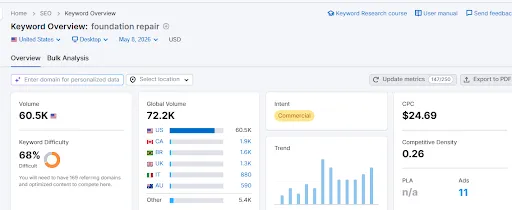
The keyword “foundation repair” alone generates approximately 60,500 monthly searches in the United States and over 72,000 globally. Canada contributes around 1,900 monthly searches, the United Kingdom approximately 1,300, and Australia nearly 590 for the same core term. With an estimated cost-per-click of $24.69, these searches carry strong commercial value — meaning the people behind them are actively looking to hire, not casually browsing.
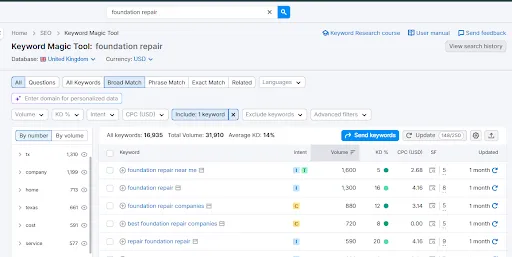
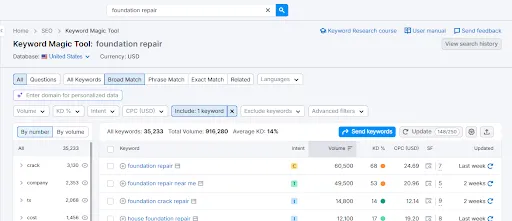
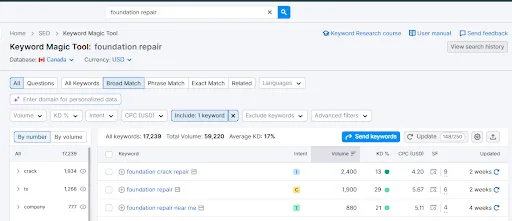
The broader opportunity is even larger:
- United States: 35,000+ related keywords generating approximately 916,000 combined monthly searches
- United Kingdom: 16,900+ related keywords with over 31,000 combined monthly searches
- Canada: 17,200+ related keywords generating nearly 59,000 combined monthly searches
These include terms like “foundation crack repair,” “house foundation repair,” “crawl space repair contractor,” “basement wall stabilization,” and “slab foundation settling” — all carrying strong purchase intent from homeowners with active structural concerns.
Contractors relying entirely on referrals or paid advertising are bypassing hundreds of thousands of monthly searches. Businesses that invest in localized SEO, service-specific pages, and long-tail keyword targeting are positioned to capture a significant share of that demand before competitors do.
Analyzing Market Opportunities Through the Search Results Landscape
A Google search for “foundation repair” returns approximately 463 million search results, showing just how competitive and high-demand the industry has become online. The search landscape is heavily dominated by local map listings, contractor websites, Google Business Profiles, and service pages targeting location-based searches. This creates a major SEO opportunity for foundation repair companies, especially in local markets where many competitors still lack properly optimized content, localized landing pages, and strong organic visibility.
Introducing M For SEO as Your Foundation Repair SEO Agency
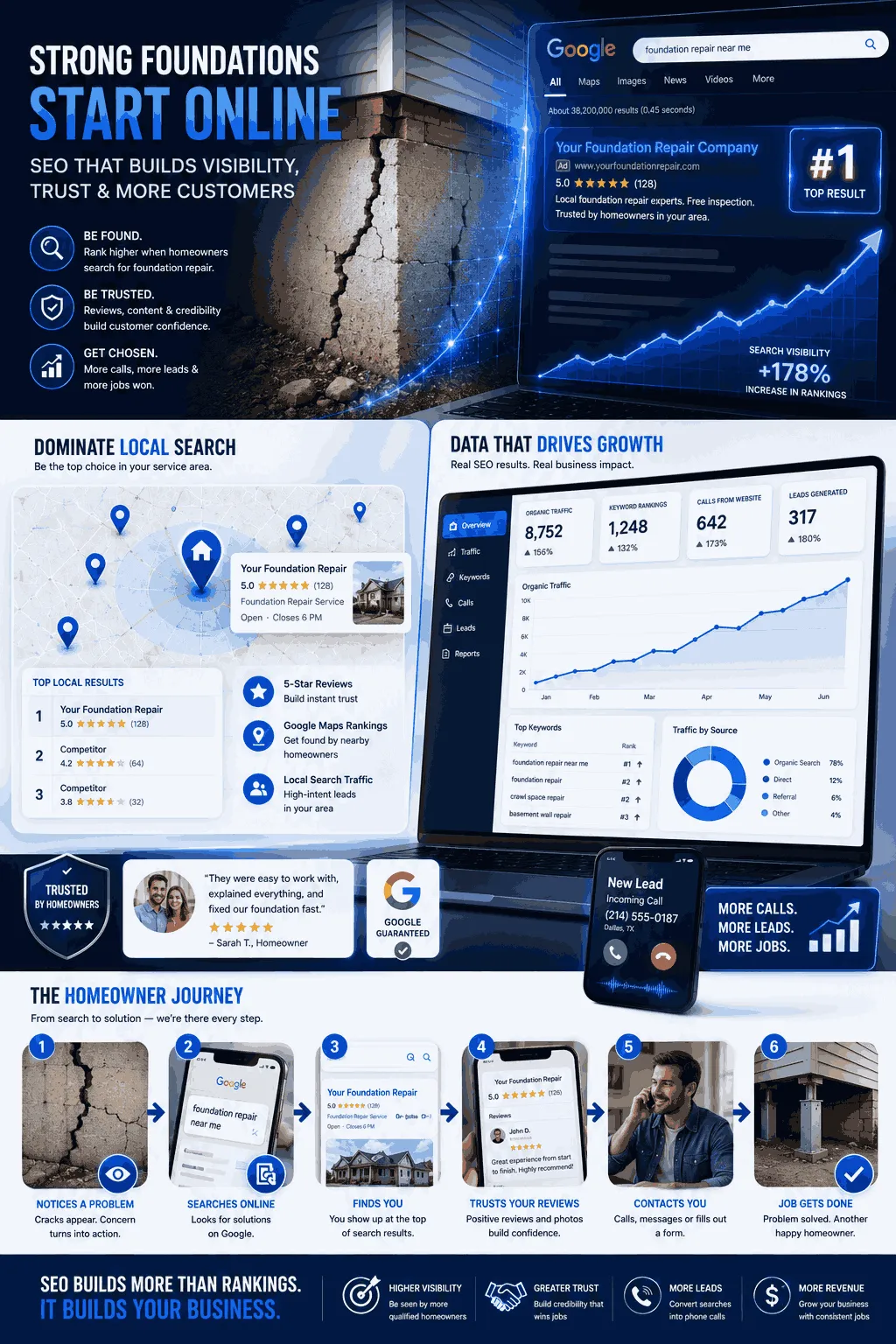
Foundation repair is a competitive industry, and most markets reward the contractors who appear first — not necessarily the ones who do the best work. If your business is not visible where homeowners are searching, the quality of your service becomes irrelevant to the people who never find you.
At M For SEO, we work specifically with foundation repair contractors to improve search visibility, generate qualified leads, and build sustainable organic growth in competitive local markets. Every strategy we implement is grounded in how homeowners actually search when they face structural problems — and how search engines decide which businesses to show them.
The sections below outline the core SEO strategies we use to help foundation repair companies rank higher, attract better leads, and compete more effectively.
Our Core SEO Strategies for Foundation Repair Companies
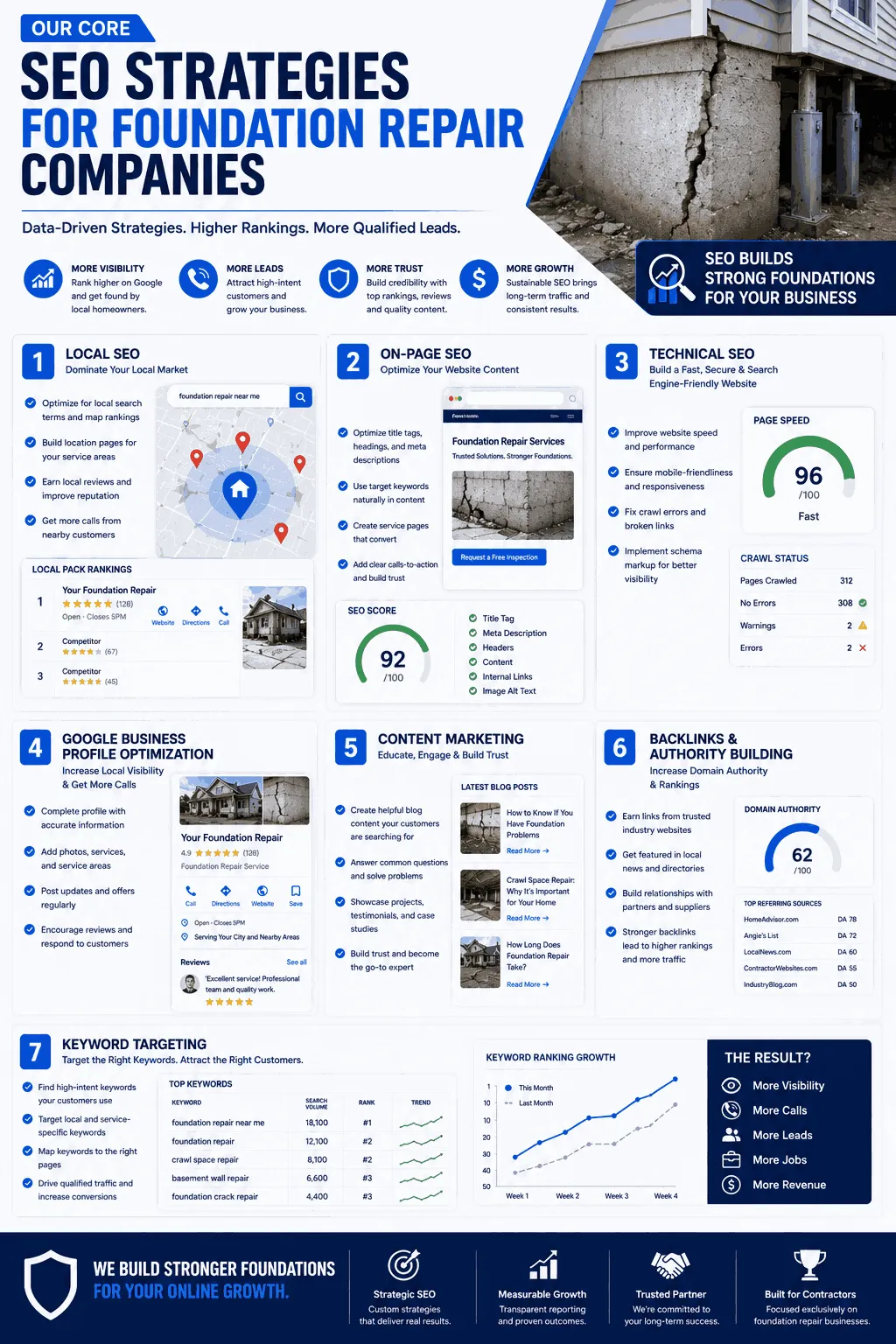
Foundation repair SEO is not a single tactic. It is a layered strategy that aligns your website, your Google presence, your content, and your authority signals with the way homeowners search and the way search engines evaluate relevance and trust.
Keyword Research and Search Intent Strategy
Effective keyword research starts with understanding why someone is searching, not just what they are typing. A homeowner searching “what causes cracks in basement walls” is in a different stage of the decision process than someone searching “foundation repair contractor in Columbus.” Both searches matter, but they require different content and different conversion strategies.
We identify primary service keywords, location-based search opportunities, problem-focused queries, and long-tail terms that reflect real homeowner concerns. This allows foundation repair companies to capture traffic at every stage of the buying process — from early research to ready-to-hire.
On-Page SEO for Foundation Repair Websites
On-page SEO ensures that every page on your website communicates clearly to both search engines and homeowners. We optimize title tags, meta descriptions, heading structures, URL formats, internal links, image alt attributes, and keyword placement across all core service and location pages.
The goal is not to stuff pages with keywords — it is to build pages that answer search queries with authority and precision, then guide visitors toward the next step.
Service Page Optimization
Most foundation repair websites use a single “Services” page to cover everything from slab repair to crawl space encapsulation. That approach limits search visibility because search engines rank pages, not websites.
We build dedicated service pages for each repair type your company offers — crawl space repair, slab foundation repair, basement wall stabilization, pier and beam repair, house leveling, and structural crack repair. Each page is written to rank independently for service-specific searches while building toward the broader authority of the site.
Location Page SEO Strategy
Ranking in one city does not guarantee visibility in the surrounding communities where your trucks actually operate. We build optimized location pages for each city and service area in your target market — pages that contain genuinely useful, location-relevant content rather than duplicated text with a city name swapped in.
This improves geographic relevance and expands ranking opportunities across your full service territory.
Google Business Profile Optimization
For most foundation repair contractors, the Google Business Profile drives more direct calls than any other single asset. When homeowners search locally, map listings appear above organic results — which means your profile often determines whether you get the call before a prospect even reaches your website.
We optimize your business categories, service descriptions, service areas, photo library, review management, and update cadence to strengthen both map rankings and conversion rates from local searches.
Technical SEO Optimization
A well-written website with poor technical foundations will still underperform in search results. Slow load times, broken pages, crawl errors, poor mobile performance, and weak internal architecture all suppress rankings regardless of content quality.
We audit and resolve technical issues across site speed, mobile usability, crawl structure, XML sitemaps, schema markup, indexing configuration, and page architecture — creating a stable technical foundation that supports sustained ranking growth.
Content Marketing and Topical Authority
Search engines increasingly favor websites that demonstrate deep, consistent expertise within a specific industry. A foundation repair company that only publishes service pages will always be outranked — over time — by a competitor that builds comprehensive content covering the full range of homeowner concerns.
Our content strategy targets the questions homeowners ask before they are ready to hire: what causes foundation movement, how serious is a horizontal basement crack, why are floors sagging in an older home. This content increases organic reach, builds credibility, and creates natural pathways from informational searches to service inquiries.
Off-Page SEO and Authority Building
Rankings in competitive markets require authority signals that originate outside your own website. We build these through relevant local citations, industry-specific link placements, geographic authority signals, and earned mentions from trusted regional sources.
Every link-building decision is based on relevance and trust — not volume. A handful of authoritative, contextually appropriate backlinks outperforms hundreds of low-quality directory submissions.
Local SEO for Nearby Service Searches
Searches like “foundation repair near me” or “crawl space contractor in [city]” carry some of the strongest buying signals in the industry. Someone using those terms is not researching — they are selecting.
We optimize your full local search presence — website, Google Business Profile, citations, reviews, and location pages — to maximize visibility for these nearby, purchase-ready searches across your service territory.
Conversion-Focused SEO Strategy
Traffic that does not convert into calls and estimate requests has no business value. We build SEO strategies around conversion as well as rankings — improving content structure, trust signals, mobile usability, contact pathways, and call-to-action placement throughout the website.
The measure of success is not rankings alone. It is inspection appointments, estimate calls, and booked projects.
Competitor and Search Landscape Analysis
Understanding what your competitors are doing — and where they have gaps — is one of the most direct ways to find ranking opportunities in your market. We analyze competitor keyword positioning, content gaps, backlink profiles, and local search performance to identify where your business can gain ground most efficiently.
This analysis runs continuously, not as a one-time audit, because search landscapes shift as competitors adjust their strategies.
Long-Term SEO Growth Strategy
Organic search rankings are earned through consistency, not shortcuts. Authority builds gradually, content accumulates reach, and trust signals compound as your website ages and improves. We build long-term strategies that sustain and expand your organic visibility rather than chasing quick wins that erode.
Foundation repair companies that commit to sustained SEO investment consistently outperform competitors who treat it as a short-term campaign.
How SEO Improves Your Foundation Repair Business Online Visibility and Builds Customer Trust
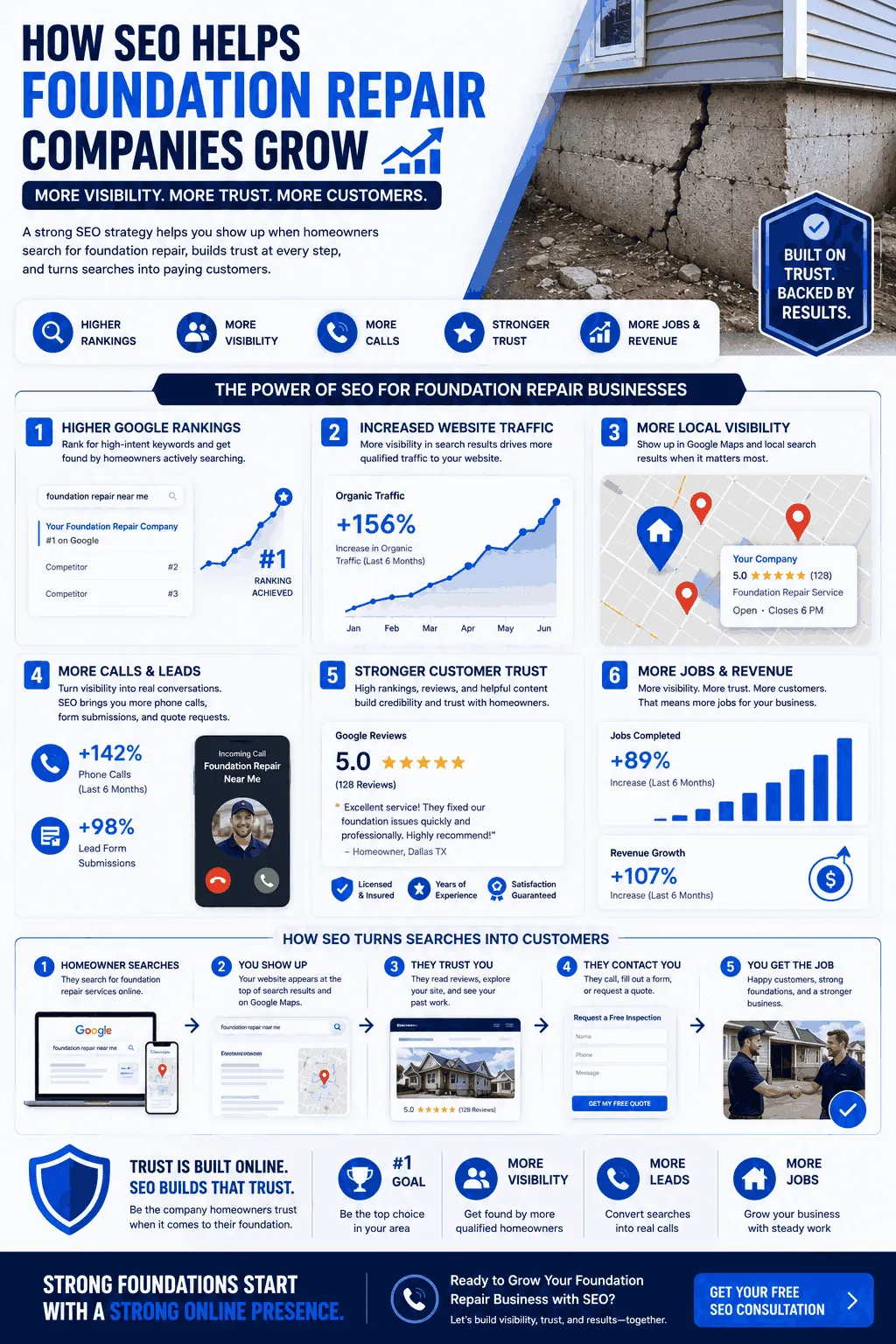
SEO works differently from other marketing channels because it meets homeowners at the exact moment a structural problem becomes urgent. There is no interruption, no cold outreach — just a homeowner with a real problem finding your business when they are actively searching for a solution.
Here is what strong SEO delivers beyond rankings.
SEO Generates Lead Flow Without Ongoing Ad Spend
Paid advertising produces leads only while the campaign is funded. The moment you pause a Google Ads campaign, your visibility disappears. Organic rankings continue generating traffic, calls, and estimate requests regardless of whether you are actively spending.
This does not mean SEO is free — it requires real investment to build. But the return compounds rather than resets, and the cost per lead decreases as rankings mature.
Local SEO Connects You With Homeowners in Your Actual Service Area
National advertising reach is largely wasted for a contractor with a defined service territory. Local SEO focuses your visibility precisely on the cities and communities where your business operates — Google Maps results, city-specific search queries, and “near me” searches from homeowners close enough to schedule an inspection.
That precision makes local SEO far more efficient than broad advertising channels.
Search Visibility Builds Trust Before the First Call
When a homeowner’s foundation is showing signs of movement, they are not just searching for any contractor — they are searching for one they can trust with an expensive, high-stakes repair. Businesses that appear consistently across Google search results, map listings, reviews, and educational content are naturally perceived as more established and credible.
By the time that homeowner calls, they often feel they already know your company. That is the conversion advantage that strong SEO creates.
SEO Captures Demand Across Hundreds of Related Searches
Homeowners do not describe their structural problems using industry terminology. They search for “crack in basement wall,” “floors sloping in old house,” “moisture in crawl space,” or “door that won’t close properly.” Each of these searches represents a homeowner who may need your services — and each is a ranking opportunity.
A well-structured SEO strategy captures demand across the full range of searches connected to foundation problems, not just the obvious primary keywords.
Better SEO Means a Better Website for Homeowners
Search engines reward websites that give users a fast, clear, mobile-friendly experience. The SEO improvements that lift rankings — faster load times, cleaner navigation, better content structure, stronger calls to action — also make the website more effective at converting visitors into leads.
The two goals reinforce each other rather than compete.
Local SEO Lets Smaller Contractors Compete Effectively
Large regional companies and national lead-generation platforms dominate paid advertising in most markets, making it expensive and difficult for independent contractors to compete through ads alone. Organic search is more level — a well-optimized local contractor website can outrank a national competitor for city-specific searches.
Geographic relevance, review depth, and localized content all favor the businesses that are actually embedded in the community they serve.
Strong SEO Extends Your Visibility Across Google’s Ecosystem
Good rankings do not only improve your position in traditional search results. They expand your visibility across Google Maps, local packs, featured snippets, image results, and FAQ-style answers that appear directly on the search results page.
Each of these placements increases brand familiarity and drives additional traffic — and collectively, they make your business much harder for competitors to displace.
Local SEO for Foundation Repair Contractors: How to Stand Out in Your Area
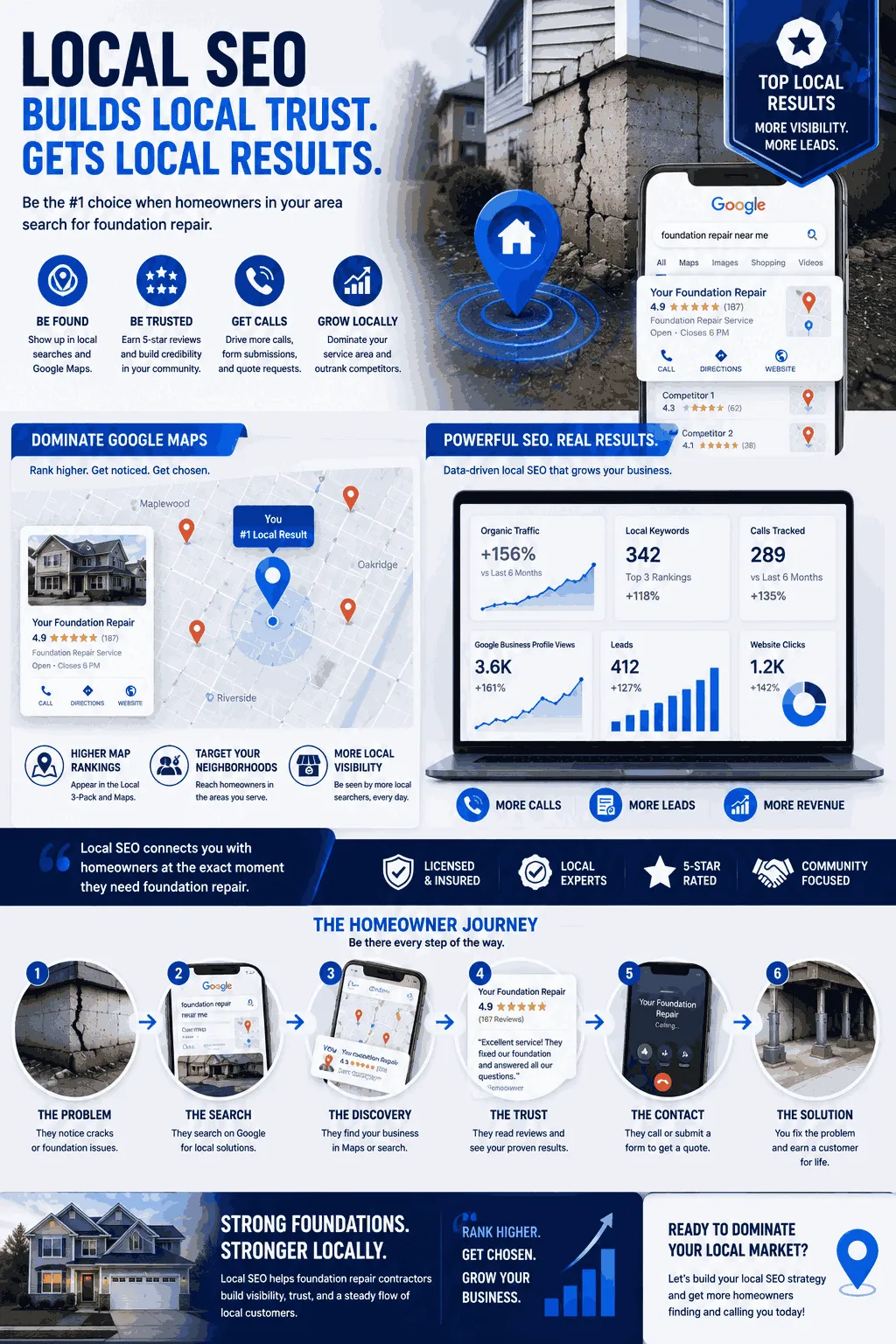
Most homeowners searching for foundation repair will hire a contractor within their city or immediate surrounding area. They are not shopping nationally. They want someone nearby, reachable, and familiar with local conditions.
Local SEO is built around that reality. Here is what it requires in practice.
Google Business Profile: Your Most Visible Local Asset
Your Google Business Profile is often the first thing a homeowner sees when they search for foundation repair locally. An incomplete or poorly maintained profile costs you map visibility and the calls that come with it.
Accurate business categories, a detailed service description, active photo uploads, regular post updates, and consistent review management all contribute to stronger map rankings. Businesses that treat the profile as an afterthought consistently lose local placement to competitors who maintain theirs actively.
Localized Service Pages for Every Area You Serve
A single “Service Areas” page listing city names is not a local SEO strategy. Search engines need dedicated, substantive pages for each location you want to rank in — pages that include locally relevant information, regional structural context, and content that genuinely serves homeowners in that specific area.
Done correctly, location pages extend your ranking footprint across every community in your service territory rather than concentrating all visibility on a single city.
Reviews Drive Both Rankings and Homeowner Decisions
Foundation repair is expensive, and homeowners making repair decisions often read reviews before they make contact. A strong review profile — with consistent volume, recent activity, and responses that demonstrate professionalism — influences both your local ranking position and the conversion rate of homeowners who find you.
Actively requesting reviews after completed projects, then responding to every review you receive, is one of the highest-return activities in local SEO.
Citation Consistency Across All Platforms
Search engines cross-reference your business information across hundreds of directories, maps, and industry platforms. Inconsistent phone numbers, varying business name formats, or outdated addresses across these listings reduce the confidence signals that support local rankings.
Auditing and standardizing your citations across all major platforms is a necessary foundation for local SEO credibility.
Localized Content That Reflects Regional Conditions
Foundation problems in Texas clay soil look different from those in flood-prone coastal regions. Homeowners in different areas face different structural risks and search for different symptoms. Content that speaks to regional soil conditions, seasonal freeze-thaw movement, local drainage challenges, or common structural issues in specific housing types performs better locally than generic content that could apply anywhere.
It also positions your company as one that genuinely understands the conditions homeowners in your area are dealing with — not just a contractor who happened to target their city.
Mobile Performance Determines Whether You Convert Local Traffic
Many homeowners searching for foundation repair are doing so on a phone, often shortly after noticing a problem. A website that loads slowly, has hard-to-tap navigation, or requires scrolling to find a phone number loses those conversions to competitors with faster, cleaner mobile experiences.
Mobile performance is not a design detail — it is a direct factor in local lead capture.
Common SEO Mistakes Foundation Repair Businesses Should Avoid
Most SEO failures in the foundation repair industry are not caused by algorithm changes or increased competition. They are caused by avoidable structural problems in how the website was built, how content was written, and how the Google Business Profile is managed. Here are the mistakes that consistently cost contractors rankings and leads.
Targeting Broad Keywords Without Considering Search Intent
“Foundation repair” is a real keyword worth pursuing — but it should not be the only target. Homeowners searching for help with bowing basement walls, crawl space moisture, slab cracks, or house settling use specific language that reflects exactly what they need.
Websites built only around broad keywords miss the majority of searches that carry the strongest conversion potential.
Service Pages Too Thin to Rank
A 150-word service page that vaguely describes foundation repair will not rank for any meaningful keyword. Search engines evaluate content depth as a proxy for expertise. Your service pages need to explain the repair process, the structural conditions involved, the warning signs homeowners should recognize, and what makes your approach reliable.
Thin pages are not just a ranking problem — they fail to build the credibility that converts visitors into callers.
Duplicate Content Across Location Pages
Creating 30 location pages by copying the same content and swapping city names is not local SEO — it is content that search engines discount or ignore. Each location page needs to earn its ranking by providing genuinely local, useful information.
The effort required to build real location pages is exactly why so many competitors have not done it — and exactly why it creates competitive advantage for those who do.
Neglecting the Google Business Profile
Contractors who focus entirely on website optimization while ignoring their Google Business Profile are leaving their highest-visibility local asset unmanaged. In most local markets, the map results generate more direct calls than organic listings — meaning a weak profile translates directly into missed calls.
Category selection, service descriptions, service area configuration, photo recency, and review response rates all affect map ranking. None of these are set-and-forget.
Ignoring Reviews Until It Is Too Late
Businesses that do not actively generate reviews discover two problems simultaneously: their rankings plateau, and homeowners comparing options choose competitors with stronger proof of quality. Review velocity matters as much as total count — a competitor with 40 recent reviews often outperforms one with 200 reviews collected years ago.
Build review generation into your post-project process rather than treating it as optional.
Technical Problems That Suppress Rankings Silently
Site speed issues, mobile usability failures, broken internal links, duplicate page titles, missing schema markup, and crawl errors do not announce themselves. They quietly reduce ranking performance while the business wonders why content improvements are not moving the needle.
A technical SEO audit is not a luxury — it is a prerequisite for understanding whether the rest of your SEO investment is working.
Publishing Content Without a Strategy
Blog posts written randomly about tangentially related topics do not build topical authority. They generate isolated pages that rarely rank and do not reinforce each other.
A content strategy maps specific topics to specific search queries, covers structural problems from multiple angles, builds internal links between related pages, and expands the website’s relevance systematically rather than arbitrarily.
Pursuing Low-Quality Backlinks
Buying 500 links from irrelevant websites does not improve rankings — it creates a liability. Search engines evaluate link quality, relevance, and context. A single authoritative link from a local home improvement publication or regional contractor association is worth more than hundreds of directory submissions from sites that exist only to sell links.
Chasing link volume without evaluating link quality is one of the fastest ways to undermine an otherwise solid SEO strategy.
Expecting Results Before Momentum Builds
Organic SEO requires sustained effort before rankings stabilize at competitive positions. Businesses that expect page-one rankings within 30 days and abandon the strategy when that does not happen have simply funded a competitor’s advantage.
Understanding the timeline — and committing to it — is what separates contractors who build lasting organic lead flow from those who cycle through marketing tactics without seeing returns from any of them.
Blogging Strategies for Foundation Repair Companies to Turn Website Visitors Into Customers
Most homeowners do not search for a contractor the moment they first notice a problem. They search for information — what this crack means, whether those sloping floors are serious, how much foundation repairs typically cost, what happens if they wait. They are looking for answers before they are ready to look for someone to hire.
Blogging positions your business as the resource that provides those answers. When you are the company that educated them, you are also the company they consider calling first.
Write About the Problems Homeowners Are Already Searching
The most effective foundation repair blog topics are not about your company — they are about the symptoms homeowners are worried about. “Why are cracks appearing in my drywall?” “Is a bowing basement wall dangerous?” “What causes floors to slope in older homes?” “Can poor drainage damage a foundation?”
These searches happen every day from people who are actively concerned about structural issues in their home. A blog post that answers these questions directly captures that traffic and introduces your business at exactly the right moment.
Target Long-Tail Keywords That Broad Pages Cannot Capture
Your service pages compete for primary keywords like “foundation repair” and “crawl space repair.” Blog posts can capture everything else — the more specific, lower-competition searches that still convert effectively because they come from homeowners deep into a specific problem.
Terms like “how to tell if foundation cracks are structural,” “crawl space encapsulation vs vapor barrier,” “what causes pier and beam foundations to settle,” or “signs of foundation movement in brick homes” all attract readers who are one step away from calling a contractor. These searches are too specific for a service page — but they are exactly what blog content is built for.
Build Topical Authority Across the Full Structural Repair Domain
A website with one or two blog posts is not building authority — it is publishing content. Authority comes from consistent, comprehensive coverage of a topic domain over time.
A foundation repair company that publishes detailed content about soil conditions, drainage effects on foundations, different crack types and what they indicate, the differences between repair methods, seasonal structural movement, and basement waterproofing will be treated by search engines as a genuinely expert resource. That authority transfers to the service pages and location pages, improving their rankings as well.
Answer the Questions That Come Before the Decision
Many of the highest-converting blog topics are questions homeowners ask before they are ready to hire anyone. “Are hairline cracks in a foundation normal?” “Does foundation repair affect home value?” “How long does slab repair take?”
These questions indicate an active evaluation process. A blog post that answers honestly and clearly — without overselling — moves readers from uncertainty toward confidence. Confident readers request inspections.
Create Content Tied to Regional Conditions
A homeowner in Houston searching about foundation problems in expansive clay soil has different concerns than one in Minneapolis dealing with freeze-thaw movement. Content that addresses regional conditions, local soil types, area weather patterns, and housing stock characteristics performs better locally than generic advice.
It also differentiates your company from national content platforms that cannot speak to conditions in your specific market.
Use Internal Links to Connect Blog Content to Service Pages
A blog post that answers a homeowner’s question but offers no pathway to your services is an incomplete strategy. Every blog post should link naturally to relevant service pages, location pages, and contact pathways — giving readers a clear next step when they are ready to move forward.
Internal links also distribute ranking authority across the website, strengthening the pages that drive direct conversions.
Publish Consistently Rather Than in Bursts
Search engines interpret consistent publishing as an indicator of an active, maintained resource. A website that publishes four posts in a week and then goes silent for three months sends weaker authority signals than one that publishes steadily throughout the year.
Consistency matters more than frequency. One well-researched post per week outperforms four rushed posts followed by a long pause.
Make Every Post Work Toward a Conversion Goal
Informational blog content should educate — but it should also move readers toward a decision. Clear calls to action, logical internal linking, mentions of relevant services, and invitations to schedule an inspection all convert passive readers into active leads without making the content feel promotional.
Local vs. National SEO: Choosing the Right Strategy for Your Foundation Repair Business
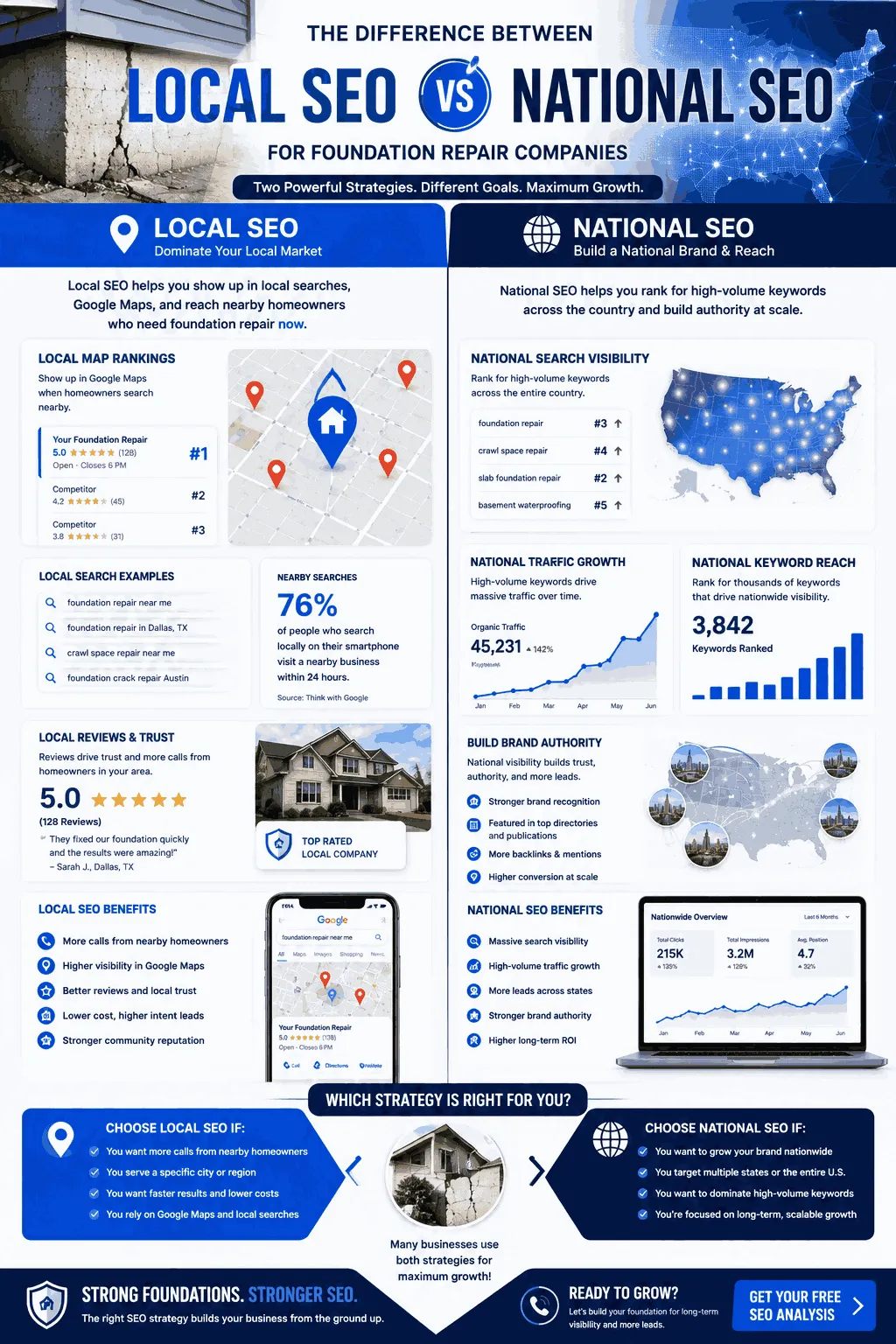
For the vast majority of foundation repair contractors, local SEO delivers better results than any attempt at national visibility. Here is why, and when the calculation changes.
Foundation repair is inherently a local service. Homeowners want a contractor who can inspect their property, understands their regional soil conditions, and can start work without a three-week wait. Searches like “foundation repair near me” and “crawl space contractor in [city]” dominate search volume — and they convert at higher rates than broad national searches because the intent behind them is immediate.
Local SEO concentrates your ranking effort precisely where your revenue comes from. A properly optimized local presence — strong Google Business Profile, genuine location pages, consistent citations, active reviews, and localized content — can put a well-run independent contractor on equal footing with larger regional companies in their target markets.
National SEO is a different undertaking. It requires substantially higher domain authority, a broader content strategy, larger link acquisition budgets, and a longer timeline before rankings stabilize for competitive broad-match terms. It makes sense for franchise operations, companies serving multiple states, or businesses building brand recognition across a large region. For a contractor serving three to five counties, it is not where resources are best allocated.
The most effective approach for growing contractors is to dominate local SEO in your core market first, then expand location page coverage into surrounding service areas as authority builds. National visibility follows from consistent local dominance — it rarely precedes it.
Conclusion
The homeowners who need your services are already searching. They are typing their symptoms into Google at night, comparing which contractors show up, and calling the businesses that appear most credible and accessible. The question is not whether they are searching — it is whether they find you or a competitor.
Foundation repair SEO is the discipline that answers that question consistently. Strong local rankings, a fully optimized Google Business Profile, well-structured service and location pages, authoritative content, and a clean technical foundation all work together to place your business in front of the right searches at the right moment.
The companies that invest in building that presence now are the ones with full inspection schedules six months from now — while competitors relying on referrals and paid ads are watching their cost-per-lead climb and their lead flow stall.
Start with what matters most in your market, build it correctly, and maintain it consistently. That is how you turn search visibility into a business asset that compounds rather than evaporates.