Every furniture sale today begins the same way. Someone opens Google and starts searching.
It might be “sofa set under $500,” “best furniture store near me,” or “modern bedroom furniture ideas.” Whatever the query, one thing is certain. The stores that appear at the top of those results get the clicks, the footfall, and the sales. The ones that don’t, simply get skipped.
This is the reality of the furniture market today, and it is why SEO for furniture stores is no longer optional. It is the foundation of sustainable growth for any furniture business that wants to compete online. Whether you own a single showroom, manage multiple locations, or run a fully online brand, the challenge is the same. Your customers are searching every single day, and the question is whether they find you or your competitor.
This guide walks you through the best SEO practices for furniture stores, from understanding market demand and local search strategy to content, technical SEO, and everything in between. You will see exactly how SEO for furniture retail works in practice and how businesses like yours are using it to grow steadily and predictably.
Before we get into strategy, let’s first look at the numbers. Because when you see the actual size of the search demand for furniture, the opportunity becomes impossible to ignore.
Understanding Your Market Potential Through Search Demand
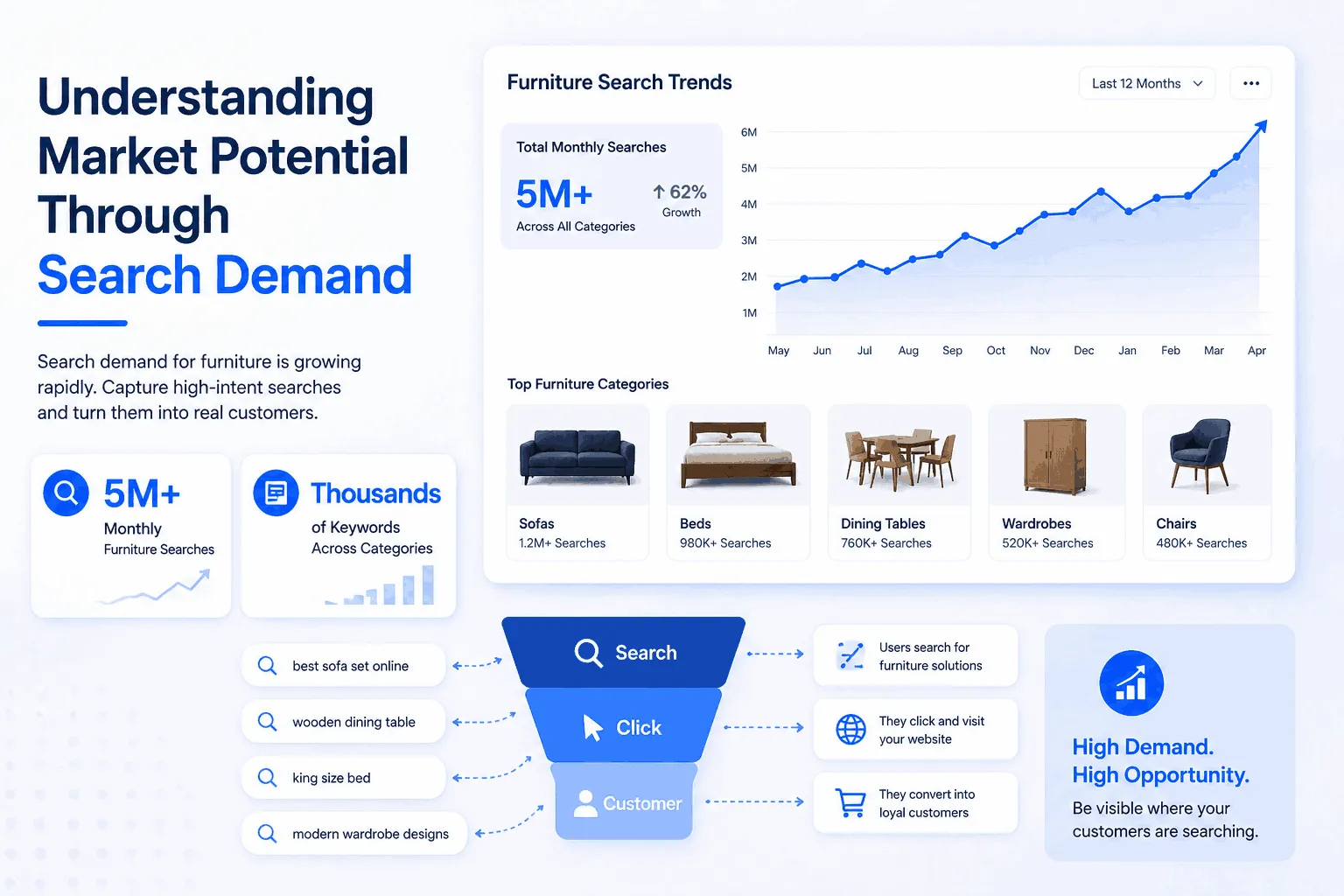
Before investing in seo for furniture, you need to understand the scale of real demand that already exists for your products. Search demand tells you exactly how many people are actively looking for furniture, what specific terms they are using, and how close they are to making a purchase.
This data removes guesswork. It gives you a clear and evidence based picture of where the opportunities are, how competitive the landscape is, and where your business has the most realistic room to grow. Let’s start with the broader market before zooming into the search data itself.
Furniture Industry Overview: Market Size and Growth Insights
The global furniture industry is already worth over $650 billion and is projected to exceed $800 billion in the coming years, according to data from Statista and Fortune Business Insights. This is not just a large market, it is one that continues to expand steadily, with a compound annual growth rate of around 5% to 6%, as reported by Grand View Research.
The demand is also widely distributed. Residential furniture dominates the market due to ongoing housing activity and lifestyle upgrades, while office and commercial segments continue to grow alongside business expansion. At the same time, insights from Precedence Research show a clear shift toward online purchasing, with digital channels taking a larger share of total sales each year.
Taken together, these numbers point to a market that is not only large, but consistently active and evolving. It is driven by recurring demand, multiple customer segments, and a growing digital buying behavior, making it one of the most stable and opportunity-rich industries in the consumer space.
Measuring Industry Demand Through SEO Data
Market size reports tell you the industry is big. Search data tells you exactly how many people are actively looking for what you sell right now, every single month.
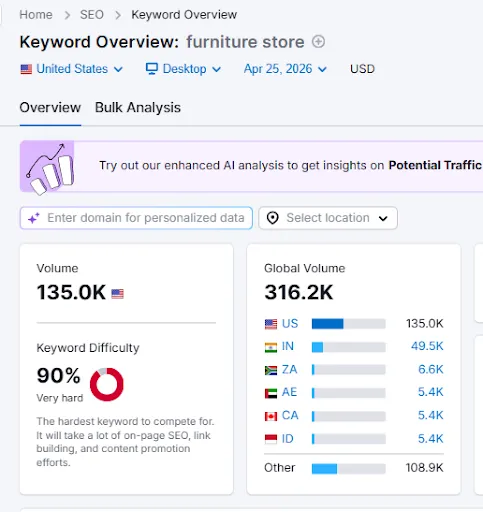
The keyword “furniture store” alone generates over 316,000 global searches per month, with 135,000 of those coming from the United States and nearly 50,000 from India. And that is just one keyword.
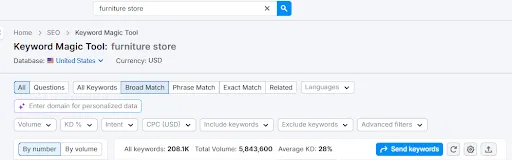
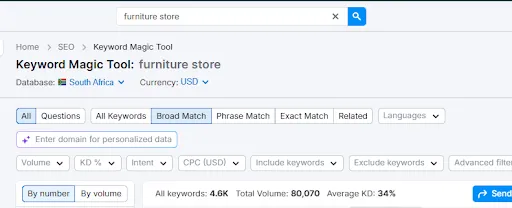
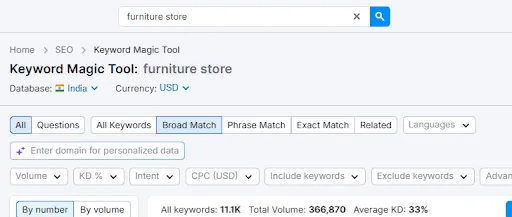
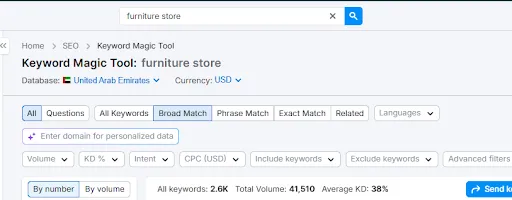
When you expand beyond that single term, the scale becomes far more significant. In the United States alone, there are more than 28,000 related keywords generating over 5.8 million monthly searches. India adds another 11,000 plus keywords contributing over 360,000 monthly searches. These searches span product types, styles, room categories, price points, and buying intent. Demand is not concentrated in one place. It is spread across thousands of variations that together represent an enormous pool of potential customers.
Trend data makes this picture even stronger. Over the past five years, search interest in furniture related queries has remained consistently active. After a stable period through 2022 and 2023, demand began rising again in 2024 and has since reached some of its highest recorded levels. This indicates that consumer interest in furniture is not seasonal or declining. It is growing.
At the most competitive level, keywords like “furniture store” carry a difficulty score of around 90%, meaning the top positions are dominated by established national and global brands. However, that only reflects the tip of the iceberg. The real opportunity in seo for furniture lies in the thousands of mid and long tail keywords. Specific product queries, location based searches, and style driven terms that carry strong purchase intent and far lower competition.
The conclusion is straightforward. Demand for furniture in search is massive, continuous, and currently increasing. The opportunity is not limited to ranking for one keyword. It exists across thousands of daily searches, and businesses that capture multiple entry points consistently win more traffic and more customers.
Analyzing Market Opportunities via SERP Landscape
When you look at the actual search results for furniture-related queries, the scale of opportunity becomes even clearer. A single search like “furniture store” can return hundreds of millions of results, showing how many businesses are competing for visibility. At the same time, the results page is not just a list of websites. It includes local listings, maps, filters like “top rated” and “open now,” and multiple entry points where businesses can appear. This means the opportunity is not limited to ranking first organically. It exists across local packs, business profiles, and different SERP features. Instead of seeing competition as a barrier, this landscape shows that visibility is distributed, and businesses that position themselves correctly can capture attention in multiple ways across the same search results page.
Who We Are: Introducing M For SEO As Furniture Store SEO Agency
MForSEO is a team of SEO professionals with over 5 years of hands-on experience scaling businesses through search across multiple industries. We were the people inside agencies doing the actual work, not managing accounts or writing reports, but building strategies, fixing technical issues, and getting pages to rank in markets where competition is real. We built our own team because we wanted to do that work without compromise, delivering directly to businesses that want results over presentations. Furniture retail is one of the industries we know inside out. We understand how a customer moves from a search query to a store visit or an online order, what content influences that decision, and where most furniture businesses are leaving visibility and revenue on the table. That knowledge shapes every strategy we build, whether you are running a single showroom, a growing retail chain, or an ecommerce furniture store competing nationally.
Our Core SEO Strategies for Furniture Stores
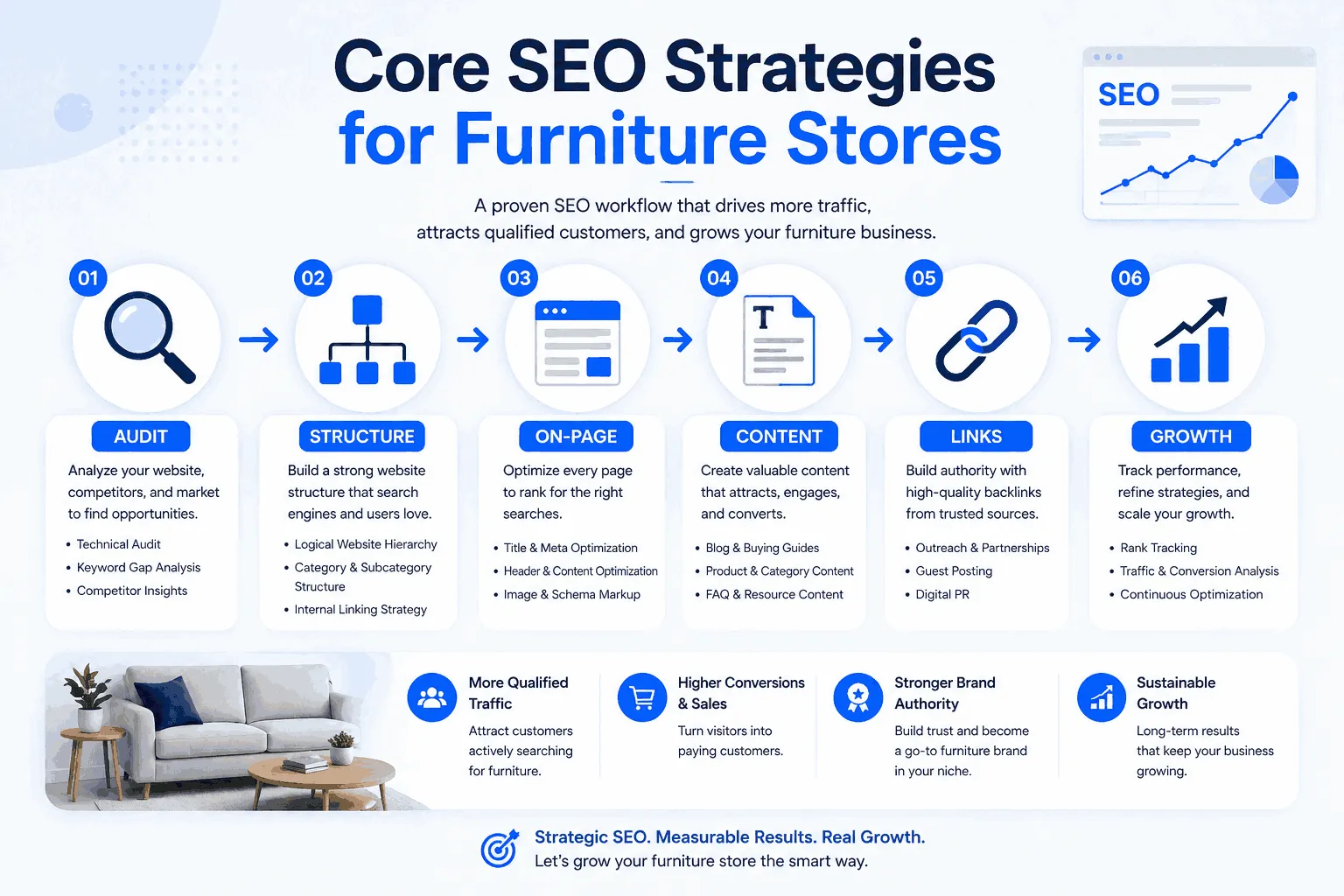
Most furniture businesses approach SEO the wrong way. They publish a few blogs, optimise a handful of pages, and wonder why nothing moves. The problem is not effort. It is the absence of a system. Seo for furniture stores only works when every part connects to everything else, and that connection has to be built in the right order.
Here is exactly how we do it.
The Technical Foundation
Before anything gets touched, we run a full technical audit. We look at how search engines are crawling the site, which pages are indexed and which are not, and whether product filters are silently creating duplicate content. In furniture websites, faceted navigation for size, colour, and material is one of the most common sources of indexing damage. Page speed is another. Furniture websites are naturally image heavy and that weight slows load times in ways that directly hurt rankings and user experience. We also audit the mobile experience separately because Google crawls and ranks the mobile version of your site first, not the desktop version. A furniture website that looks perfect on a large screen but breaks the browsing experience on a phone is already losing rankings it does not know about. We fix crawl issues, resolve indexing problems, improve core web vitals, and make sure the mobile experience meets the standard Google actually uses to evaluate your site.
The Intent Map
Furniture buyers do not all search the same way. Some search by product, some by room, some by style, and some are ready to buy today. Each behaviour represents a different type of query and a different page that needs to exist on the site. We map all of it into a structured hierarchy. Core category pages sit at the top targeting the highest volume terms. Below them sit subcategory and style based pages. Product pages handle specific transactional searches. And a content layer of guides, comparisons, and inspiration pieces captures buyers earlier in their journey. This is how seo for furniture retail moves from ranking a few keywords to owning an entire market segment.
Site Architecture and Navigation
The way a website is structured tells search engines what matters and what does not. Beyond internal linking, breadcrumb navigation helps both users and crawlers understand exactly where a page sits within the site. A user landing on a specific sofa product page should be able to see they are inside the sofas category, which sits inside the living room section, which sits inside the main store. That hierarchy makes navigation intuitive for buyers and makes crawling efficient for search engines. We build and optimise the full site architecture including breadcrumbs, category depth, URL structure, and navigation menus so that every page is easy to find, easy to understand, and easy to rank.
On Page Execution
A category page and a blog post are not the same thing and should not be optimised the same way. Category pages target broad commercial intent with clear structure and strong internal linking. Product pages target transactional queries with content that removes doubt and drives action. Blog content addresses the questions buyers ask before they are ready to purchase. We align every title, heading, content block, and internal link to the specific job that page is supposed to do. For ecommerce furniture websites we also handle the details that most agencies overlook. Out of stock page management, canonical tags for filtered URLs, pagination handling, and product schema markup that gives search engines structured data about what you sell, its price, its availability, and its reviews.
Image Optimisation
Furniture is one of the most visual industries in retail. Buyers make purchasing decisions based on how a product looks, which means images are not just a design choice, they are a ranking factor. We optimise every image with descriptive file names, accurate alt text, and proper compression that reduces page weight without sacrificing visual quality. This improves page speed, helps pages rank in Google image search, and creates an additional discovery channel that most furniture websites are completely ignoring.
The Content Layer and Topical Authority
Most furniture websites have content that exists but does not function. It is there but not connected to anything, not answering real buyer questions, and not building any meaningful authority in the eyes of search engines. We build content with a specific purpose at every stage of the buying journey. Buying guides, comparison pieces, style based content, and category expansions that open new areas of search demand. But more importantly we build it as a connected system designed to establish topical authority. When Google sees that a website covers every meaningful aspect of a topic, from product education to buying decisions to style inspiration, it begins to treat that website as a trusted source across the entire category. That trust compounds over time and is what separates websites that rank consistently from those that spike and drop.
Internal Linking
Internal links are not just navigation. They are how authority moves through a website and how search engines understand relationships between pages. We connect blogs to the category pages they support, category pages to the products within them, and products to related products across categories. A page about beds connects to mattresses. A page about dining tables connects to chairs. This kind of intentional structure is what separates a website that ranks for a handful of terms from one that ranks across hundreds of related searches consistently.
Schema Markup
Most furniture websites are invisible to search engines at the data level. Schema markup changes that. We implement product schema so search engines understand exactly what is being sold, its price, availability, and ratings. We add review schema so star ratings appear directly in search results, increasing click through rates without changing rankings. For stores with physical locations we implement local business schema that strengthens map pack visibility and gives Google accurate, structured information about who you are and where you operate. These are not optional extras. In competitive furniture markets they are the difference between a listing that gets clicked and one that gets skipped.
E-E-A-T and Trust Signals
Google does not just evaluate pages. It evaluates the entity behind them. For furniture businesses selling high consideration products, trust is a ranking factor as much as it is a conversion factor. We strengthen E-E-A-T signals across the website by ensuring business information is accurate and consistent everywhere it appears, author credibility is established on content pages, brand mentions and citations are built across relevant platforms, and the overall website communicates the kind of experience and expertise that both Google and buyers need to see before they trust a store with a significant purchase. An about page, a team page, real customer reviews, and clear policies are not just good practice. They are signals that contribute directly to how authoritative Google considers the site to be.
Analytics and Tracking
Every decision in SEO should be backed by data and that requires proper tracking from day one. We set up GA4, Google Search Console, and conversion tracking so that every meaningful action on the website is being measured. Which pages are driving traffic, which are converting, where users are dropping off, and which keywords are gaining or losing ground. Without this infrastructure the entire strategy is operating without feedback. With it, every month of data becomes an opportunity to improve something specific rather than guess at what to do next.
Building Authority
Once the on site foundation is solid we build external authority. For local furniture stores the focus is directory listings, local citations, and geo relevant placements that strengthen map pack visibility. For ecommerce stores competing nationally we move into guest posting within home and interior spaces, editorial placements, and content driven backlink acquisition. The goal is never to accumulate links for the sake of numbers. It is to build the specific level of authority needed to compete in your market.
Conversion Optimisation
Traffic without conversion is just a vanity metric. Furniture is a high consideration purchase. Buyers spend more time evaluating, comparing, and second guessing than they do with lower ticket items. That means the page experience has to actively support the decision rather than getting in its way. We optimise category page layouts for easier browsing, product pages for trust and clarity, and calls to action for the right moment in the buying journey. Trust signals like reviews, delivery policies, return guarantees, and social proof are positioned where they have the most influence on a buyer who is close to deciding. This is where seo for furniture shops stops being about rankings and starts being about revenue.
New Website or Existing, the Approach Adapts
For a new furniture website we start with intent mapping before a single page goes live. The full structure is defined upfront, every page has a clear purpose, and optimisation is built in from day one. For an existing website we audit before we act. Keyword cannibalization, thin pages competing against each other, and technical issues dragging down otherwise strong content are extremely common in furniture websites that have been running without a proper strategy. We resolve what is broken first and then scale from a clean foundation.
The result is not just a website that ranks. It is a system that captures demand across every way a furniture buyer searches, at every stage of their decision, and turns that visibility into consistent revenue over time.
How SEO Drives Growth for Your Furniture Business
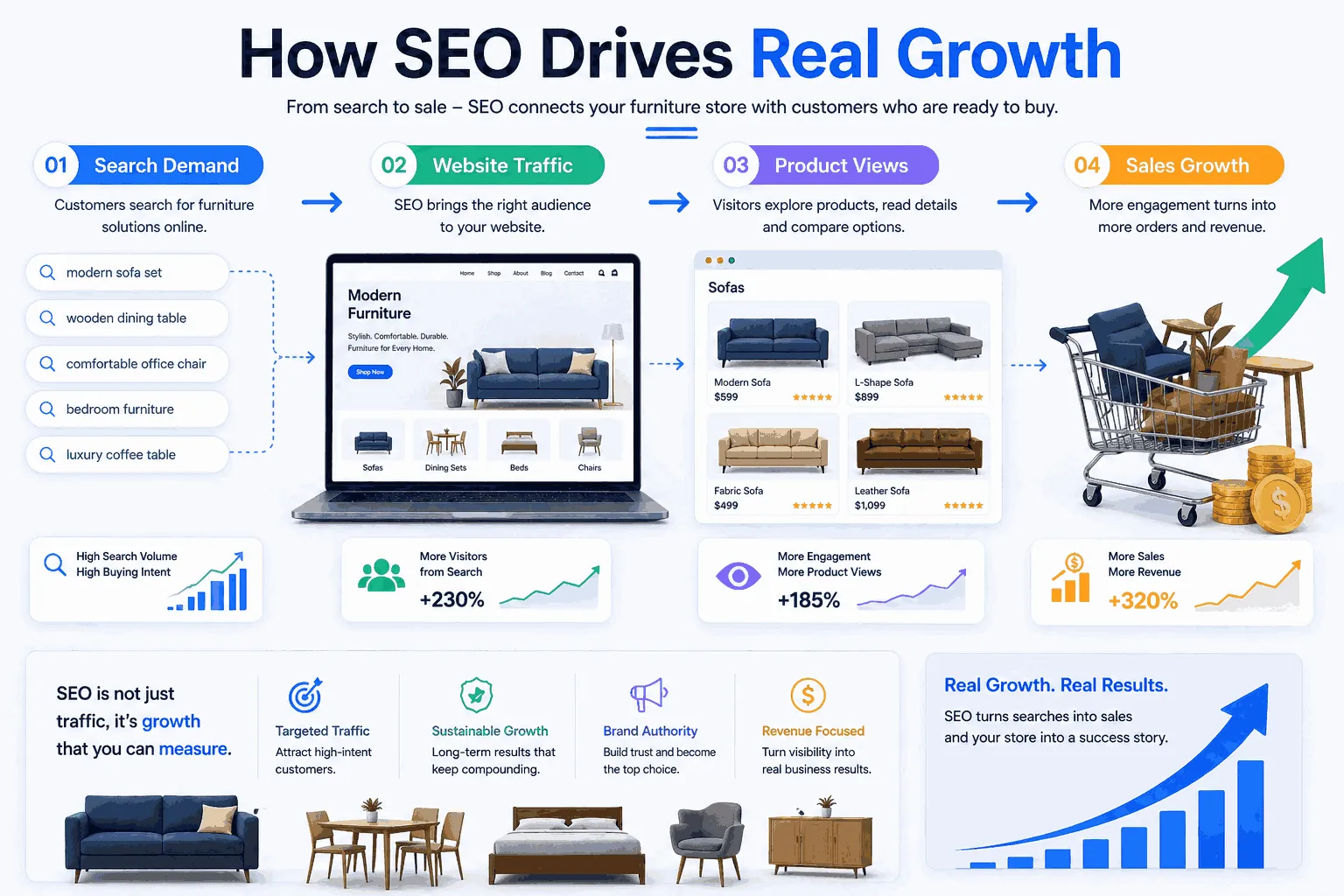
Paid ads stop the moment you stop paying. SEO does not work that way. Every page that ranks and every piece of content that earns authority continues working long after the initial effort was put in. That compounding nature is what makes seo for furniture stores one of the most valuable long term investments a furniture business can make.
You Show Up Before They Decide
Most furniture purchases do not start with a brand. They start with a search. Someone needs a new sofa, is renovating a bedroom, or furnishing a new home. Businesses with strong SEO are present at that early stage, building familiarity before the buyer is even ready to decide. By the time they are ready to purchase, the stores they encountered during research are the ones they consider first.
Local Search Drives Showroom Visits
Someone searching for a furniture store nearby is not browsing. They are close to a decision and looking for somewhere to go. Businesses that show up consistently for those searches turn online visibility directly into footfall and sales. For physical stores this is one of the highest converting channels available because the intent behind those searches is already there.
Organic Traffic Does Not Stop When the Budget Does
Paid visibility is rented. The moment the budget stops the traffic stops with it. Organic rankings work differently. A category page that ranks for a high volume furniture term brings in traffic every single day without a cost attached to each visit. Over time the cost of acquiring a customer through organic search becomes significantly lower than any paid channel.
SEO Drives Online Sales for Ecommerce Stores
For furniture businesses selling online, seo for ecommerce furniture websites builds a consistent stream of product and category page traffic that converts without relying on ad spend. Buyers searching for specific products, styles, or price ranges land directly on relevant pages and the purchase journey starts from a position of intent rather than interruption.
It Builds Brand Authority Over Time
A furniture store that consistently appears in search results for relevant queries builds a perception of authority that paid ads simply cannot replicate. Buyers notice which stores show up repeatedly during their research. That repeated visibility creates trust before the first interaction even happens and trust is what moves a high consideration purchase forward.
Small Stores Can Outrank Large Competitors
Bigger brands have bigger budgets but SEO is not purely a budget game. A local furniture store or a niche ecommerce brand can outrank national competitors for specific product terms, style based searches, and location based queries by being more relevant and more targeted. That is the opportunity seo for furniture shops creates for businesses that are not the biggest player in the market but are willing to be the most strategic one.
The Advantage Compounds and Becomes Difficult to Close
Businesses that invest in SEO early build a position that takes competitors significant time and effort to challenge. Authority accumulates, content builds on itself, and rankings become more stable over time. That defensibility is what separates furniture businesses that grow steadily and predictably from those that remain dependent on paid channels indefinitely.
Mistake To Avoid While Doing SEO
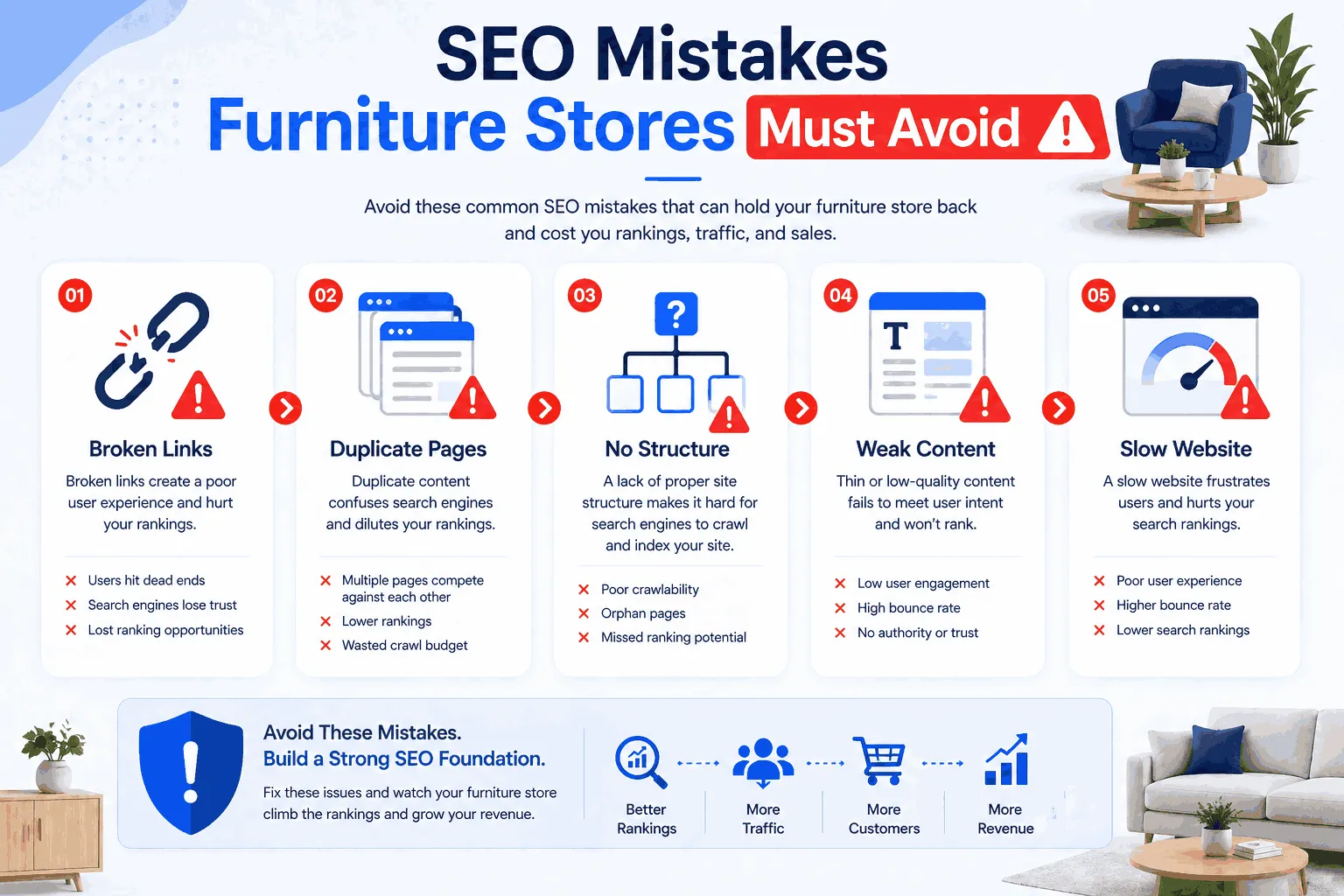
Most furniture businesses do not fail at SEO because they are not trying. They fail because they are doing the wrong things consistently and expecting different results. These are the mistakes we see most often and the ones that silently kill growth before it ever starts.
Targeting Only Broad Keywords
Going after terms like “furniture store” from day one is one of the fastest ways to see no results for a very long time. These keywords are dominated by national brands with years of authority behind them. The real opportunity is in specific product terms, style based searches, and location based queries where competition is lower and intent is higher. Broad keywords are a long term goal not a starting point.
Ignoring Site Structure
Publishing content without a clear hierarchy is like building a house without a foundation. If category pages, product pages, and blogs are not connected in a logical structure, search engines cannot understand what the site is about and authority never concentrates where it needs to. This is one of the most common problems in furniture websites and one of the most damaging.
Treating All Pages the Same
A category page and a blog post serve completely different purposes and need to be optimised differently. When every page is approached the same way, none of them perform the way they should. Category pages need commercial intent signals. Product pages need transactional clarity. Blog content needs to match informational queries. Mixing these up confuses both search engines and buyers.
Publishing Content Without Intent
Writing blogs just to have content is not a strategy. If the content does not match what buyers are actually searching for at a specific stage of their journey, it will not rank and it will not convert. Every piece of content needs a clear purpose, a defined audience, and a connection to the pages it is supposed to support.
Neglecting Technical Issues
Slow load times, duplicate content from product filters, crawl errors, and mobile usability problems are not minor inconveniences. They are active barriers that prevent search engines from properly accessing and ranking the website. Most furniture businesses focus entirely on content and backlinks while these issues quietly suppress everything else they are doing.
Building Backlinks Before the Foundation Is Ready
Link building without a solid on site foundation is like driving traffic to a store that is not open yet. If the technical issues are unresolved, the content is thin, and the structure is broken, backlinks will not move rankings in any meaningful way. Authority needs somewhere solid to land before it can do its job.
Ignoring Local SEO for Physical Stores
Furniture stores with a physical location that focus only on national or ecommerce SEO are leaving their highest converting channel untouched. Local searches carry some of the strongest purchase intent in the entire category. Not optimising for them means competitors with less overall SEO effort are winning customers who were physically close to choosing you.
Expecting Results Too Soon and Quitting
SEO is not a paid channel. It does not produce results in days or weeks. Furniture businesses that expect rankings within the first month and pull back investment when it does not happen are essentially starting over every time. The businesses that win through organic search are the ones that treat it as a long term commitment and stay consistent long enough to see the compounding effect take hold.
Blogging For Furniture Business To Convert Readers Into Customers
Most furniture businesses ignore blogging or treat it as an afterthought. That is a significant mistake because the data tells a completely different story.
When you look at question based searches for furniture across major markets, the opportunity is enormous. In the United States alone there are nearly 140,000 question based keywords around furniture generating over 1.6 million monthly searches with an average keyword difficulty of just 22%. Canada adds another 53,000 keywords with close to 400,000 monthly searches. India contributes over 8,000 keywords with 58,700 searches and the UAE brings 1,217 keywords generating 5,240 searches monthly.
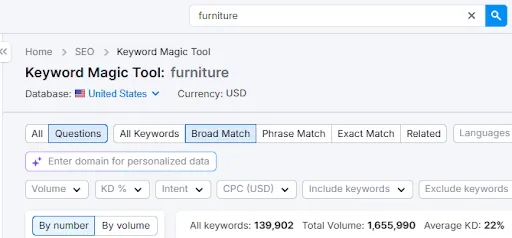
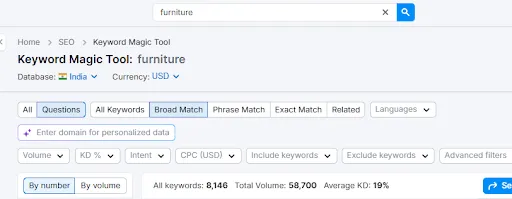
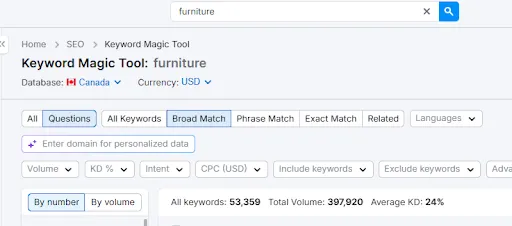
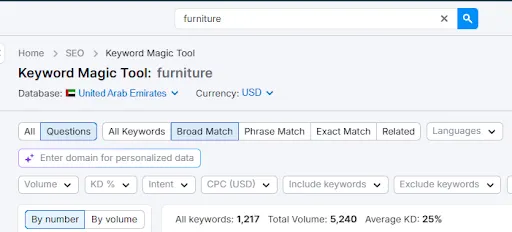
What makes this data important is not just the volume. It is difficult. An average keyword difficulty of 19% to 25% across all four markets means these are searches where a well written, properly optimised blog post from a furniture business can realistically rank without needing massive domain authority or thousands of backlinks.
These are pre buyers. People who are not yet ready to purchase but are actively researching. They are asking questions like which sofa material is most durable, how to choose the right bed size, what furniture works best for small spaces, or how to style a modern living room. They are in the consideration stage and the business that answers those questions well earns their trust before any competitor even gets a chance.
Why Most Furniture Blogs Fail to Convert
The problem is not a lack of content. Most furniture businesses that blog write about things no one is searching for, cover topics that are too broad to rank for, or produce content that reads like a product catalogue rather than genuine advice. That kind of content attracts no traffic and converts nothing.
A blog that converts readers into customers does three things. It targets real questions buyers are asking at specific stages of their journey. It answers those questions with enough depth and clarity to build genuine trust. And it connects naturally to the category or product pages where the purchase can actually happen.
What Furniture Blog Content Should Actually Cover
The best performing blog content for furniture businesses falls into a few clear categories. Buying guides that help customers understand what to look for before making a high consideration purchase. Material and style comparisons that answer the questions buyers have when they are weighing their options. Room specific content that captures searches around bedroom furniture, living room setups, home office solutions, and dining spaces. Care and maintenance content that targets existing customers and builds long term brand loyalty. And trend based content that captures seasonal demand and keeps the website fresh in the eyes of both search engines and returning visitors.
Each of these content types serves a different buyer at a different stage. Together they create a blogging system that captures demand across the entire pre purchase journey and funnels it toward conversion.
The Connection Between Blogs and Commercial Pages
A blog post that ranks but does not connect to anything is traffic with no destination. Every piece of blog content should link naturally to the category or product pages most relevant to what the reader just learned. Someone reading a guide on how to choose a dining table should be one click away from the dining table category. Someone reading about sofa materials should land directly on the sofa collection. That connection is what turns a reader into a visitor with purchase intent and a visitor with purchase intent into a customer.
The data is clear. The questions are being asked, the competition is low enough to compete, and the buyers are there. The only question is whether your business is showing up with the answers or leaving that visibility to someone else.
Local vs. International SEO: Choosing the Right Strategy for Your Store
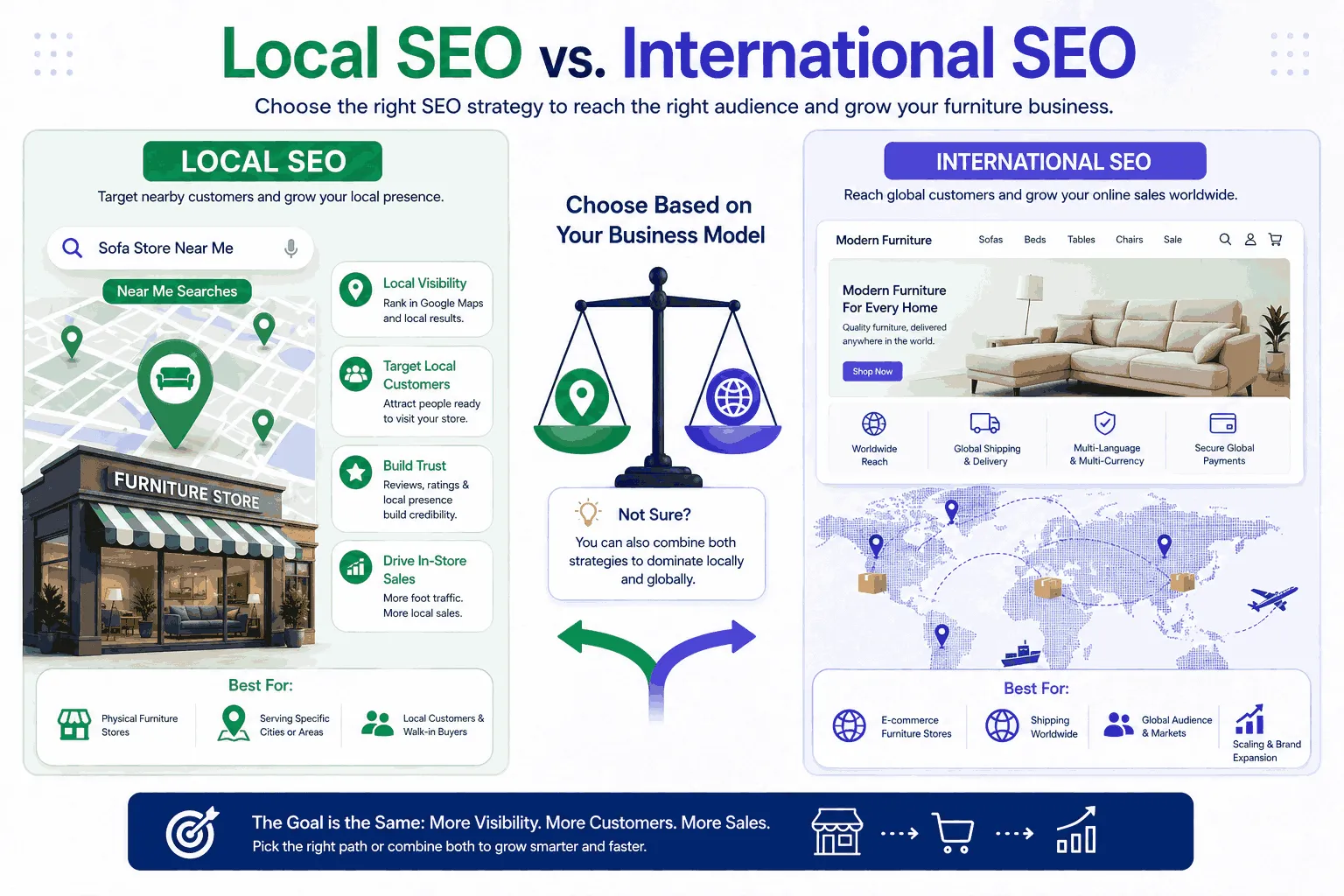
Not every furniture business should approach SEO the same way. The right strategy depends entirely on how your business generates revenue, who your customers are, and where they are located. Choosing the wrong direction does not just waste budget. It delays real results while your competitors capture the demand you should be owning.
Local SEO: Built for Showroom Traffic and Nearby Buyers
Local SEO is designed for furniture businesses that serve a specific geographic area. When someone searches for a furniture store near them or includes a city name in their query, they are not casually browsing. They are close to a decision and looking for somewhere specific to go. That intent is immediate and the businesses that show up for those searches convert at a significantly higher rate than those capturing broader traffic.
Local SEO for furniture stores focuses on making your business visible in those moments. This includes optimising location based pages on your website, aligning content with local search intent, building consistent citations across directories, and maintaining a strong presence in the Google Local Pack where most high intent clicks actually happen. For furniture stores with a physical showroom, this channel often produces the fastest and most direct return because the path from search to sale is short.
International SEO: Built for Scale and Online Sales
International SEO is relevant for furniture businesses operating beyond a single location, particularly ecommerce stores that can ship products nationally or globally. Instead of targeting one area, the focus shifts to capturing demand across different regions, cities, and markets at scale.
This involves building category and product pages that rank for broader terms, creating content that appeals to wider audiences, and ensuring the site structure supports multiple markets if needed. In this model growth comes from being present across thousands of searches rather than relying on proximity. For seo for ecommerce furniture websites, this becomes the primary driver of consistent organic traffic and revenue because the audience is not limited by location.
Which One Is Right for You
If your revenue depends on people visiting a showroom, local SEO should be the priority. If you sell online and can reach customers beyond your immediate area, a broader search strategy opens up a significantly larger opportunity.
Many furniture businesses benefit from a combined approach. Local SEO captures nearby buyers who are ready to act, while broader content and category optimisation builds visibility across wider markets at the same time. The key is not picking one blindly but aligning the strategy to how your customers actually find and buy from you. A furniture business that tries to compete nationally before dominating locally is spreading itself thin before it has a foundation to build from.
The Role of Google Business Profile in Furniture Business Visibility
For local SEO, one factor plays a central role in visibility: the Google Business Profile.
When users search for furniture stores nearby, search results often display a map with local business listings before traditional website results. This is where most high-intent clicks happen, and where visibility can directly influence store visits.
A well-optimized Google Business Profile increases your chances of appearing in these local results. It provides essential information such as location, hours, contact details, and customer reviews, all of which help users decide whether to visit your store.
Beyond basic information, it also acts as a trust signal. Businesses with complete profiles, consistent updates, and strong reviews are more likely to attract attention and engagement.
For furniture stores, this is especially important because many customers prefer to see products in person before purchasing. Showing up in local search results at the right time can directly translate into showroom traffic and sales.
Bringing It Together
Local and international SEO are not competing strategies. They serve different purposes within the same growth system.
Local SEO captures high-intent buyers who are ready to act nearby. International SEO expands your reach and brings in consistent traffic from broader markets. And at the center of local visibility, Google Business Profile connects your business directly with customers searching in your area.
When these elements are aligned with your business model, SEO becomes more than visibility. It becomes a reliable way to attract the right customers, in the right place, at the right time.
Conclusion
The furniture market is large, growing, and increasingly driven by search, and the businesses that have invested in SEO are the ones capturing that demand every single day. Seo for furniture stores is not a single tactic. It is a system built on a technical foundation, an intent driven structure, content that earns authority, and links that build credibility over time. Whether you run a local showroom, a multi location brand, or an ecommerce store, the fundamentals are the same. Show up where your customers are searching, answer the questions they are asking, build the trust that moves a high consideration purchase forward, and stay consistent long enough for the results to compound. The businesses that treat SEO as a long term asset build positions that competitors cannot displace overnight, and that stability is what separates furniture businesses that scale sustainably from those that remain dependent on paid channels indefinitely. If you are ready to build that kind of visibility for your furniture business, MForSEO is here to make it happen.
Frequently Asked Questions:
How long does SEO take to show results for a furniture store?
Typically 3 to 6 months to see real movement. We know that feels like a wait, which is why we focus on quick wins in the first few weeks so you are seeing progress from the start, not just waiting.
Is SEO worth it for a small furniture store?
100% yes. Small stores actually have an advantage because local searches have far less competition. We have helped small furniture stores outrank national brands in their own city. Budget is not the barrier, the right strategy is.
Can a furniture store rank on Google without paid ads?
Yes, and that is exactly the point. Paid ads stop the moment you stop paying. Organic rankings we build for you keep bringing in customers without a cost attached to every single click. That is the whole advantage.
How important is Google Business Profile for a furniture store?
Extremely. It is the first thing a local buyer sees before they even visit your website. If your profile is not fully optimised you are losing showroom visits to competitors who are. We make sure that does not happen.
How do you measure SEO success for a furniture store?
Rankings, traffic, and most importantly sales coming from search. We set up proper tracking from day one so you can see exactly what SEO is contributing to your revenue. No vanity metrics, no confusing reports. Just clear numbers that show what is actually working.