Local SEO in Oxfordshire is more competitive than many business owners realise. When customers search for services in Oxford, Banbury, Bicester, Witney, or Didcot, Google often shows only a handful of local businesses before users make a decision.
Oxfordshire’s population reached approximately 763,200 in mid-2024, according to Oxfordshire County Council data, making it one of the largest and fastest-growing counties in South East England. The county’s economy is driven by knowledge-intensive industries, life sciences, technology, advanced manufacturing, education, and professional services, supported by globally recognised research institutions and a strong innovation ecosystem.
Business activity continues to grow across the county. Oxfordshire recorded a record 48,030 registered companies, with 5,446 new business formations in a single year, up 12.5% from the previous year. Additionally, Oxford alone supports around 4,950 businesses and 117,000 employee jobs, with more than 70% of jobs in knowledge-intensive sectors.
This guide explains how to improve your visibility in Oxfordshire search results using Google Business Profile optimisation, local keyword targeting, on-page SEO, review generation, and citation building. Follow these strategies consistently, and you can increase your chances of appearing in local searches that drive enquiries, calls, and qualified customers.
What the Search Data Says About Oxfordshire
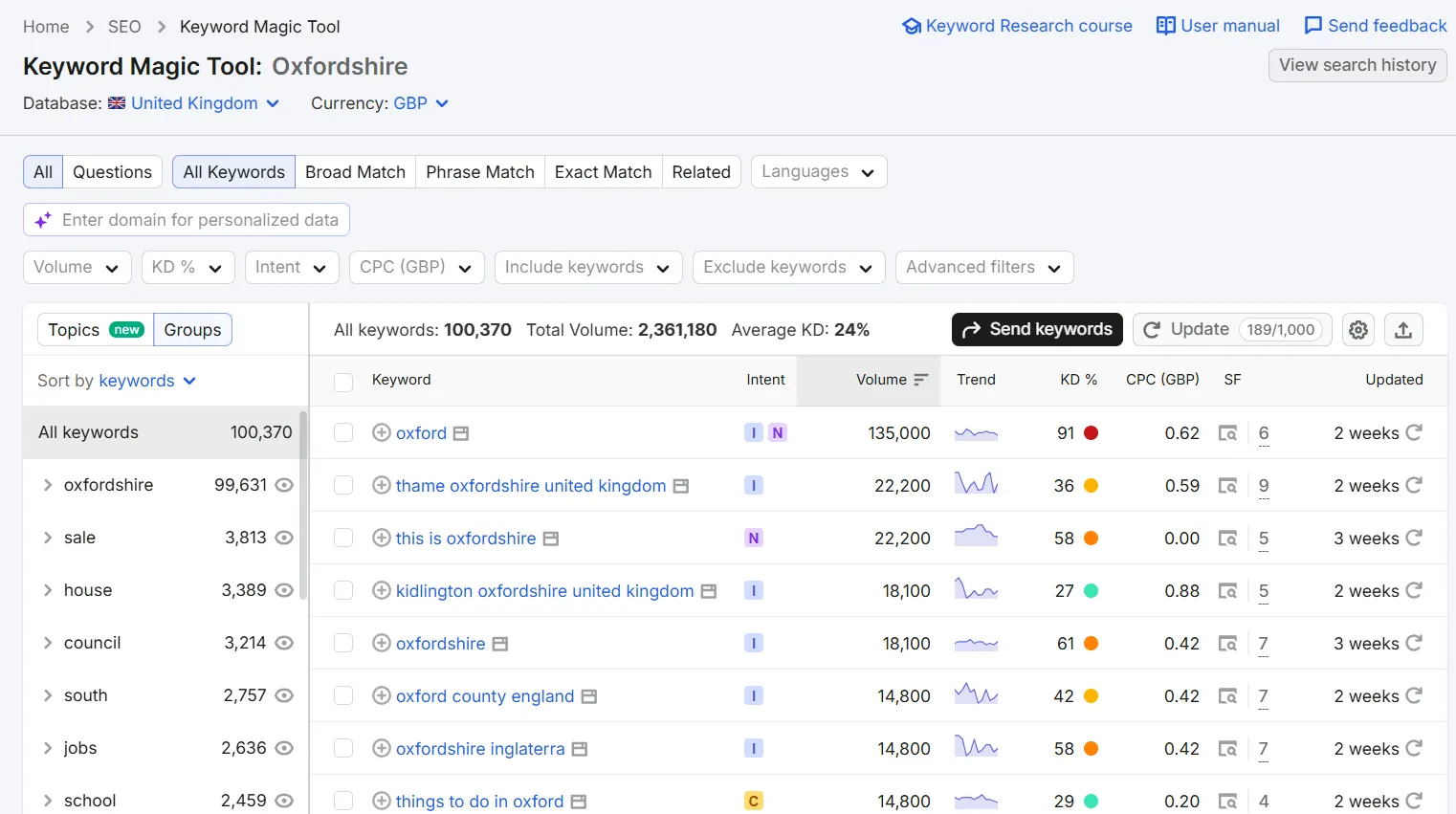
The Oxfordshire dataset contains 100,370 tracked keywords generating a combined monthly search volume of 2,361,180. That level of demand points to a mature local market where residents, visitors, home movers, job seekers and businesses are actively searching across a wide range of local topics. The breadth of coverage visible in the dataset suggests that search behaviour is spread across many intents rather than concentrated around a small number of terms, creating opportunities for businesses that target specific local needs instead of competing only for broad visibility.
The average keyword difficulty sits at 24%, which indicates that a significant portion of the available search demand is not locked behind highly competitive rankings. For business owners, the implication is clear: visibility is often more constrained by content coverage and local relevance than by overwhelming competition. The market rewards businesses that build pages around real local demand rather than relying on a small number of generic service terms.
The CPC figures reinforce commercial value. Advertisers are paying to appear for searches such as “oxford” (£0.62), “thame oxfordshire united kingdom” (£0.59), “kidlington oxfordshire united kingdom” (£0.88), “oxfordshire” (£0.42), “oxford county england” (£0.42), “oxfordshire inglaterra” (£0.42) and “things to do in oxford” (£0.20). Paid investment at this level signals that businesses see measurable value in reaching searchers connected to the area.
Several visible keywords highlight where attention is concentrated. Broad location terms like “oxford” and “oxfordshire” dominate demand, while place-specific searches around Thame and Kidlington reveal interest at a town level. Queries such as “things to do in oxford” show strong visitor intent, creating opportunities for hospitality, leisure and tourism-focused businesses. Even informational searches like “oxford county england” demonstrate sustained interest in local geography and identity.
The opportunity lies in capturing targeted local demand before competitors build dedicated coverage around it. Businesses that align content with the specific places, services and intents already visible in the search landscape are positioned to secure visibility where demand already exists, which is exactly what the rest of this guide explores.
Why SEO Actually Matters for Businesses in Oxfordshire
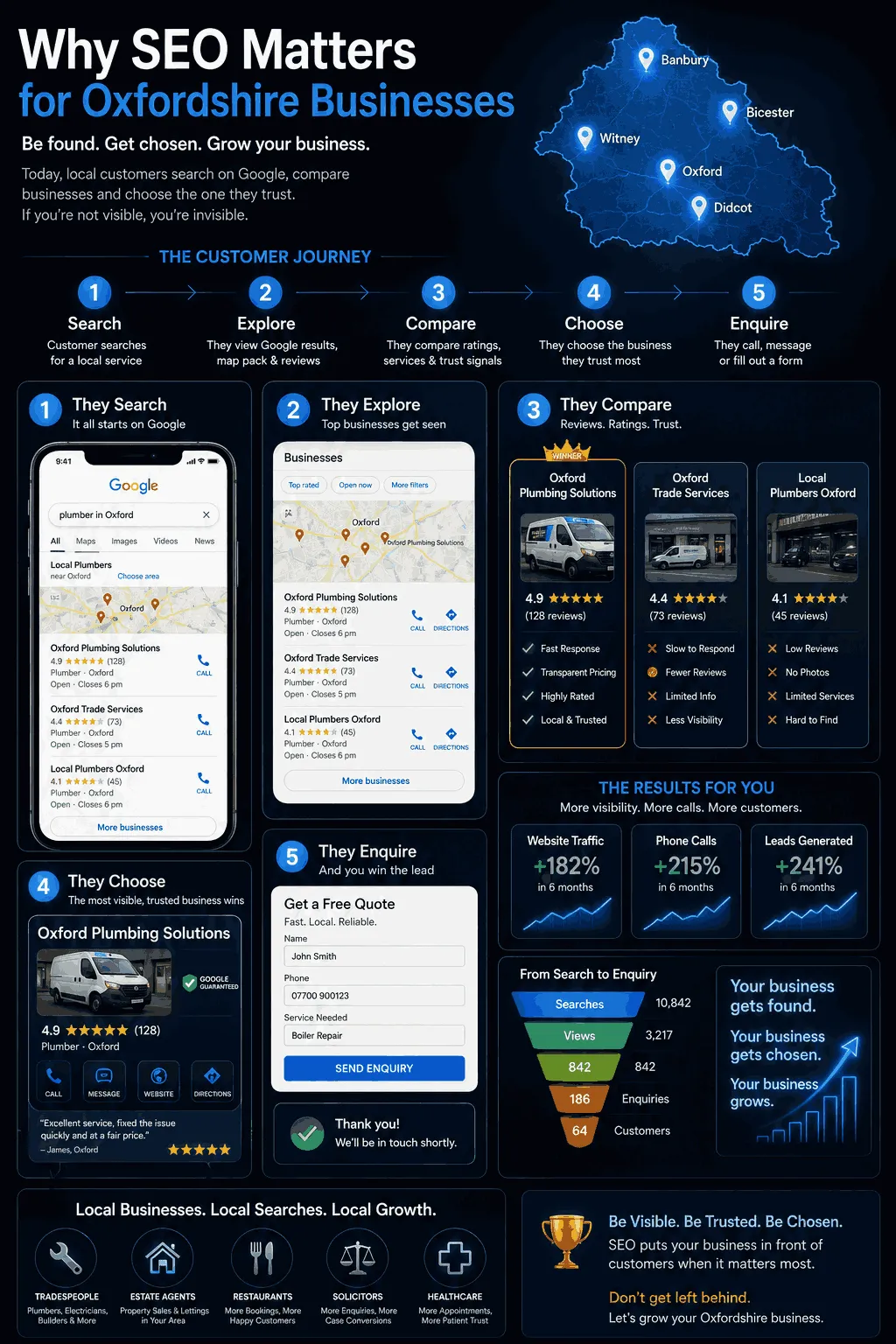
Oxfordshire is not one market — it is several layered on top of each other. Oxford city carries dense professional and student demand. Banbury and Bicester serve trade, logistics, and retail. Witney, Abingdon, and the Cotswold-fringe towns run on hospitality, independent retail, and local services. What connects all of them is this: the person looking for your business is not asking around anymore. They are opening Google, typing what they need, and calling whichever business appears first.
That shift happened gradually, then all at once. A few years ago, a plumber in Kidlington or a letting agent in Witney could rely on repeat customers, referrals, or a decent listing in the local directory. That pipeline has not disappeared — but it no longer drives growth. The majority of new customers in Oxfordshire now start with a search, check the reviews, and make a decision before a single word is exchanged. The businesses that show up in that moment win. The ones that do not are simply not part of the conversation.
What makes this particularly sharp in Oxfordshire is the density of educated, time-poor buyers. This is a county with one of the highest-qualified workforces in the country. These are people who research before they spend, compare before they commit, and trust Google’s local results to filter out the weaker options for them. If your Google Business Profile is thin and your website does not rank, you are being filtered out — not by choice, but by default.
Oxfordshire ended 2024 with nearly 49,000 registered companies — an all-time high — with over 5,300 new businesses formed in that year alone. Many are service businesses entering the same local searches you depend on, building their online presence from day one.
Every month without SEO, someone else in Oxfordshire is getting the call you should have received.
The Biggest Industries in Oxfordshire — What the Search Data Shows
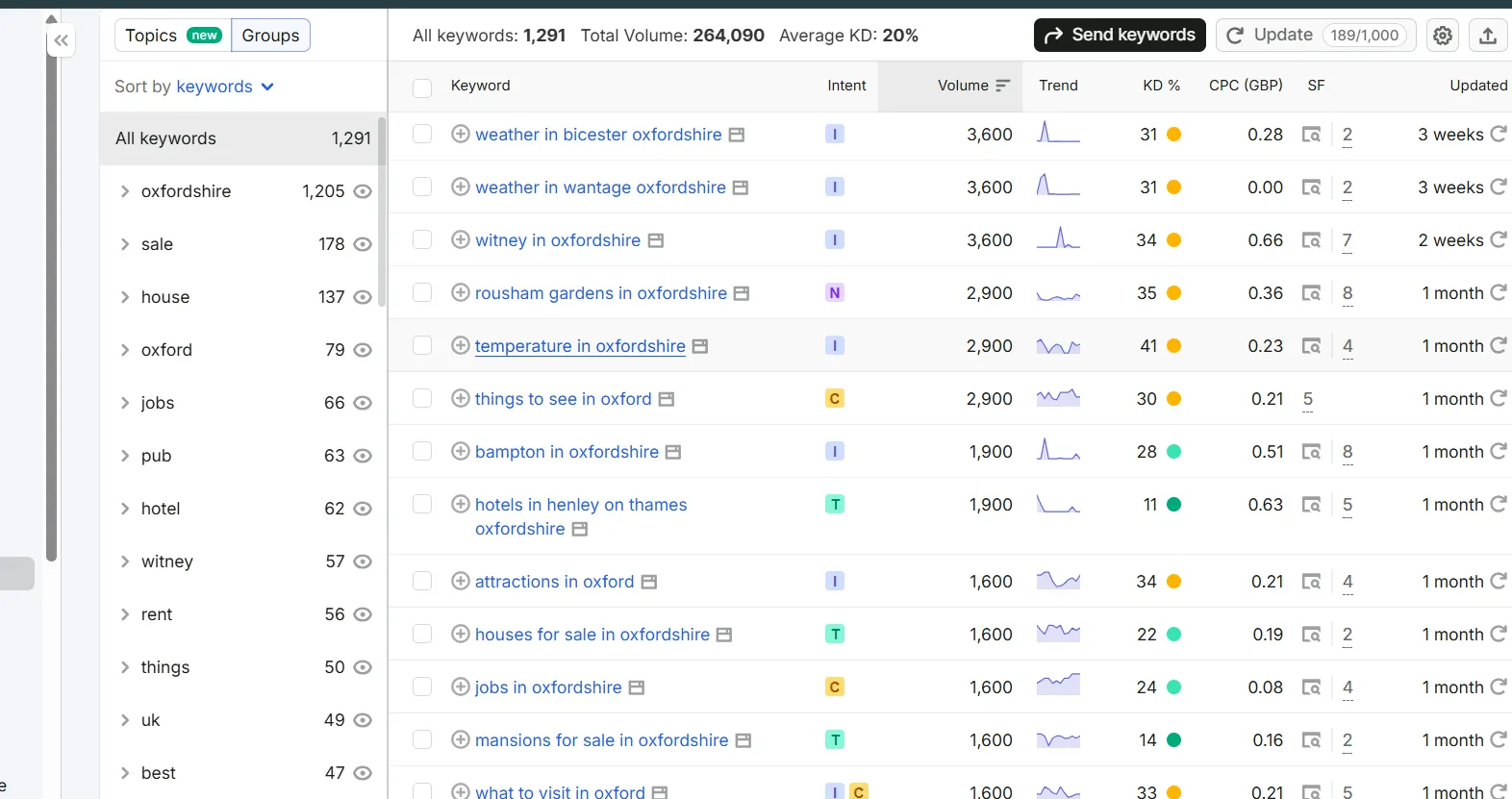
Across the 1,291 Oxfordshire keywords in the dataset, search demand is concentrated around a handful of sectors that directly generate enquiries, bookings, applications and sales. Tourism-related searches dominate, followed by hospitality, property, employment and local retail. What stands out is how location-specific the demand is. Searchers are not looking for generic services—they are looking for hotels in Henley, houses in Witney, pubs in Burford and jobs in Thame. That creates a clear roadmap for where businesses can capture demand through local SEO.
Tourism & Attractions — 49,060
- things to do in oxford — 14,800/month | KD: 29 | CPC: £0.16
- what to do in oxford — 4,400/month | KD: 28 | CPC: £0.17
- things to see in oxford — 2,900/month
- attractions in oxford — 1,600/month | KD: 34 | CPC: £0.17
- what to visit in oxford — 1,600/month | KD: 33 | CPC: £0.17
- things to do in oxfordshire — 1,300/month
- things to do in burford oxfordshire — 880/month
- things to do in oxford uk — 880/month
- stuff to do in oxford — 880/month
- to do in oxford — 880/month
- places to visit in oxford uk — 590/month
- activities in oxford — 480/month
The volume here is exceptional because Oxford acts as both a local destination and an international visitor market. CPCs remain relatively modest, which suggests many tourism operators are still underinvesting in search visibility despite substantial demand. KD scores mostly sit in a range where focused local content can compete. Attractions, tour providers, museums and visitor-focused businesses that fail to rank for these terms are effectively handing traffic to larger brands and directory sites.
Hotels & Hospitality — 32,980
- hotels in henley on thames oxfordshire — 1,900/month | KD: 37 | CPC: £0.50
- hotels in oxfordshire — 1,000/month
- pubs in burford oxfordshire — 1,300/month
- hotels in burford oxfordshire — 880/month
- hotels in witney oxfordshire — 880/month
- hotels in woodstock oxfordshire — 880/month
- hotels in didcot oxfordshire — 720/month
- good restaurants in oxfordshire — 590/month
- pubs in oxfordshire — 590/month
- pubs in thame oxfordshire — 590/month
- pubs in bicester oxfordshire — 720/month
- places to eat in witney oxfordshire — 480/month
- restaurants in witney oxfordshire — 480/month
The commercial intent here is significantly stronger than tourism searches. Someone searching for a hotel, pub or restaurant is often much closer to spending money. The higher CPC values around accommodation-related terms show businesses are willing to pay for these visitors because bookings generate immediate revenue. Oxfordshire hospitality businesses that rank organically reduce their reliance on booking platforms and paid advertising while capturing customers at the decision stage.
Real Estate & Property — 24,610
- houses for sale in oxfordshire — 1,600/month
- mansions for sale in oxfordshire — 1,600/month
- houses for sale in thame oxfordshire — 1,000/month
- houses for sale in witney oxfordshire — 1,000/month
- houses for sale in didcot oxfordshire — 720/month
- houses for sale in faringdon oxfordshire — 720/month
- houses for sale in bloxham oxfordshire — 590/month
- houses for sale in burford oxfordshire — 590/month
- houses for sale in wantage oxfordshire — 590/month
- property for sale in oxfordshire — 590/month
- property for sale in thame oxfordshire — 590/month
- new homes in oxfordshire — 590/month
- bungalows for sale in oxfordshire — 480/month
- property for sale in burford oxfordshire — 480/month
- houses for sale in bicester oxfordshire — 480/month
Property searches carry some of the highest customer values in the entire dataset. One successful enquiry can translate into thousands of pounds in commission or fees. Search demand is spread across multiple Oxfordshire towns, showing buyers are researching very specific locations rather than the county as a whole. Estate agents that build town-level visibility are positioned to capture demand long before a buyer submits an enquiry.
Jobs & Employment — 12,400
- jobs in oxfordshire — 1,600/month
- jobs in thame oxfordshire uk — 1,300/month
- jobs in witney oxfordshire — 1,000/month
- jobs in abingdon oxfordshire — 590/month
- jobs in oxfordshire uk — 590/month
- jobs in didcot oxfordshire — 480/month
- jobs in carterton oxfordshire — 390/month
- indeed jobs in oxfordshire — 320/month
- part time jobs in wantage oxfordshire — 260/month
- admin jobs in oxfordshire — 210/month
The most striking feature here is the relatively low competition compared to the demand available. Job seekers are actively searching across Oxfordshire’s major towns, yet many local employers rely almost entirely on recruitment platforms. Businesses, recruiters and specialist job boards that optimise for these searches can attract candidates directly rather than paying repeatedly for visibility through third-party platforms.
Retail & Shopping — 4,170
- shops in burford oxfordshire — 590/month
- shops in witney oxfordshire — 590/month
- shops in thame oxfordshire — 390/month
- coffee shops in witney oxfordshire — 320/month
- music shops in oxfordshire — 260/month
- shops in wallingford oxfordshire — 260/month
- shops in wantage oxfordshire — 260/month
- furniture shops in abingdon oxfordshire — 210/month
- supermarkets in witney oxfordshire — 140/month
- bed shops in oxfordshire — 110/month
Retail volume is smaller than tourism or property, but the intent is highly local. Searchers are looking for physical businesses in specific Oxfordshire towns, which means visibility often translates directly into footfall. The specialised retail terms carry higher commercial value than generic shopping searches, making them attractive targets for independent retailers. Many of these keywords are also less competitive, creating opportunities that larger chains frequently overlook.
The Pattern Across All of It
The data points to a county where commercial intent is heavily tied to location. Searchers are not browsing broadly; they are searching for specific services, businesses and opportunities in specific Oxfordshire towns. The highest CPC values appear in sectors where a single customer can generate significant revenue, particularly property and hospitality. Meanwhile, many keyword difficulty scores remain within a range that local businesses can realistically compete for. The gap between search demand and local SEO execution is still large enough to create opportunity. Businesses that build visibility now will be competing against today’s market, not tomorrow’s more crowded one.
Areas Within Oxford — Where the Local Search Opportunity Actually Sits
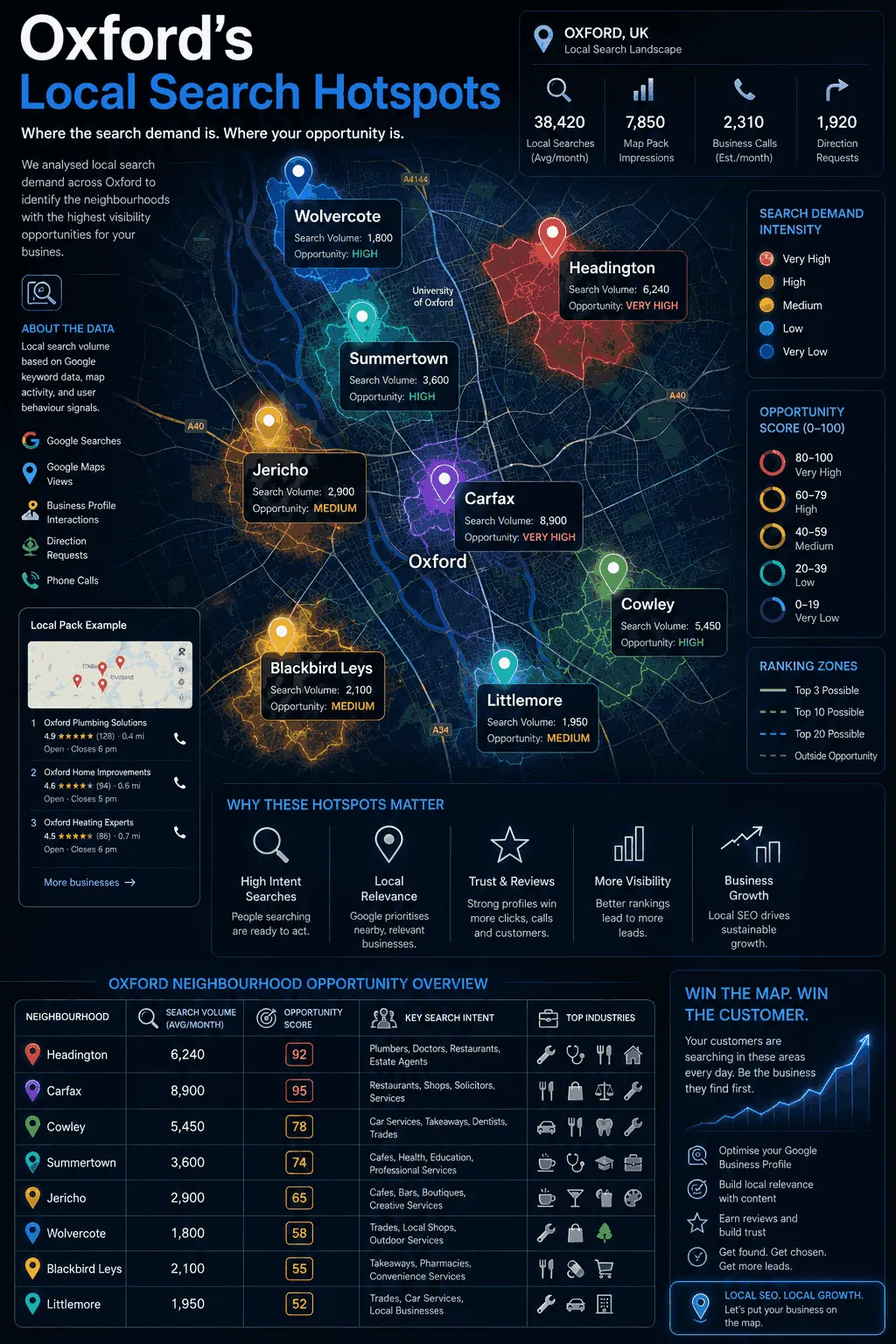
Oxford is often treated as a single market, but that overlooks how demand is distributed across its distinct neighbourhoods and wards. The city contains more than 20 electoral wards, each with different demographics, housing stock, commercial activity and search behaviour. Businesses targeting only “Oxford” as a keyword are competing in the broadest possible market, while valuable neighbourhood-level searches often remain far less contested.
Headington
A major residential and healthcare hub in east Oxford, Headington is anchored by the city’s hospital cluster and serves a large population of professionals, students and families. Healthcare providers, dentists, tradespeople, accountants and property services all have strong opportunities here. Searches are often highly practical and service-led, driven by residents looking for nearby providers rather than city-wide options.
Cowley
Cowley combines dense residential areas with some of Oxford’s most established commercial and industrial activity. Automotive businesses, trades, recruitment firms, retailers and local service providers benefit from its mix of residents and workers. Search demand here is typically transaction-focused, making it attractive for businesses that rely on enquiries rather than foot traffic.
Summertown
Summertown is one of Oxford’s most affluent neighbourhoods, with independent retailers, restaurants, professional services and premium residential property. Businesses targeting higher-value clients often find stronger opportunities here than through generic Oxford-wide campaigns. The area’s established retail parade creates demand for both local discovery and reputation-driven searches.
Jericho & Carfax
This area combines Oxford’s city centre with one of its best-known mixed-use neighbourhoods. Hospitality, leisure, retail and tourism-related businesses benefit from constant visitor activity. Searchers here are often looking for immediate decisions—places to eat, shop, stay or visit—which creates strong commercial intent.
Blackbird Leys
Primarily residential, Blackbird Leys presents opportunities for trades, home services, healthcare providers, childcare businesses and local retailers. Many businesses overlook the area in favour of central Oxford, creating less competition for neighbourhood-focused visibility. Service-area businesses can often gain traction faster here than in more saturated parts of the city.
Littlemore
Littlemore continues to grow as a residential area with strong demand for everyday services. Estate agents, removal companies, home improvement firms and healthcare providers all benefit from neighbourhood-level visibility. Businesses that create dedicated local pages often outperform competitors relying solely on Oxford-wide targeting.
Wolvercote
Located on Oxford’s northern edge, Wolvercote combines residential living with strong community identity and access to green spaces. Local hospitality, trades, property services and family-focused businesses are particularly well positioned. Searches here tend to favour proximity and local trust rather than city-centre brands.
What This Means for Your SEO
Most Oxford businesses optimise for the city name and stop there. The problem is that customers often search much closer to home, using neighbourhood names, landmarks and local identifiers that never appear on generic service pages. Trades, healthcare providers, estate agents, solicitors, restaurants and retailers all benefit from creating location-specific content for the areas they actually serve. Neighbourhood pages help businesses match how people search while reducing competition compared with broad city-level terms. The businesses that dominate local visibility over the next few years are likely to be those that own these neighbourhood searches before competitors recognise their value.
Local Search and Google Business Profile Optimisation in Oxfordshire
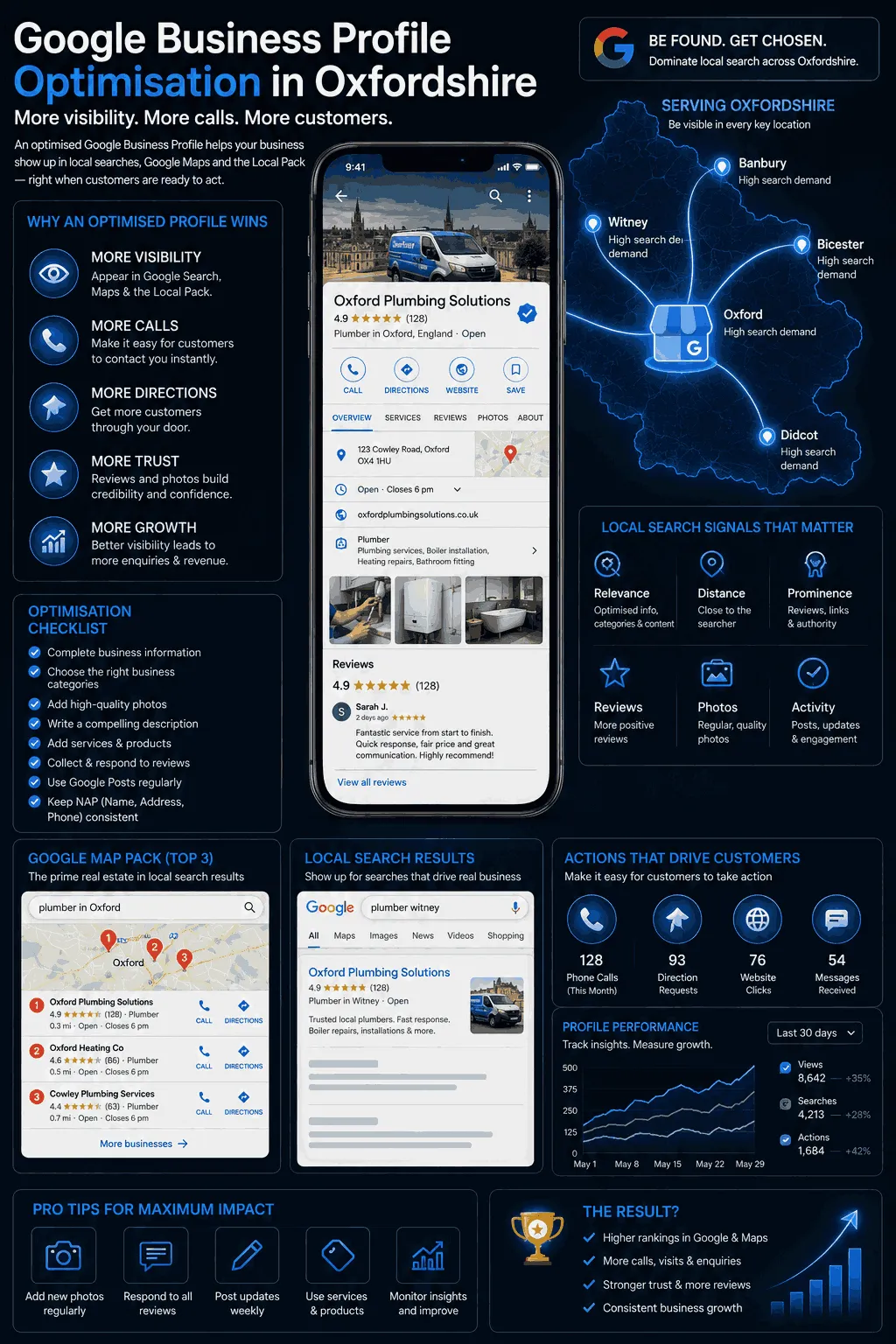
Local search in Oxfordshire behaves differently from larger UK cities because demand is spread across multiple commercial centres rather than concentrated in a single urban core. A business in Oxford is competing in a very different environment from one in Banbury, Witney, Didcot, Abingdon or Bicester, yet customers frequently search across those boundaries. The county’s mix of market towns, affluent residential areas, tourism hotspots, science and technology hubs, and established local service businesses creates a search landscape where relevance often matters more than sheer brand size. Unlike London or Birmingham, where businesses can disappear beneath thousands of competitors, many Oxfordshire sectors still have clear visibility gaps.
Google’s local rankings are built around relevance, distance and prominence, but Oxfordshire’s geography changes how those factors interact. Distance is particularly influential because many searches are tied to specific towns rather than the county as a whole. Someone searching for an accountant in Witney or a plumber in Abingdon is often looking for a nearby provider rather than the biggest company in Oxfordshire. That gives smaller businesses a genuine opportunity to compete. Relevance remains essential, but prominence is often easier to build in Oxfordshire than in larger cities because local markets are less saturated and many competitors still have incomplete local optimisation.
For most Oxfordshire businesses, an optimised Google Business Profile remains the fastest route to increased visibility. In many sectors, the local pack is not dominated by national brands. It is often occupied by businesses that have simply invested more consistently in reviews, category selection, business information and local engagement. The effort required to move from an average profile to a highly competitive one is often significantly lower than it would be in a major metropolitan market. That creates an opening for local firms willing to treat their profile as a lead-generation asset rather than a directory listing.
Search behaviour across Oxfordshire is also unusually location-driven. Residents and visitors regularly search using town names such as Oxford, Banbury, Bicester, Didcot, Wantage, Thame and Henley-on-Thames. Tourism-related searches cluster around destinations like Woodstock and Burford, while professional and trade-related searches are often tied to specific service areas. This means businesses should align their profiles, service areas and website content with the actual towns they serve rather than relying solely on county-wide targeting. Many businesses overlook this and end up competing for broader terms when local intent is sitting much closer to conversion.
Compare a search for a tradesperson in Oxfordshire with the same search in London and the difference becomes obvious. The volume may be lower, but the competition is often dramatically more manageable. Fewer businesses are actively investing in local SEO, fewer profiles are fully optimised, and there is still room for newcomers to earn visibility. That window will not remain open indefinitely. As more Oxfordshire businesses recognise the value of local search, the cost of catching up will increase.
Over six to twelve months, consistent local SEO and Google Business Profile optimisation build something competitors struggle to replicate quickly: local authority, review momentum, search visibility and trust within the exact communities that generate revenue. Businesses that establish those signals now will be significantly harder to displace later. The easiest rankings to win are usually the ones your competitors have not noticed yet.
Why Most Businesses in Oxfordshire Struggle to Rank on Google
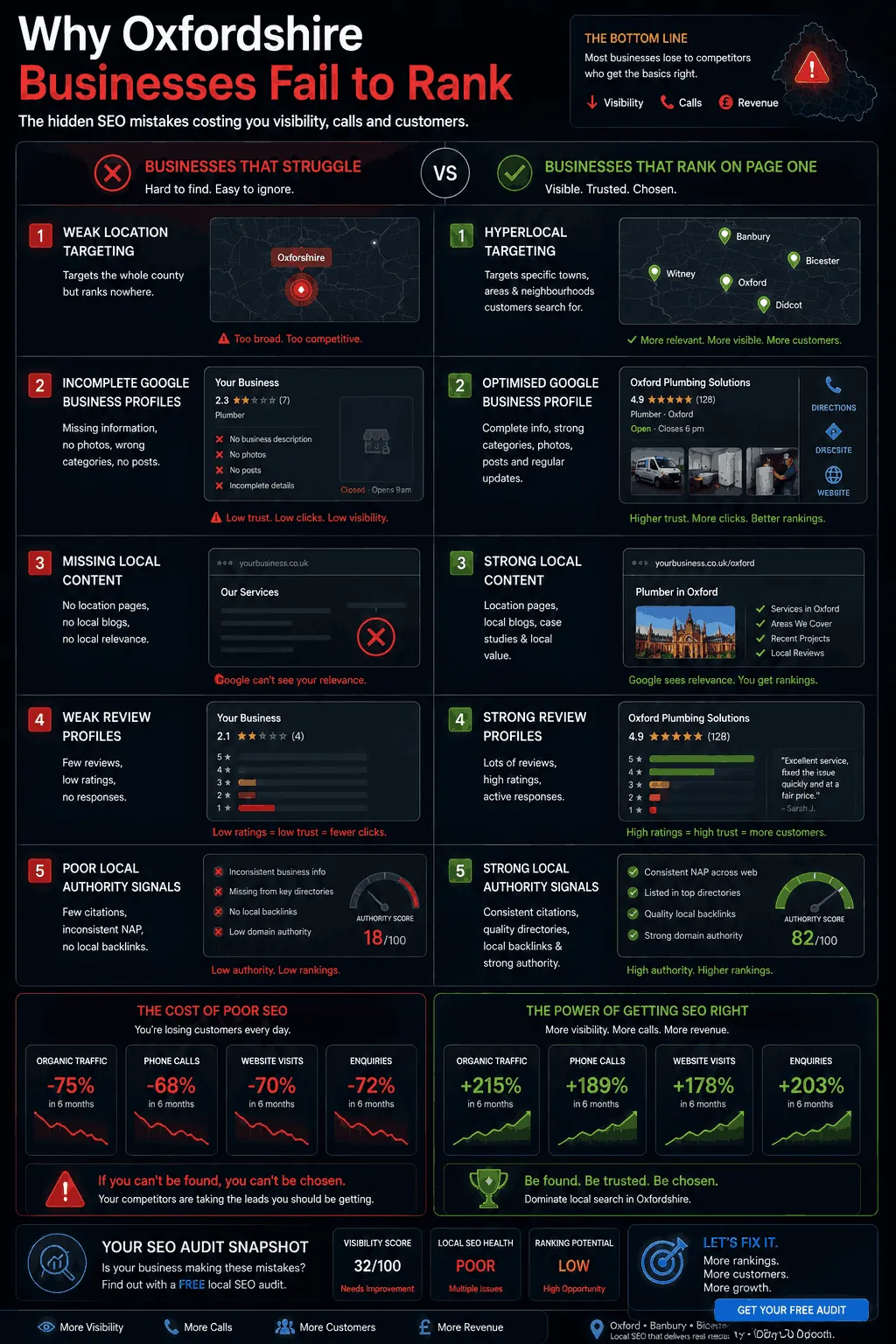
To understand why so many Oxfordshire businesses fail to gain consistent visibility in Google, we analysed the sectors driving the strongest local demand across the county: trades, hospitality, property, professional services, healthcare and tourism. The pattern was remarkably consistent across Oxford, Banbury, Bicester, Didcot, Witney, Abingdon and the county’s market towns. Here is what we found.
Mistake 1: Targeting Oxfordshire Instead of the Towns That Generate the Searches
Many businesses build their SEO strategy around broad county-level terms while customers search using specific locations. A resident looking for an accountant in Witney, an estate agent in Didcot or a roofer in Banbury is rarely searching for “Oxfordshire” alone. Yet many local websites have a single generic service page attempting to rank across the entire county.
This creates a visibility gap because competitors with town-specific pages appear more relevant to both users and Google. According to BrightLocal, local intent searches continue to be dominated by location-based modifiers, with proximity and relevance playing a central role in local rankings.
Across Oxfordshire, businesses that create dedicated pages for Oxford, Bicester, Abingdon, Thame and other service areas are consistently better positioned than those relying on county-wide optimisation alone.
Mistake 2: Treating Google Business Profile as a Directory Listing
A surprising number of Oxfordshire businesses have incomplete categories, limited service descriptions, outdated imagery or long periods without new reviews. This is particularly common among trades, professional services and independent retailers.
Google’s own guidance consistently identifies completeness and accuracy as ranking factors for local visibility. Separately, BrightLocal research shows consumers overwhelmingly use reviews as part of their local business evaluation process before making contact.
In practical terms, businesses with active profiles dominate local pack results while competitors with neglected profiles struggle to appear, even when they provide comparable services. In many Oxfordshire towns, the gap between first and fifth position is often little more than profile quality and review activity.
Mistake 3: Ignoring the High-Intent Searches Driving Revenue
Many local businesses invest heavily in homepage content while neglecting the searches most likely to generate enquiries. Oxfordshire’s search demand is highly location-specific and commercially focused. Searches related to property, hospitality, healthcare and local services frequently indicate immediate buying intent.
According to Google, local searches often occur close to the point of decision-making, particularly for service-based businesses. Yet many Oxfordshire companies still optimise for broad informational terms instead of transactional searches.
The result is predictable. Businesses that focus on service-plus-location searches capture enquiries, while competitors attract visitors who never become customers.
Mistake 4: Weak Local Authority Signals Across the Website
Many Oxfordshire websites provide little evidence of where they actually operate. Service areas are vague, local case studies are missing, and there are few references to the towns, neighbourhoods and communities being served.
Research from Whitespark consistently places on-page local signals among the most influential local ranking factors. When Google cannot confidently associate a business with specific locations, visibility suffers.
This is particularly damaging in Oxfordshire because demand is fragmented across dozens of towns. Businesses that demonstrate genuine local presence in places like Headington, Cowley, Woodstock, Wantage or Henley-on-Thames create stronger relevance signals than those relying on generic county-wide messaging.
Mistake 5: Relying on Referrals in a Market That Has Already Moved Online
Many established Oxfordshire businesses still generate work through reputation and referrals, but they underestimate how modern customers validate recommendations. Even when someone receives a referral, they frequently search Google before making contact.
According to BrightLocal, the majority of consumers regularly read online reviews when evaluating local businesses. A referral is often only the first step, not the final decision.
This creates a hidden risk. Businesses with excellent offline reputations lose visibility to competitors who appear stronger online. Across Oxfordshire’s competitive property, hospitality and service sectors, that means potential customers often choose the business they can find most easily rather than the one that was originally recommended.
These are not complicated SEO failures. They are consistent, repeatable weaknesses that appear across businesses throughout Oxfordshire. Fixing even two or three of them puts a business ahead of much of the local competition—and ahead of competitors who still assume visibility will take care of itself.
The Best Strategy to Rank in Oxfordshire
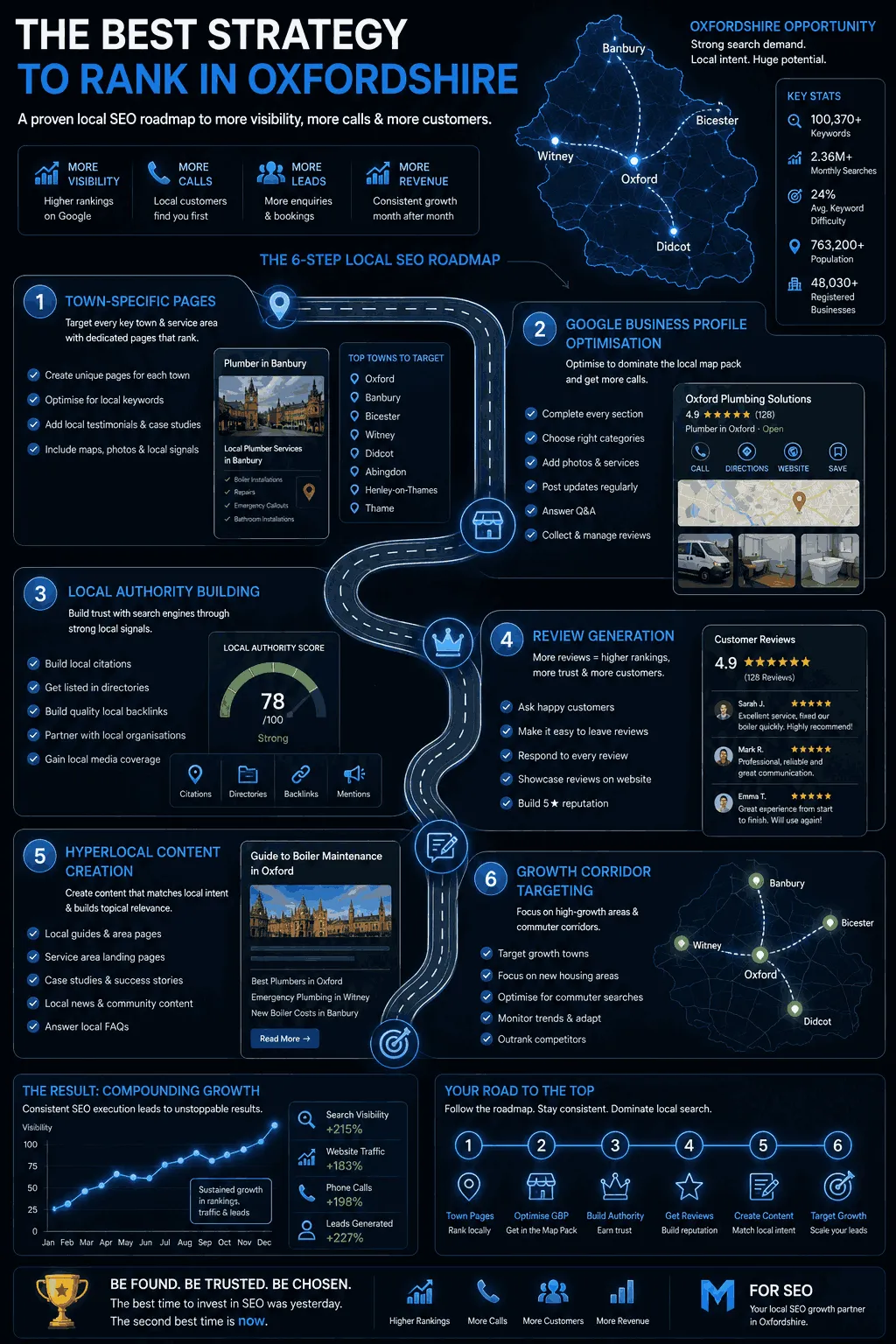
Oxfordshire remains one of the more winnable local SEO markets in southern England because demand is spread across multiple towns rather than concentrated in a single city. Most businesses are still competing locally while optimising broadly, creating opportunities for companies willing to build visibility around how people actually search across Oxford, Banbury, Bicester, Witney, Abingdon, Didcot, Thame and the county’s market towns.
Own the Towns Before You Try to Own Oxfordshire
The strongest opportunity in Oxfordshire is not ranking for county-wide terms. It is dominating individual towns. Most businesses still rely on generic service pages that mention Oxfordshire once or twice and hope to rank everywhere. Creating dedicated pages for each service area—whether that is Bicester, Witney, Didcot, Wantage or Henley-on-Thames—aligns far more closely with real search behaviour and immediately improves local relevance. Businesses that build town-level authority often outperform larger competitors trying to rank the entire county from a single page.
Target the Commercial Searches Hidden Behind Tourism Demand
Oxfordshire generates enormous search demand from visitors, but most businesses focus only on tourism-related keywords. The bigger opportunity is capturing the searches that follow. Visitors searching for accommodation, restaurants, transport services, estate agents, relocation services, accountants and legal firms often arrive through tourism-driven discovery first. Businesses that create content around these secondary commercial journeys position themselves in front of users who are much closer to spending money than the average visitor.
Build Location Authority Around Oxfordshire’s Growth Corridors
The strongest economic growth in the county is not confined to Oxford city centre. Areas such as Bicester, Didcot, Abingdon and the wider Science Vale corridor continue to attract investment, businesses and new residents. Search demand follows that growth. Businesses that consistently publish content, case studies and service pages tied to these locations create stronger local signals while competitors continue targeting only broad county-level phrases. Over time, this creates a difficult-to-replicate advantage in emerging demand centres.
Turn Your Google Business Profile Into a Competitive Asset
In many Oxfordshire sectors, local pack results are not dominated by national brands or sophisticated SEO campaigns. They are often controlled by businesses that simply maintain more complete profiles, stronger review momentum and clearer service information. That means local visibility gains are frequently achievable without the level of investment required in larger cities. For trades, healthcare providers, estate agents, restaurants and professional services, profile optimisation often produces results faster than almost any other local search activity.
Create Content Around Real Oxfordshire Buying Decisions
Many businesses publish generic blog content that attracts visitors but rarely generates enquiries. A more effective approach is building content around the actual decisions people make in Oxfordshire. Searches comparing towns, choosing schools, relocating for work, moving house, selecting local contractors or finding services near business parks and employment hubs all reflect genuine commercial intent. Businesses that answer these questions become visible earlier in the buying journey and capture demand before competitors enter the conversation.
Cover the Places Your Competitors Ignore
Most local businesses compete heavily for Oxford while neglecting smaller but commercially valuable markets such as Thame, Wantage, Wallingford, Carterton, Woodstock and Charlbury. These locations often have lower competition and clearer search intent. Winning visibility in multiple underserved towns frequently generates more enquiries than fighting for a handful of highly contested keywords centred on Oxford alone.
A business in Oxfordshire that executes even half of these strategies consistently over the next six to twelve months will build an advantage that compounds with every new ranking, review and enquiry. While competitors continue chasing broad visibility, the businesses winning locally will be quietly capturing demand town by town, search by search.
Introducing M For SEO
By now, one thing should be clear: ranking in Oxfordshire is not about chasing broad keywords and hoping for the best. The businesses winning search visibility across the county are the ones aligning themselves with how people actually search. They understand that someone looking for a service in Witney behaves differently from someone searching in Bicester, Didcot, Banbury or Oxford itself. They recognise that search demand is spread across dozens of towns, commercial centres and growing residential areas rather than concentrated in a single market. That is exactly where M For SEO comes in.
M For SEO was built around the reality that every local market behaves differently. Oxfordshire is a perfect example. Across the county, we see strong search demand in property, hospitality, tourism, professional services, local trades and healthcare, yet many businesses still rely on generic county-wide pages that fail to capture town-level intent. At the same time, our analysis identified thousands of monthly searches tied to specific locations, while many local competitors continue to overlook opportunities in places such as Abingdon, Wantage, Thame, Woodstock, Wallingford and Carterton. Those gaps create opportunities, but only for businesses with a strategy designed around Oxfordshire’s actual search behaviour.
Rather than applying the same formula used everywhere else, M For SEO builds campaigns around the way local customers move through the county. We focus on the service-area visibility, local authority signals, Google Business Profile optimisation and location-specific content that directly influence rankings in Oxfordshire’s fragmented search landscape. Whether a business serves homeowners, visitors, professionals or other local businesses, the objective remains the same: become the company Google trusts most in the locations that generate revenue.
What separates M For SEO is that we do not measure success by rankings alone. The goal is to turn search visibility into enquiries, bookings, consultations and sales. In a county where keyword difficulty remains achievable across many commercially valuable searches, the businesses that act now can establish a lead that becomes increasingly difficult for competitors to close. Oxfordshire still offers opportunities that have already disappeared in many larger UK markets. The question is whether your business captures them first.
The Future of SEO in Oxfordshire
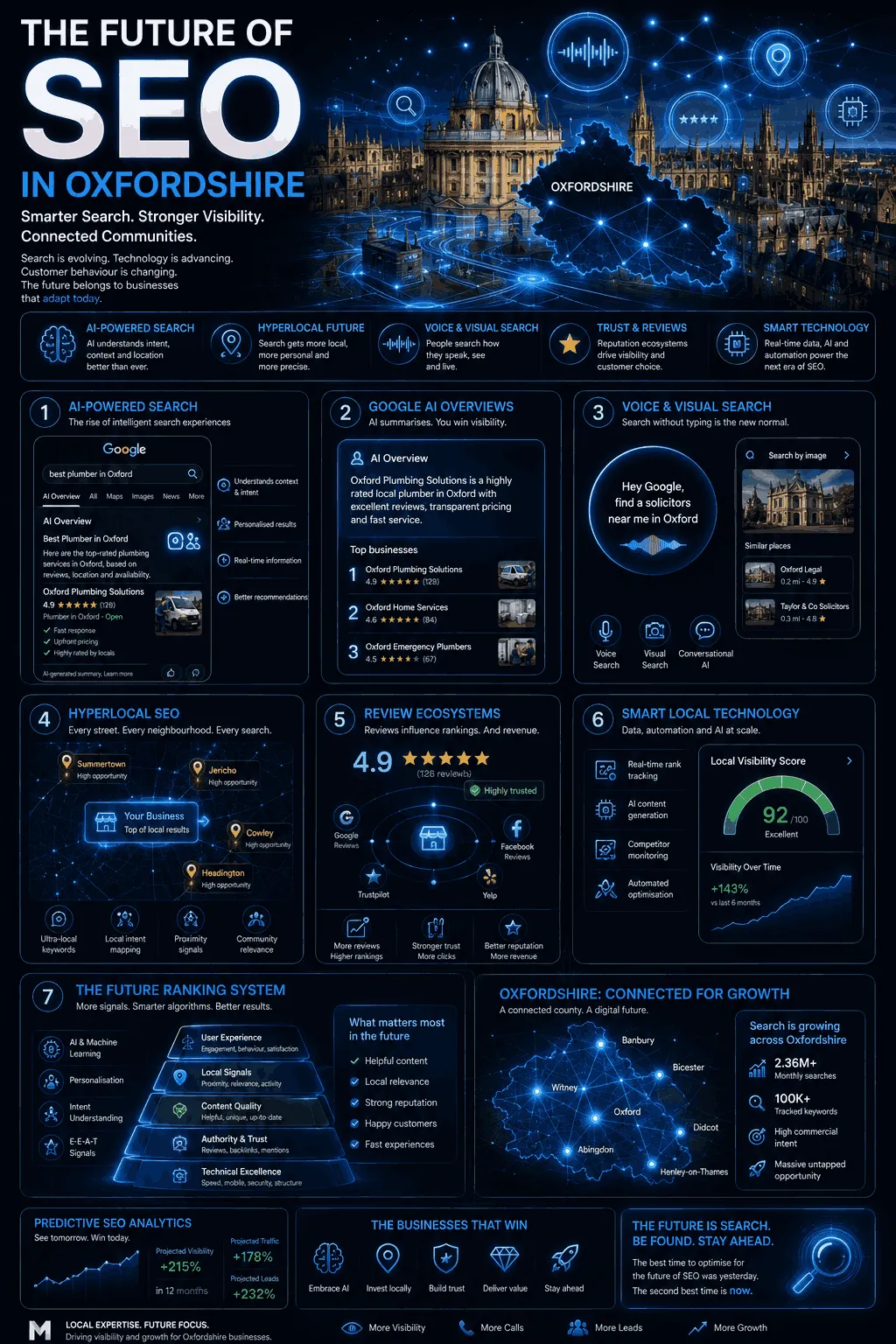
The businesses that dominate search visibility in Oxfordshire over the next few years will not necessarily be the biggest—they will be the ones that adapt fastest to how local search is changing.
AI Overviews Will Reward Genuine Local Authority
Google’s AI Overviews are increasingly pulling information from sources that demonstrate expertise, relevance and local credibility. For Oxfordshire businesses in property, professional services, hospitality and trades, generic service pages will become less effective than content tied to specific towns, customer questions and real local experience. According to Search Engine Land, businesses earning visibility in AI-driven results are typically providing deeper, more specific answers than competitors targeting broad keywords alone.
Reviews Will Become a Stronger Competitive Divider
In many Oxfordshire sectors, the local pack is still relatively attainable compared with larger UK cities. BrightLocal research consistently shows that consumers rely heavily on reviews when evaluating local businesses, and Google’s local systems continue to use prominence signals as a ranking factor. For businesses competing in Oxford, Banbury, Bicester, Witney and Didcot, review velocity and quality will increasingly separate market leaders from businesses with similar services but weaker reputation signals.
Google Business Profile Will Capture More Clicks Without a Website Visit
Zero-click search behaviour continues to increase as users find answers directly within search results. Semrush and Search Engine Journal have both reported the growing influence of SERP features that reduce the need for additional clicks. In Oxfordshire, where many searches involve immediate needs such as trades, restaurants, hotels, estate agents and healthcare providers, Google Business Profile is becoming the first point of conversion rather than simply a route to a website.
Speed Will Matter More in Search-to-Call Industries
Many of Oxfordshire’s highest-intent searches happen on mobile devices. Someone searching for a plumber in Abingdon, a hotel in Woodstock or an estate agent in Witney is often looking to make contact quickly rather than browse extensively. Google continues to prioritise page experience and usability, meaning businesses with slow mobile websites risk losing enquiries before the visitor ever reaches the contact page.
Neighbourhood and Town-Level Content Will Become the Real Battleground
The largest SEO opportunity in Oxfordshire is likely to emerge below the county level. Most businesses still optimise for Oxfordshire as a whole, while search demand remains fragmented across Oxford, Bicester, Banbury, Thame, Wantage, Wallingford, Carterton and dozens of other locations. According to Local Falcon and BrightLocal research, proximity and local relevance remain central to local rankings, making hyper-local content one of the most underutilised opportunities in the county today.
The future of SEO in Oxfordshire will belong to businesses that build authority town by town, review by review and search intent by search intent while competitors continue chasing broader visibility.
Final Thoughts
The data throughout this guide points to a simple conclusion: Oxfordshire remains one of the more accessible local SEO opportunities in the South East. Search demand is spread across tourism, hospitality, property, professional services, trades and local retail, while many businesses are still competing with incomplete Google Business Profiles, weak town-level targeting and generic county-wide content. The opportunity is not hidden. It is sitting in the gap between how people search across Oxford, Bicester, Banbury, Witney, Didcot, Abingdon and the surrounding market towns and how many businesses still market themselves online.
The challenge is that these opportunities do not stay open forever. Every review a competitor earns, every location page they publish and every local ranking they secure makes those positions harder to take back later. In Oxfordshire, where search demand is fragmented across dozens of commercially valuable towns and neighbourhoods, the businesses that move first often establish a level of local authority that compounds over time.
At this point, the roadmap is clear. You have seen where the search demand exists, which industries generate the strongest opportunities, where competitors are making mistakes and what strategies are producing results. You also know how local search is evolving, from AI-driven results and zero-click searches to increasing emphasis on reviews, Google Business Profile optimisation and hyper-local relevance. The remaining variable is execution.
For businesses willing to build visibility town by town, service by service and search intent by search intent, Oxfordshire offers opportunities that are becoming increasingly rare in larger, more saturated markets. When you’re ready to turn that opportunity into rankings, enquiries and long-term growth, the next step starts at mforseo.com.
Frequently Asked Questions About SEO in Oxfordshire
How much should an Oxfordshire business realistically budget for SEO?
The answer depends largely on the level of competition in your sector and the number of towns you want to target. A trades business focused on one or two locations such as Witney or Abingdon will require a different investment from an estate agency competing across Oxford, Bicester, Banbury and Didcot. The key is matching the budget to the commercial value of the searches you are targeting rather than choosing a figure in isolation.
Can a business based outside Oxfordshire rank for searches within the county?
Yes, but it is usually more difficult than many businesses expect. Google tends to favour companies with strong local relevance signals, particularly for service-based searches. Businesses outside Oxfordshire often need dedicated location pages, local case studies, reviews from Oxfordshire customers and clear service-area signals before they can compete effectively against businesses already established within the county.
Should seasonal businesses in Oxfordshire approach SEO differently?
They should. Oxfordshire’s tourism and hospitality sectors often experience fluctuations linked to visitor activity, local events and seasonal travel patterns. Businesses that wait until demand peaks to start SEO work are usually too late. Building visibility several months before peak periods allows pages to gain authority and rankings before search demand begins to rise.
Is it worth creating separate pages for towns that generate only a small number of searches?
In many cases, yes. Some of Oxfordshire’s smaller towns and market centres may not generate huge search volumes individually, but together they represent a significant opportunity. Businesses that build pages for locations such as Wallingford, Wantage, Thame, Woodstock and Carterton often face less competition than those targeting only Oxford, while still attracting highly relevant enquiries.
How do I know whether SEO is generating actual business rather than just website traffic?
The most useful metrics are usually enquiries, phone calls, quote requests, bookings and form submissions rather than rankings alone. In Oxfordshire, many high-intent searches come from people actively looking for local services, so increases in qualified leads are often a better indicator of success than raw traffic numbers. Tracking enquiries by location can also reveal which towns are producing the strongest return.
Does SEO work differently for B2B businesses in Oxfordshire?
The principles remain the same, but the search behaviour is often different. Oxfordshire has a strong concentration of professional services, technology companies, research organisations and specialist suppliers, particularly around Oxford, Didcot and the wider innovation corridor. B2B buyers typically conduct more research before making contact, which means authority-building content, industry expertise and trust signals often play a larger role than they do for many consumer-focused businesses.