As an electrician, you’re often fixing urgent faults in someone’s home or business while the next call is already waiting in the background — yet the people who actually need you most are usually searching for help long before they ever pick up the phone.
You might be highly skilled in wiring, panel upgrades, fault finding, safety inspections, and emergency repairs for residential and commercial work, but if your business doesn’t appear when someone searches for those services, they simply move on to the next name they see. In this space, visibility often decides who gets the job, not capability.
This guide breaks down how search behavior works for electrical services, what stops good electricians from being found online, and how to position your business so the right customers find you at the exact moment they need help — so you can scroll further with a clear view of what actually drives consistent inquiries.
Mapping Real Electrical Demand Across Search Behavior
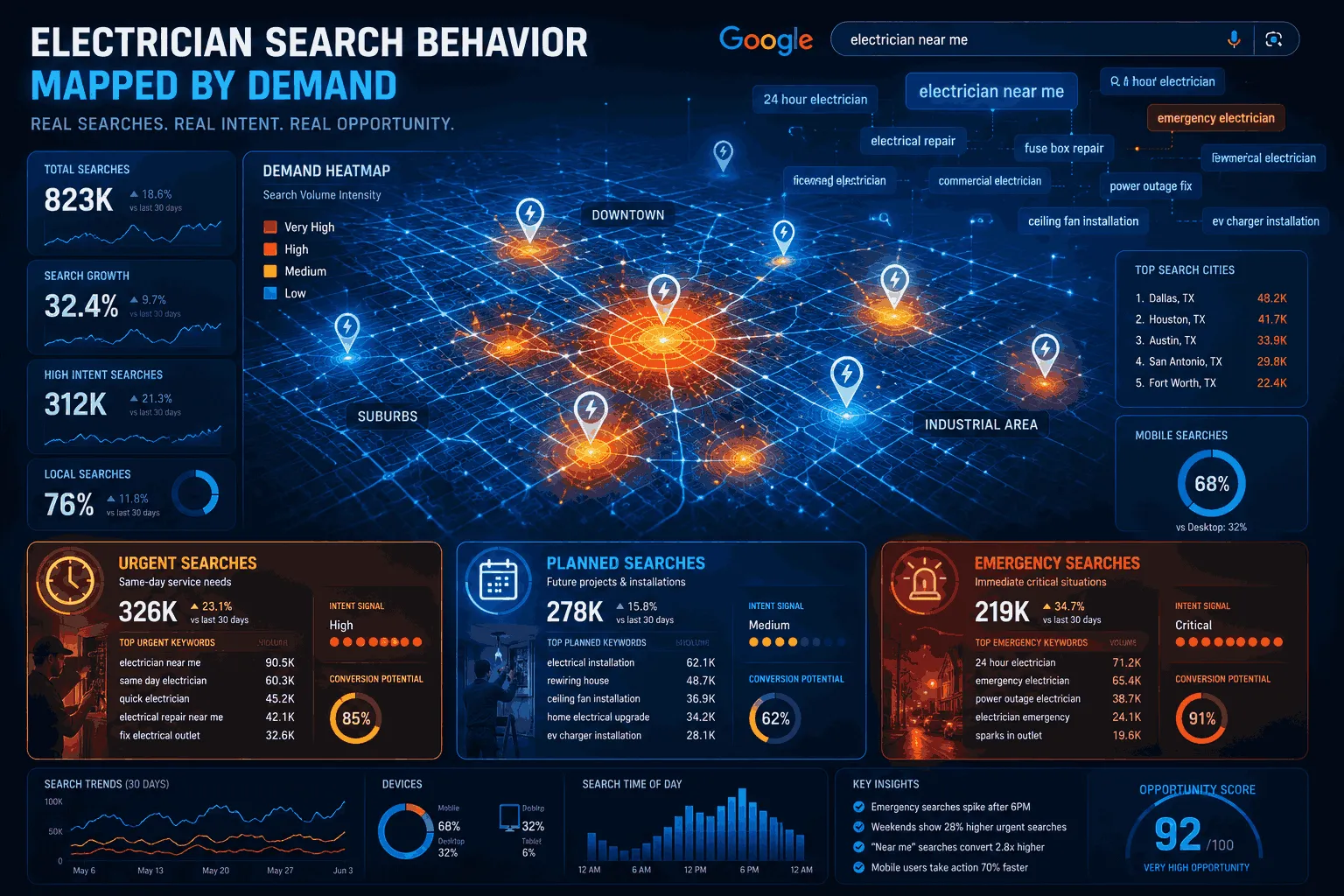
For electricians, most of the real demand isn’t visible on job sites or referrals first — it shows up in search when people are actively dealing with faults, upgrades, or safety concerns and need a solution quickly. This section breaks down what that demand looks like in practice and how much opportunity exists for electrical services in search.
Below, you’ll see a clear industry overview, how SEO data reveals actual service demand, and what the search results landscape says about your competition and positioning.
Electrician Industry Overview
The global electricians market was valued at approximately USD 1,013.49 billion in 2024, reflecting the scale of professional electrical installation, maintenance, and repair services across residential, commercial, and industrial sectors. This market includes the full scope of electrician-driven services such as wiring, power systems installation, lighting infrastructure, and safety system maintenance, all of which form the backbone of modern buildings and infrastructure.
Looking ahead, the electrical services industry is projected to continue steady expansion, with the global market expected to grow at a CAGR of around 3.7%–6.1% depending on service classification, reaching up to USD 228.76 billion by 2031 in core service segments. Growth is primarily driven by increasing electrification, smart building adoption, renewable energy integration, and ongoing infrastructure development across both developed and emerging economies.
Regionally, Asia-Pacific leads the electrician services market, accounting for the largest share of global activity at over one-third of total market value, followed by North America and Western Europe, where demand is strongly tied to modernization of aging infrastructure and rising construction activity. In the United States alone, the electrical contracting sector exceeds USD 237 billion in annual market value, highlighting the depth of domestic demand and project volume. Taken together, these figures show a large, globally distributed industry with consistent demand across residential upgrades, commercial expansion, and industrial systems. With this level of market activity, the volume of customer searches for electricians is naturally substantial, shaping a highly competitive digital landscape where visibility directly impacts job acquisition.
Measuring Electrician Demand Through SEO Data
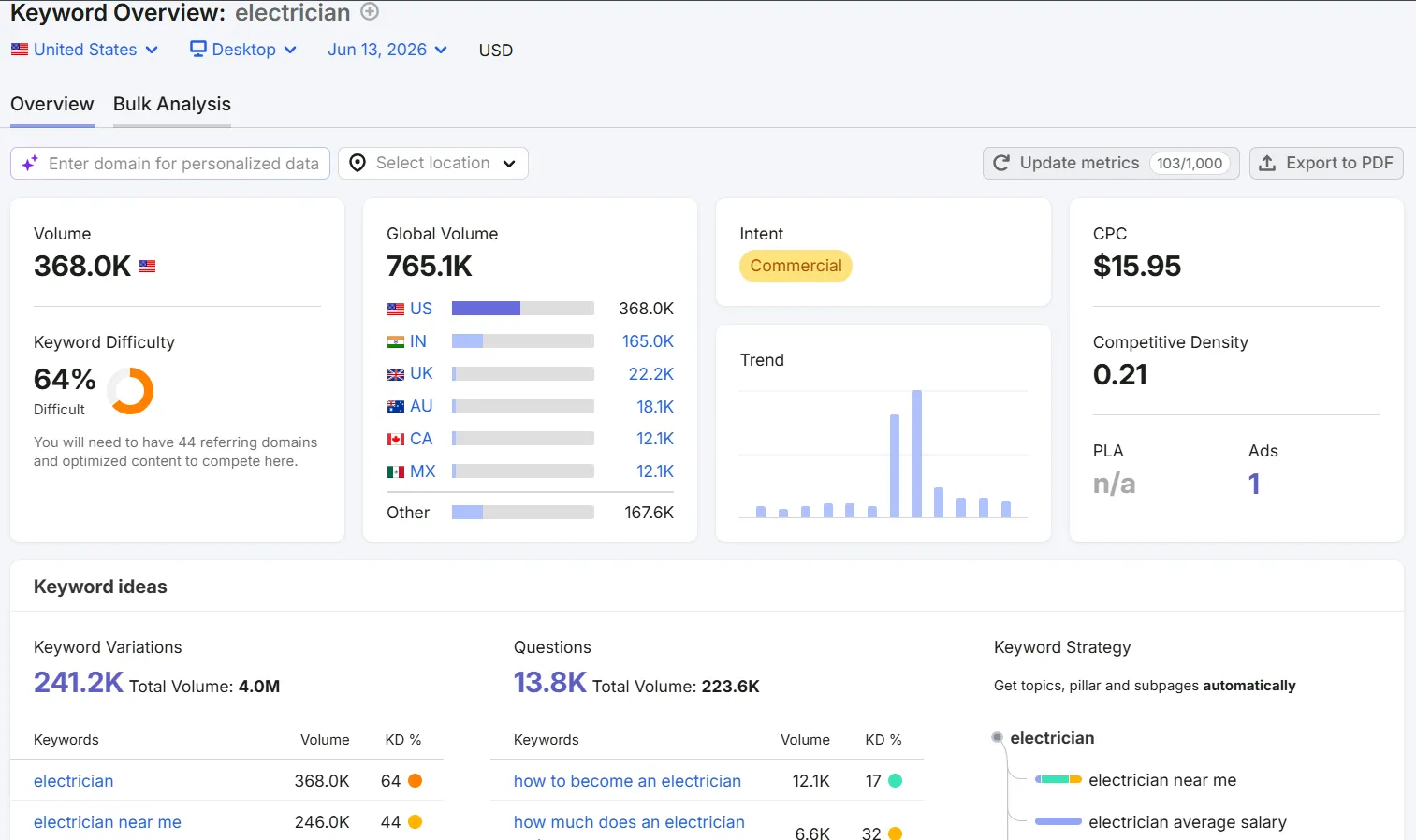
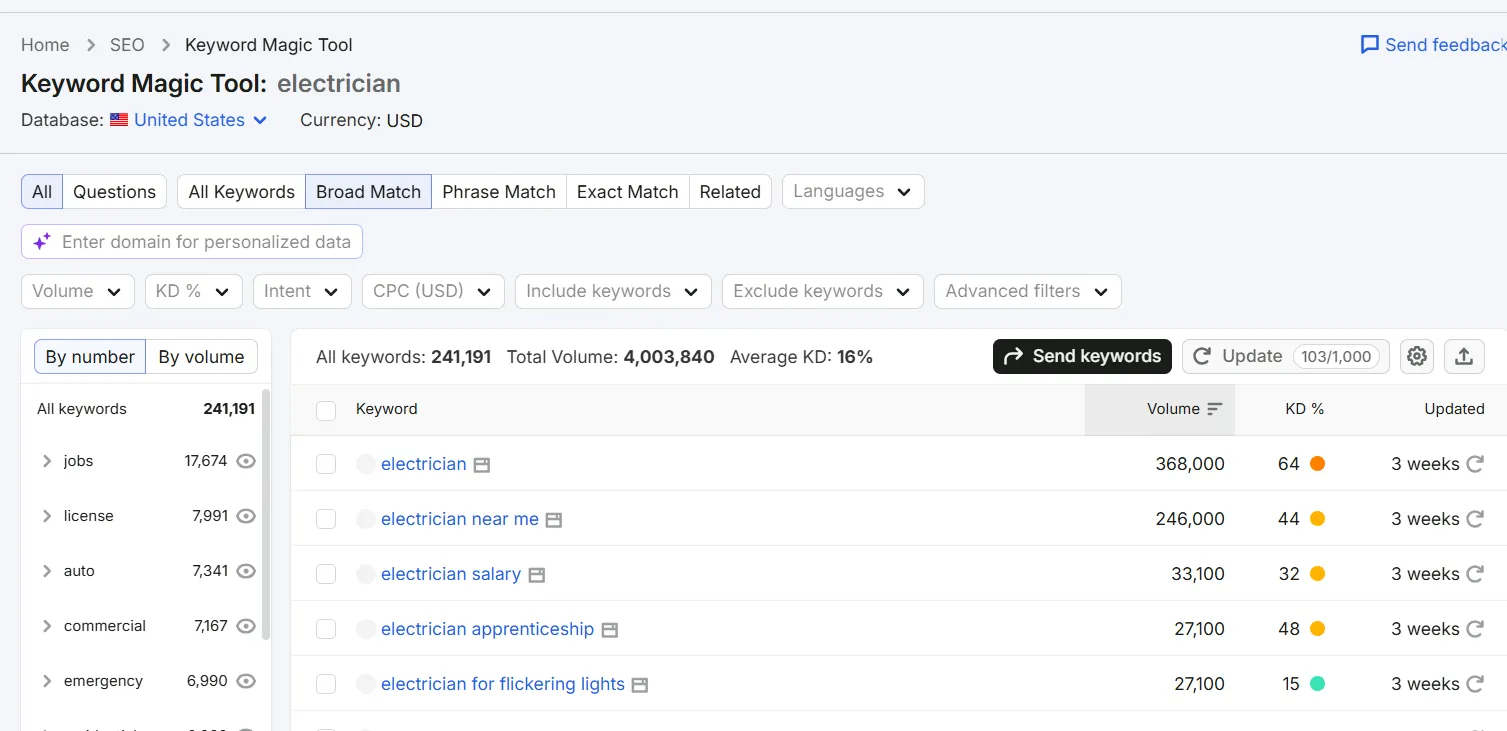
Search demand for electrician services is no longer a local signal—it behaves like a constant global utility stream, with people actively looking for help every month across multiple markets at scale. Across the dataset, electrician-related keywords generate a combined 765.1K global monthly searches, showing a sustained and predictable demand curve rather than seasonal spikes. That level of consistent intent means electrical services are not being “discovered” by customers—they are being actively sought at the exact moment of need. The market also carries a 64% keyword difficulty, which signals a highly competitive organic space where ranking requires authority, not just content volume. At the same time, advertisers are paying an average CPC of $15.95, which is unusually high for a local service category and signals strong commercial pressure behind every click. This combination creates a clear commercial reality: attention in this industry is expensive, competition is intense, and every organic position has direct revenue implications for electrician businesses competing online.
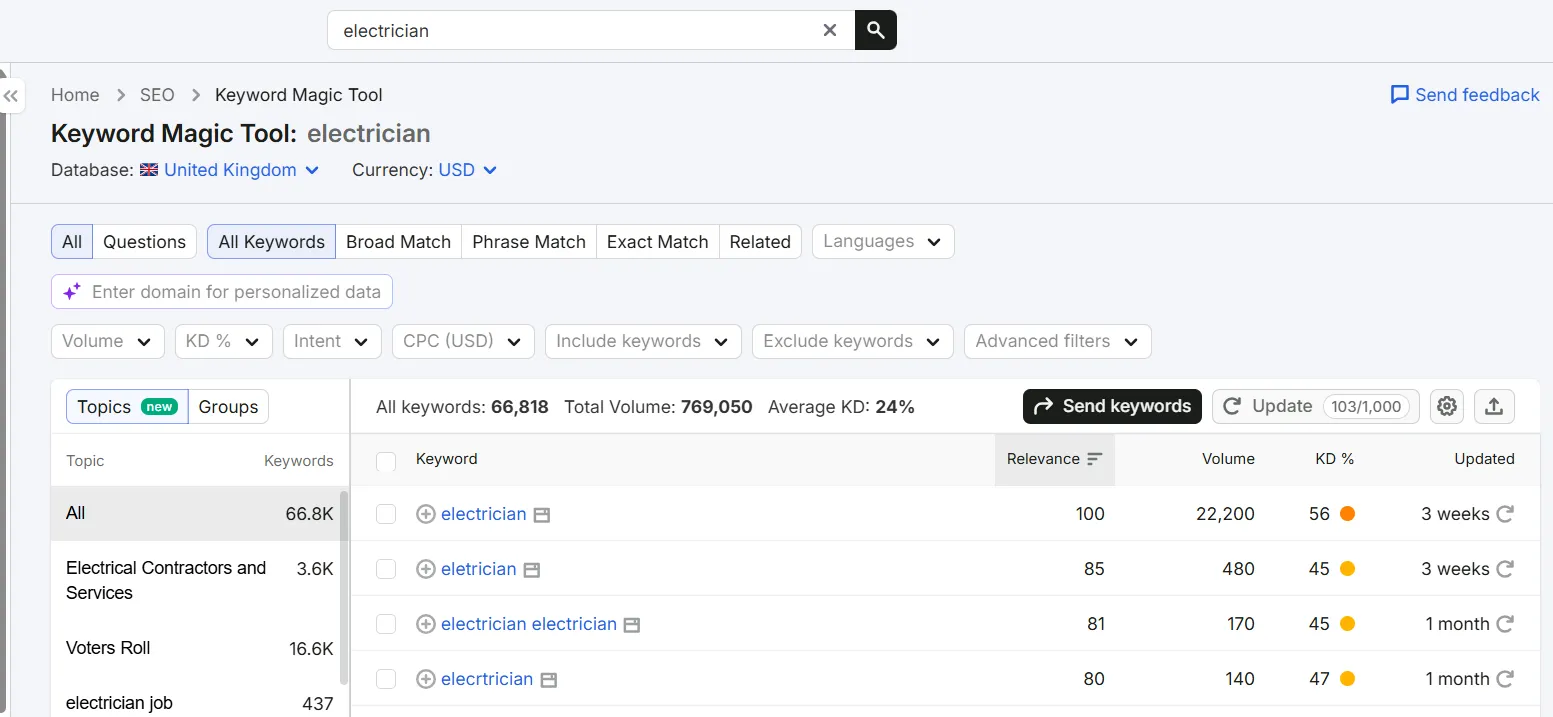
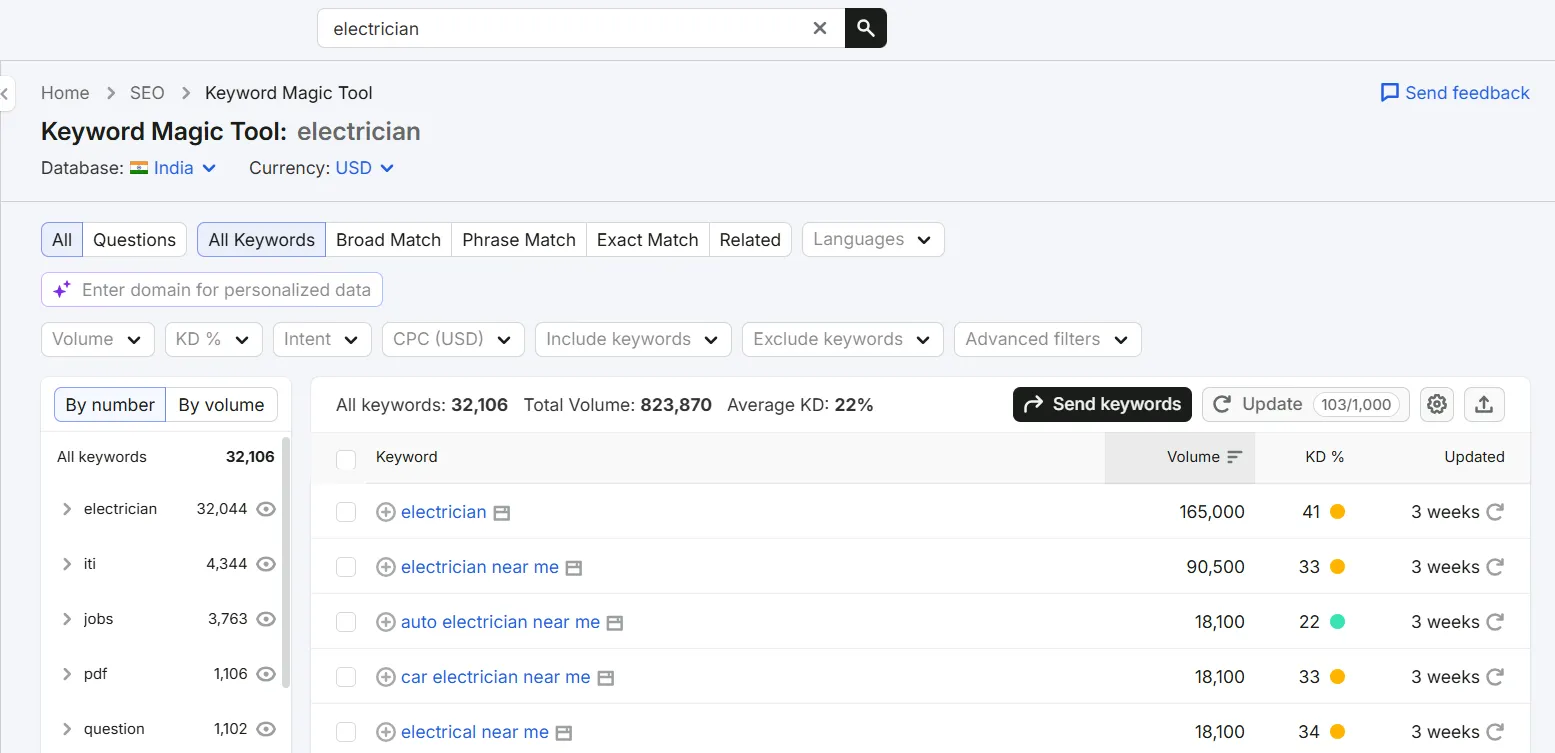
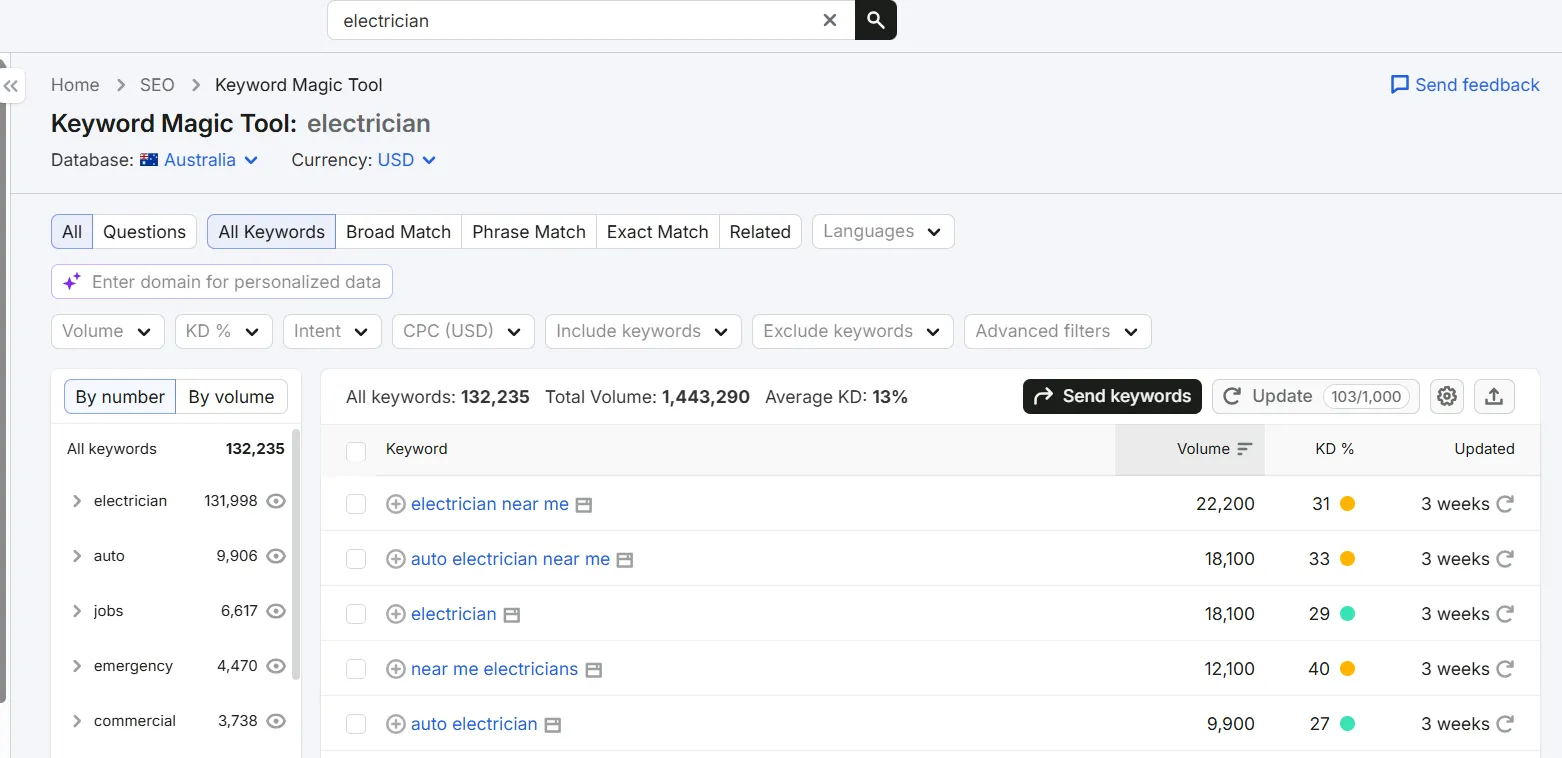
The United States represents the most commercially dense electrician search ecosystem, where 241,191 keywords generate a massive 4,003,840 monthly search volume with a relatively accessible 16% average keyword difficulty, meaning visibility is achievable for businesses that build structured SEO systems. In contrast, the United Kingdom shows a smaller but more competitive environment with 66,818 keywords and 769,050 searches, paired with a higher 24% difficulty, indicating tighter ranking conditions despite lower scale. The picture in India shifts again, where 32,106 keywords produce 823,870 searches, revealing high search concentration per keyword alongside a 22% difficulty level, suggesting strong demand but uneven competition. Australia, however, offers a different balance entirely, where 132,235 keywords and 1,443,290 searches combine with the lowest 13% difficulty, making it the most accessible organic entry point among the four while still maintaining meaningful demand density.
The most important pattern across all regions is not just demand size, but how unevenly that demand translates into competition pressure. Markets like Australia show that high-volume opportunity can still exist in relatively low-difficulty environments, while regions like the US demonstrate that scale comes with structural competition that requires long-term authority building. India shows high intent density despite smaller keyword pools, which often creates faster conversion cycles when visibility is achieved. The UK sits closer to a maturity stage where demand is stable but harder to penetrate. What this structure reveals is simple: electrician SEO is not a single-market game—it is a segmented opportunity landscape where strategy changes dramatically by geography. Businesses that understand these gradients early can position themselves in markets where ranking effort and customer value are better aligned, while those who delay often enter when difficulty has already compounded and acquisition costs have risen.
Every search for an electrician reflects urgency, not curiosity—someone is dealing with a broken circuit, a safety concern, or a project that cannot wait. These are not passive impressions; they are high-intent commercial moments where the first visible business often becomes the chosen one. In this environment, visibility is not a branding exercise—it is a direct pipeline to booked work. The businesses that appear consistently are not necessarily the most skilled, but the most discoverable at the exact moment demand appears. What follows next is a breakdown of how that visibility is actually won in this space, and why some electrician businesses dominate local search while others remain invisible despite offering the same services.
Analyzing Market Opportunities Through the Search Results Landscape for Electrician Industry
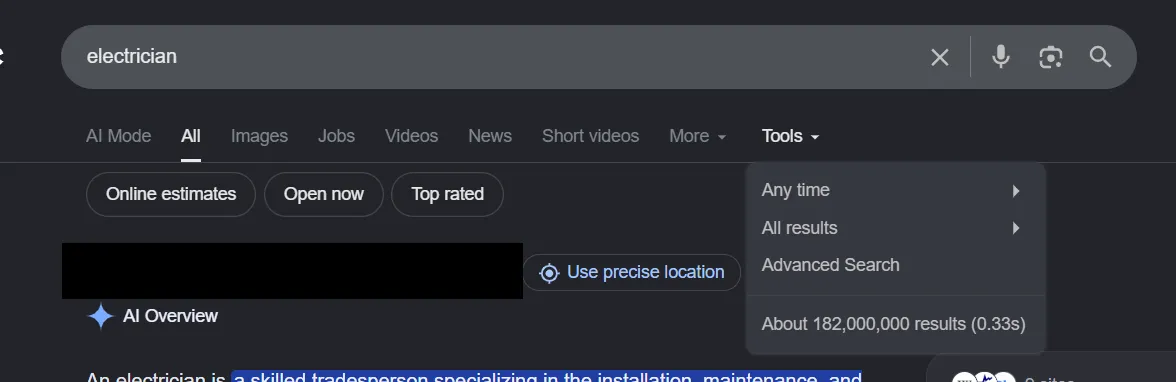
The search results for the keyword “electrician” show an extremely large index of about 182,000,000 results, which immediately signals how crowded and established this space is. What stands out is not just the scale but the fact that Google is pulling from a wide mix of pages and established service providers, meaning the algorithm already has plenty of trusted sources to choose from when showing results. For an electrician business, this creates a clear reality where new or unoptimized websites struggle to appear because the system is saturated with authority pages that already match user intent. This is where SEO becomes critical, because ranking is no longer about being present online but about building enough relevance, structure, and trust signals for Google to select your business from this massive pool. The opportunity exists in improving visibility against this large result base by aligning content and authority in a way that matches how Google filters and ranks service providers.
A Different Kind of SEO Partner for Electricians
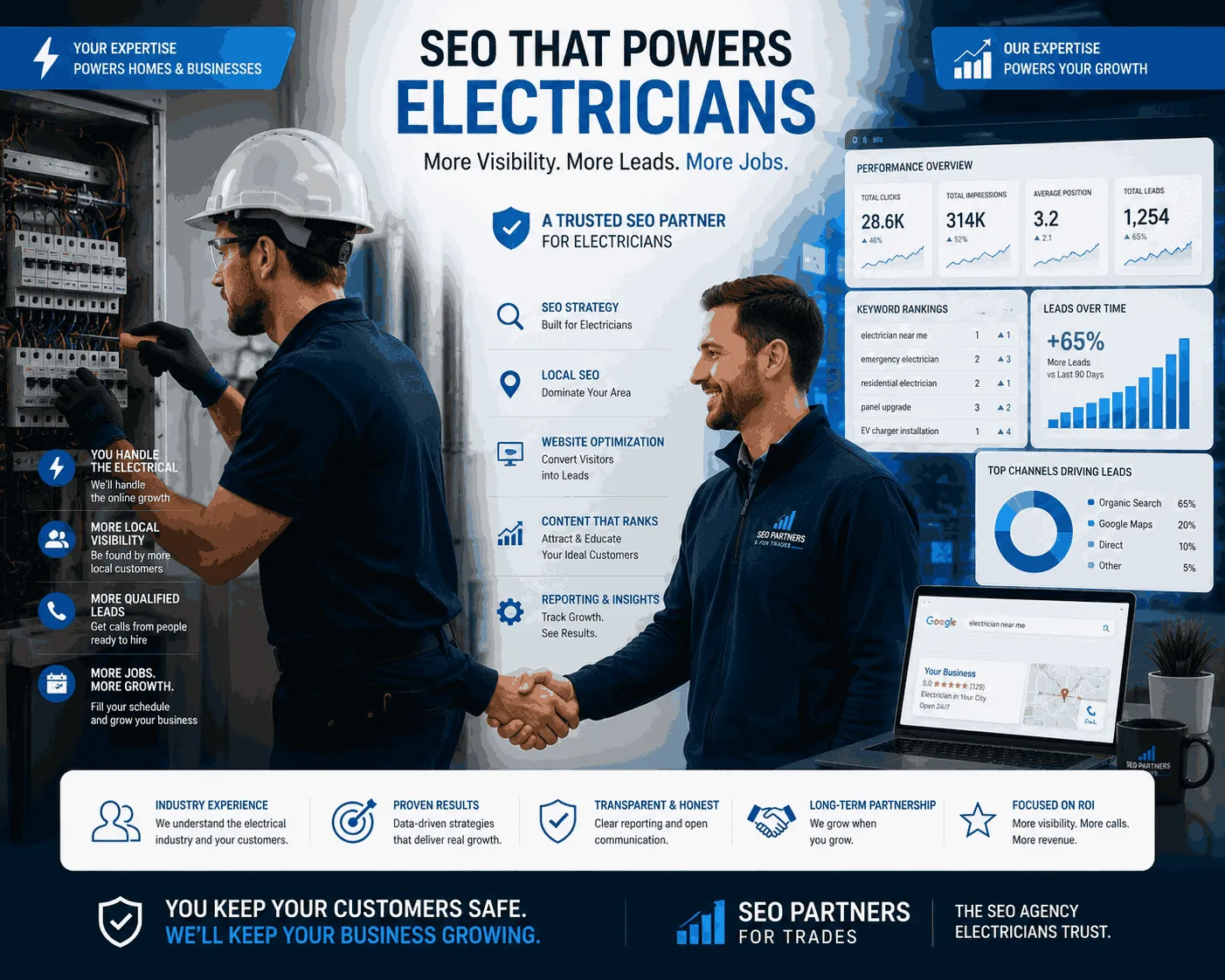
SEO for electricians is not just about ranking a website, it is about making sure a local electrical business is visible at the exact moment someone has a real problem that needs urgent fixing. M For SEO is a strategy-led team built by SEO professionals who spent years inside structured agency environments before choosing independence so they could focus on better thinking, better execution, and better outcomes. In the context of an electrician business, this matters because most customers are not browsing casually, they are searching with urgency, comparing trust, location, and availability within seconds. M For SEO positions itself around that reality by treating electrician SEO as a precision system, not a content checklist, where every decision is shaped by how real customers actually search and choose service providers in this space.
The way M For SEO works is built on clarity before action, especially in competitive local markets like electrician services where mistakes in targeting can waste entire months of visibility. Instead of pushing content or links blindly, they start with a structured SEO roadmap that maps how electrical customers search, what service pages matter most, and where competitors are already dominating. For an electrician business, this means no random blog posts or disconnected pages, but a structured system where every page has a purpose tied to real search demand. Decisions are backed by data from actual search behaviour, and timelines are communicated honestly so an electrician knows what is realistic in their market instead of being sold inflated expectations that do not match how SEO actually performs.
Electrician businesses operate in a highly intent-driven environment where customers rarely research for long; they search, compare a few options, and call the one that appears most trustworthy and visible. Most electrical leads come from urgent searches like repairs, installations, or emergency faults, which means visibility on the right queries directly impacts daily revenue. M For SEO understands that electrician SEO is not about traffic volume alone, but about capturing high-intent local searches where one conversion can equal significant job value. Every optimisation decision is built around making sure an electrician business shows up in those decisive moments when the customer is ready to hire, not just browse.
Strong SEO for electricians is not about being everywhere, it is about being present at the exact moment someone needs electrical work done and is ready to make a decision.
How We Build SEO Systems for Electricians That Generate Leads
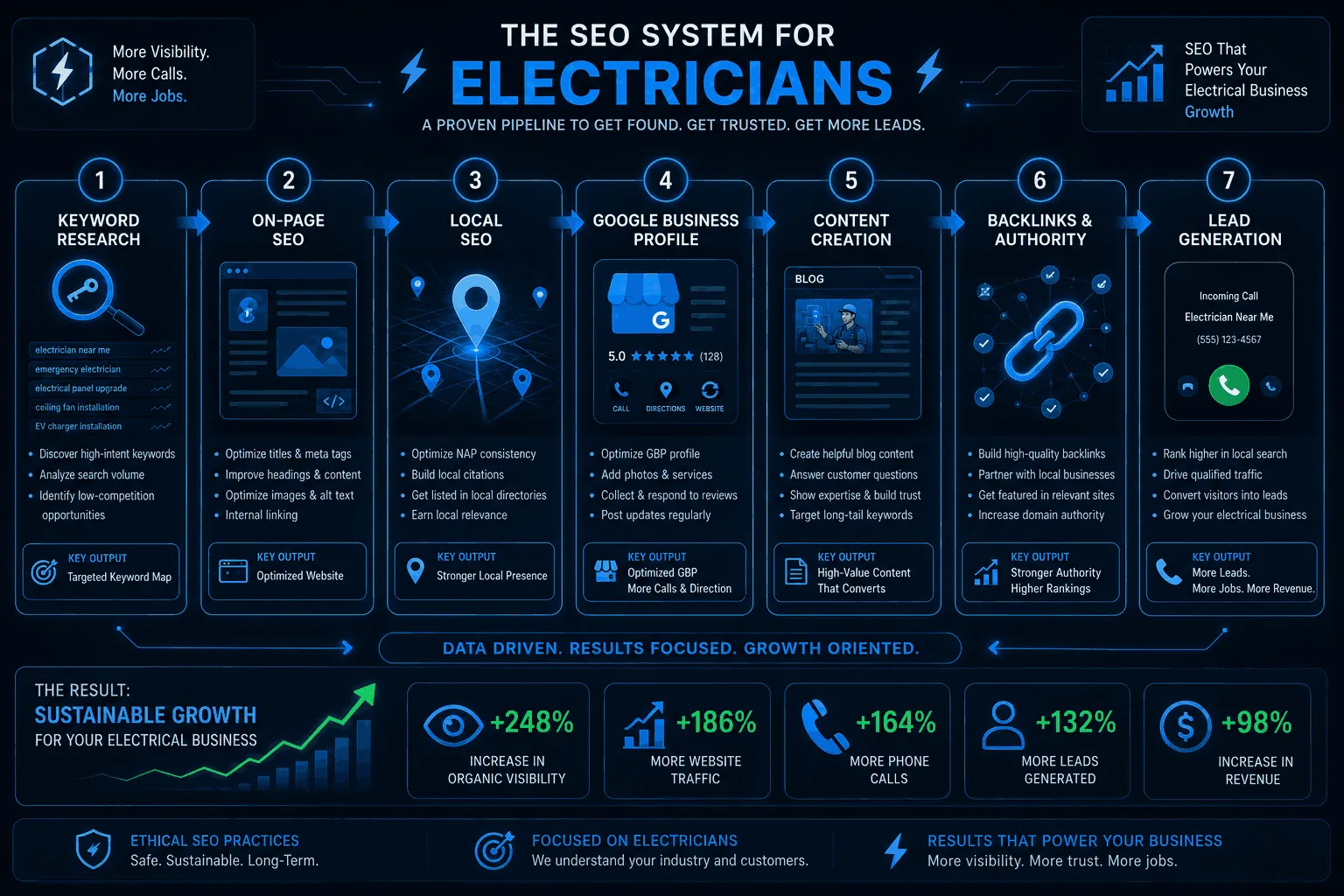
Electrician SEO is not about random optimisation or publishing content and hoping it ranks. It is a structured system built around how customers actually search for electrical services — urgent, location-based, and trust-driven. Our approach covers every layer of SEO from technical performance to local visibility, ensuring electrician businesses appear exactly when people are ready to hire. Each strategy below is part of a connected system designed specifically for how electrical customers search, compare, and choose service providers.
Keyword Research for Electrician Services
We map how customers search for electricians in real situations like emergency repairs, wiring issues, installations, and inspections. We separate high-intent searches from low-value traffic so electrician businesses focus only on queries that bring calls.
Unlike generic keyword lists, we group terms based on real job types and service urgency. This ensures visibility on searches that actually lead to booked electrical work, not just website visits.
On-Page SEO for Service Pages
We structure electrician service pages around specific offerings like residential wiring, commercial work, and emergency callouts. Each page is optimized with clear intent signals so Google understands exactly what service is being offered.
We avoid generic content and instead align each page with how real customers describe their electrical problems. This helps electrician businesses rank for service-specific searches that convert into leads.
Technical SEO Optimization
We improve site speed, mobile performance, and crawlability so electrician websites load fast and function smoothly. We fix indexing issues that often prevent service pages from appearing in local search results.
For electricians, technical SEO ensures that urgent customers don’t leave due to slow or broken pages. This creates a stable foundation for all other SEO work to perform properly.
Local SEO and City Targeting
We optimise electrician websites for location-based searches like “electrician near me” and specific city queries. We build structured location pages that match how customers actually search in different service areas.
Unlike broad agencies, we focus on service radius targeting so electricians capture nearby high-intent traffic. This directly increases local calls and emergency job requests.
Google Business Profile Optimization
We optimise Google Business Profiles with correct categories, services, and location signals for electricians. We ensure reviews, service updates, and photos support trust and visibility in map results.
We structure profiles to match real electrical services instead of generic business descriptions. This improves visibility for map-based searches where most urgent calls originate.
Competitor Analysis in Electrical Markets
We study top-ranking electrician businesses to understand what is driving their visibility.We identify gaps in their service coverage, content depth, and local targeting.
Instead of copying competitors, we build strategies that allow electricians to outperform them.This creates clear ranking opportunities even in competitive local markets.
Content Strategy for Electrical Services
We create content around real customer problems like power failures, rewiring, safety checks, and installations.Each content piece is designed to capture search intent at different stages of decision-making.
We avoid generic blog content and focus only on topics that connect to actual electrical demand.This builds authority and increases organic visibility across multiple service areas.
Link Building for Local Authority
We build relevant local and industry-specific backlinks that strengthen electrician website authority.We focus on quality sources that reinforce trust rather than bulk or irrelevant links.
For electricians, this improves rankings in competitive city-level search results.Stronger authority leads to more consistent lead generation over time.
SEO Reporting and Performance Tracking
We track keyword rankings, call conversions, and local visibility changes for electrician businesses. Reports are kept simple so business owners understand what is working and what needs improvement.
We adjust strategy based on real performance data, not assumptions.This ensures continuous growth instead of static results.
Why Local SEO Is Important for Electrician Businesses
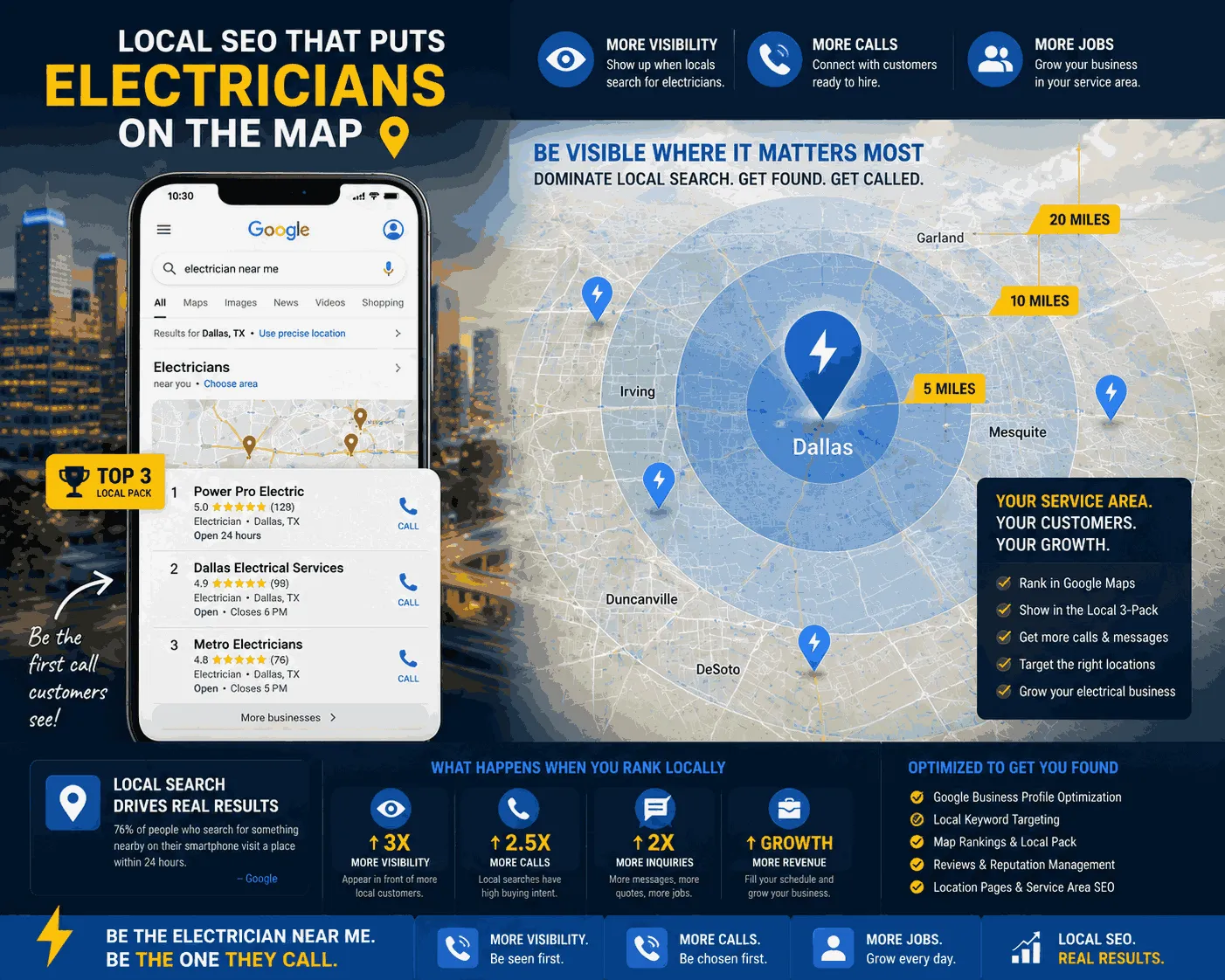
Local SEO is what determines whether an electrician business shows up when someone nearby searches for urgent help or planned electrical work. In this industry, customers rarely search broadly — they use terms like electrician near me, emergency electrician, or specific city-based searches when they already need a solution. If a business is not visible in Google Business Profile results or the map pack, it is effectively invisible at the exact moment the customer is ready to call. That is why local SEO is not an optional channel for electricians, it is the primary source of high-intent leads.
For electrician businesses, Google Business Profile is often the first point of contact, not the website. The map pack controls most of the clicks, especially on mobile searches where users want immediate action. This agency treats Google Business Profile as a core ranking asset rather than a listing, optimizing service categories, service descriptions, location signals, and review velocity in a structured way. Citations across trusted local directories are also built consistently, ensuring the business appears credible and established in the eyes of search engines. This is paired with location-specific service pages that match how customers search in different neighborhoods or service zones.
Local keywords are not treated as generic terms but as intent signals tied to real job types, such as wiring repairs, breaker issues, installation work, or emergency faults. The agency builds service area targeting around these real-world queries instead of broad keyword stuffing. Reviews are also treated as ranking signals and trust signals at the same time, with systems designed to encourage consistent, authentic customer feedback that improves both visibility and conversion rates. All of these signals work together to build local authority, which directly influences how often an electrician appears in competitive map rankings.
When local SEO is done properly, electrician businesses stop relying on unpredictable referrals or paid ads and instead build a consistent flow of inbound calls from nearby customers who are actively searching. But when it is ignored, the business slowly disappears from the most important part of search — the local results where urgent decisions are made. Over time, competitors who invest in local SEO take permanent visibility, and the cost of regaining that position becomes significantly higher than building it early.
SEO Mistakes Electrician Businesses Are Making That Are Costing Them Leads
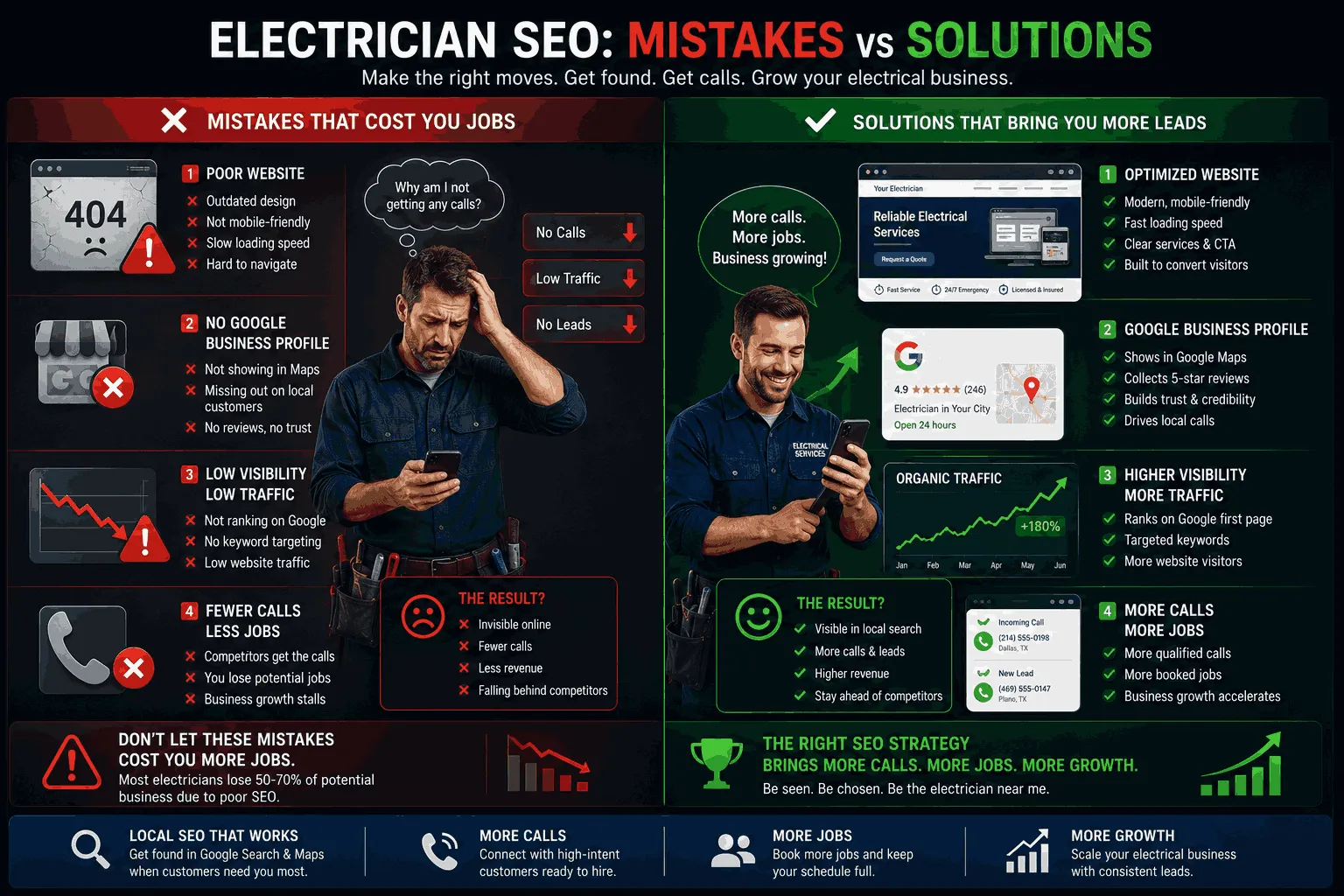
Electrician SEO problems are rarely caused by a lack of effort — they usually come from patterns that look normal on the surface but quietly block visibility in local search. After auditing multiple electrician websites, the same issues keep appearing across different cities and service areas. These mistakes don’t just affect rankings, they directly reduce calls, emergency enquiries, and daily job flow without the business even noticing.
No Dedicated Pages for Each Electrical Service
Many electrician websites list all services on one page instead of separating them into focused pages like wiring, panel upgrades, or emergency repairs. This happens because businesses assume one “services” page is enough to cover everything.
The result is that Google struggles to understand relevance for specific searches, so competitors with structured service pages rank higher and take high-intent leads.
Proper structure means each service has its own targeted page aligned with real search behaviour.
Ignoring Emergency Electrical Searches
Electricians often fail to optimise for urgent searches like “emergency electrician near me” or “power outage repair.” These searches are some of the highest-converting in the industry.
Because they are not properly targeted, businesses lose immediate-call opportunities to competitors who appear first in urgent moments. Capturing these searches requires dedicated intent-focused pages and strong local signals.
Weak Google Business Profile Setup
Many electrician profiles are incomplete, with missing services, weak descriptions, or no structured updates. This usually happens because it is treated as a one-time setup instead of an active ranking asset. The impact is immediate — reduced visibility in map results, fewer calls, and competitors dominating the local pack. A properly structured profile with service alignment and regular updates performs significantly better.
No Location-Based SEO Structure
Electrician websites often target a single city page or ignore service areas completely. This creates a gap in visibility across nearby regions. As a result, businesses lose leads from surrounding areas where demand exists but no dedicated page is ranking. Structured location pages aligned with service zones solve this gap.
Overusing Generic Electrical Content
Some electrician sites publish broad blog content that doesn’t match how customers actually search for help. This usually comes from using generic SEO templates. The consequence is low engagement and weak rankings for real service-based keywords. Content needs to reflect real electrical problems and service intent.
No Focus on Local Trust Signals
Electricians often neglect reviews, citations, and consistent business information across directories. This is usually overlooked because it doesn’t feel like “SEO work.” The result is weaker local authority, which directly impacts map pack rankings and customer trust. Strong local signals help Google and customers validate the business quickly.
Slow or Poor Mobile Website Experience
Many electrician websites are not optimised for mobile users, even though most searches happen on phones during urgent situations. This leads to high bounce rates and lost calls when users leave before the page even loads fully. Fast, mobile-first design is essential for capturing emergency traffic.
No Tracking of Actual Leads From SEO
Electrician businesses often track rankings but not actual calls or enquiries from search traffic. This creates a false sense of progress. Without tracking, money and effort get spent on pages that don’t generate real jobs. Proper SEO connects search performance directly to lead outcomes.
Why Blogging Is Important for Electrician Businesses
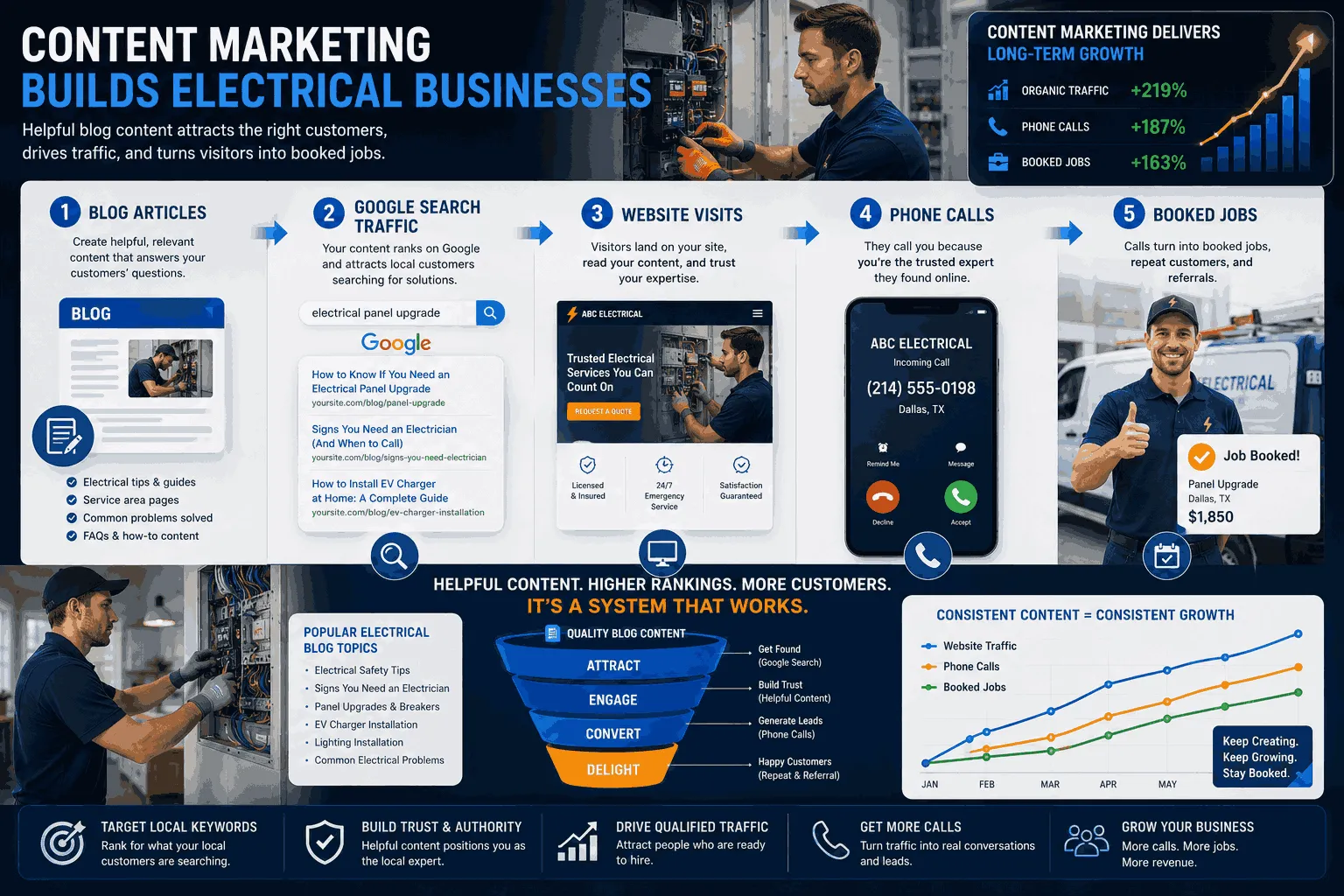
Customers looking for electrician services rarely make a quick decision. They are usually dealing with safety risks, cost uncertainty, certification concerns, and trust issues before they ever pick up the phone. They want to know who is qualified, what the job should cost, how long it will take, and whether the electrician can be trusted to work in their home or business without mistakes. Blogging becomes the bridge between that uncertainty and a booked job. It allows an electrician business to answer real-world questions before the customer even starts comparing providers, positioning the company as a credible, knowledgeable option at the exact moment trust is being formed.
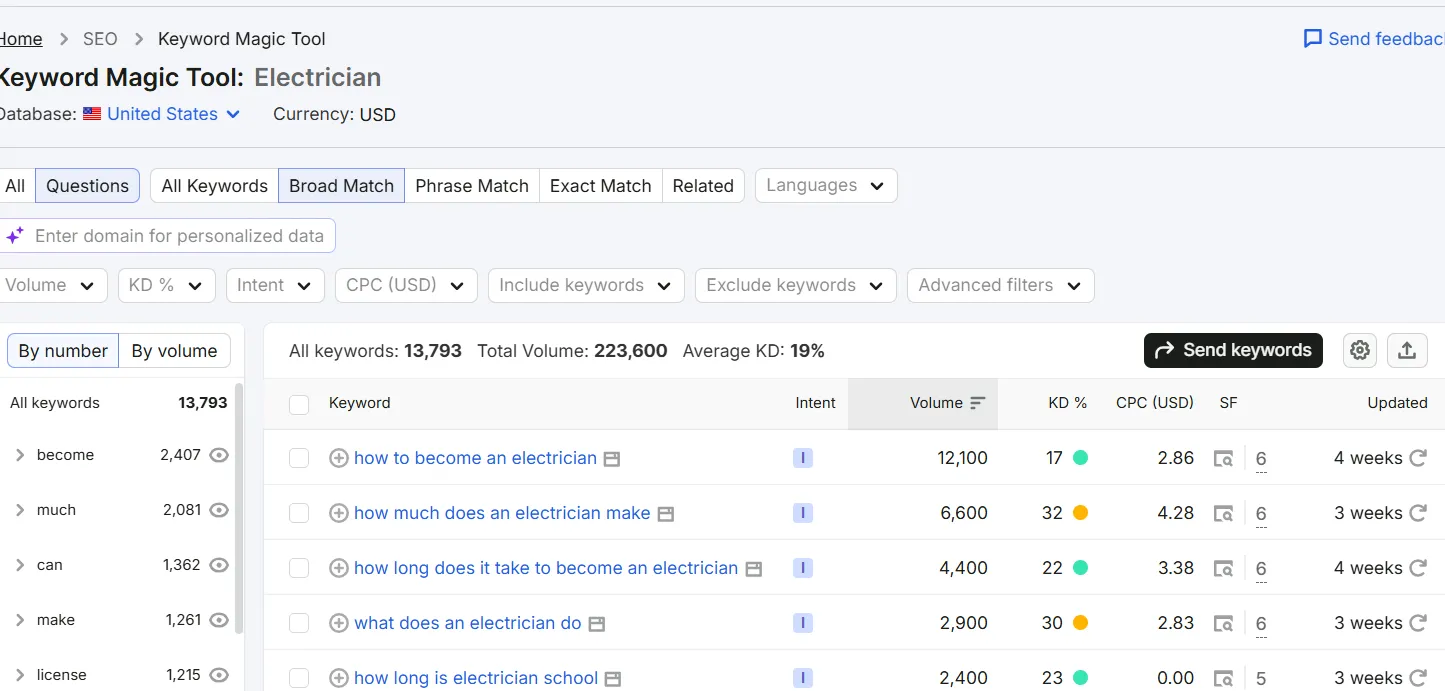
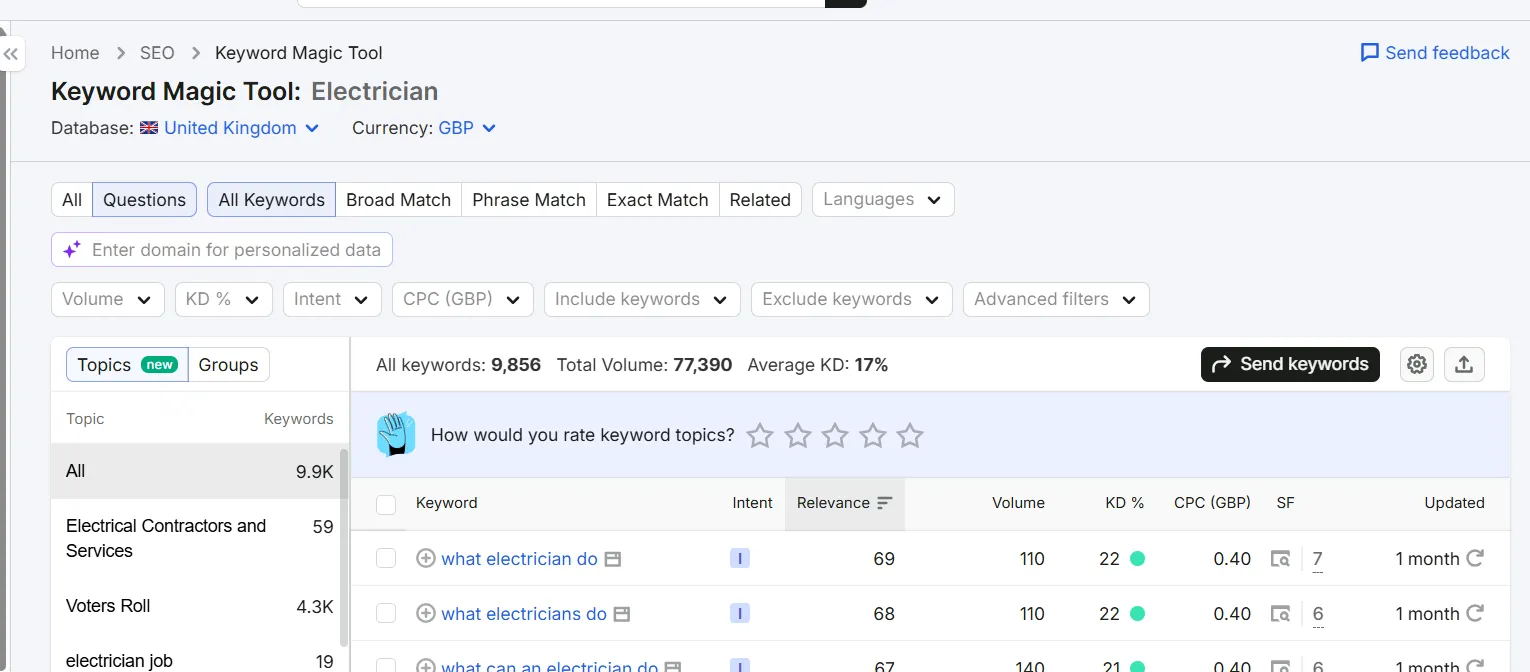
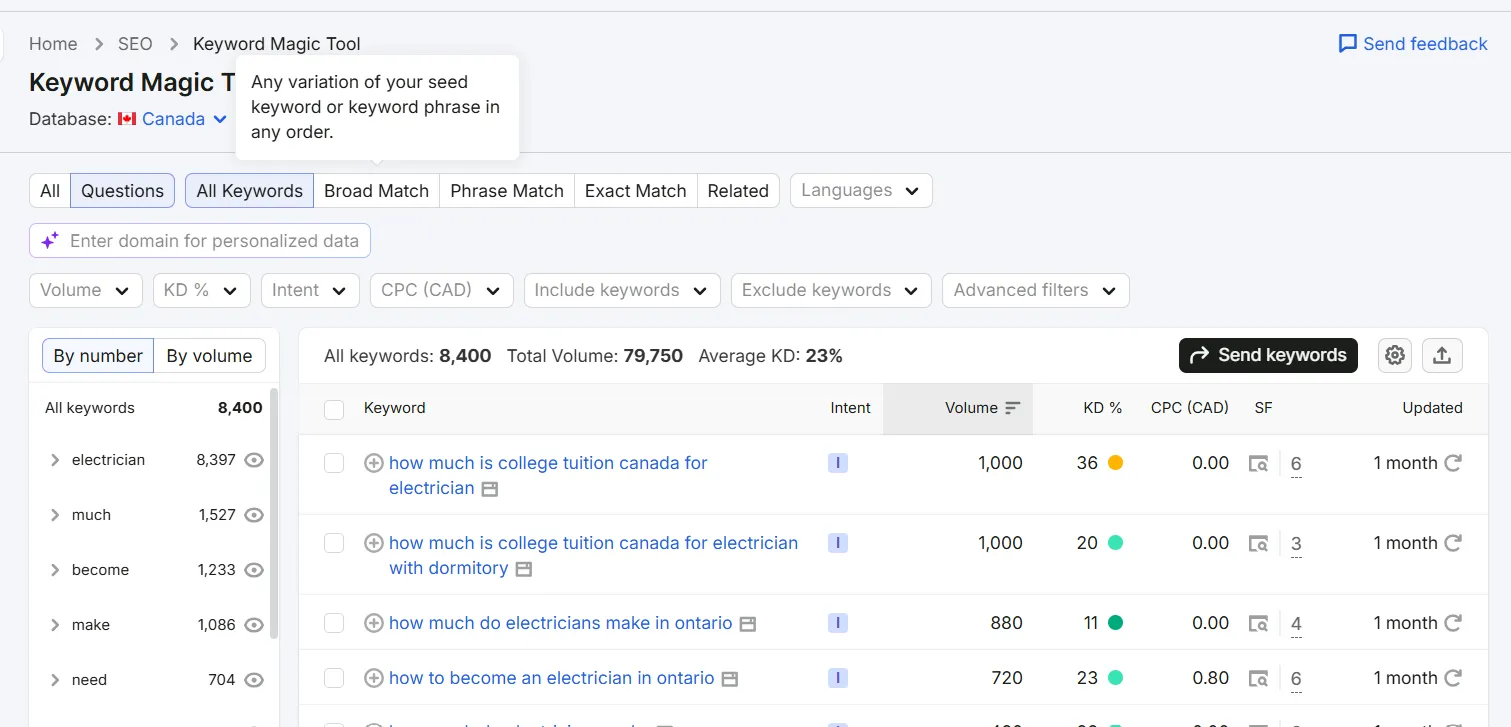
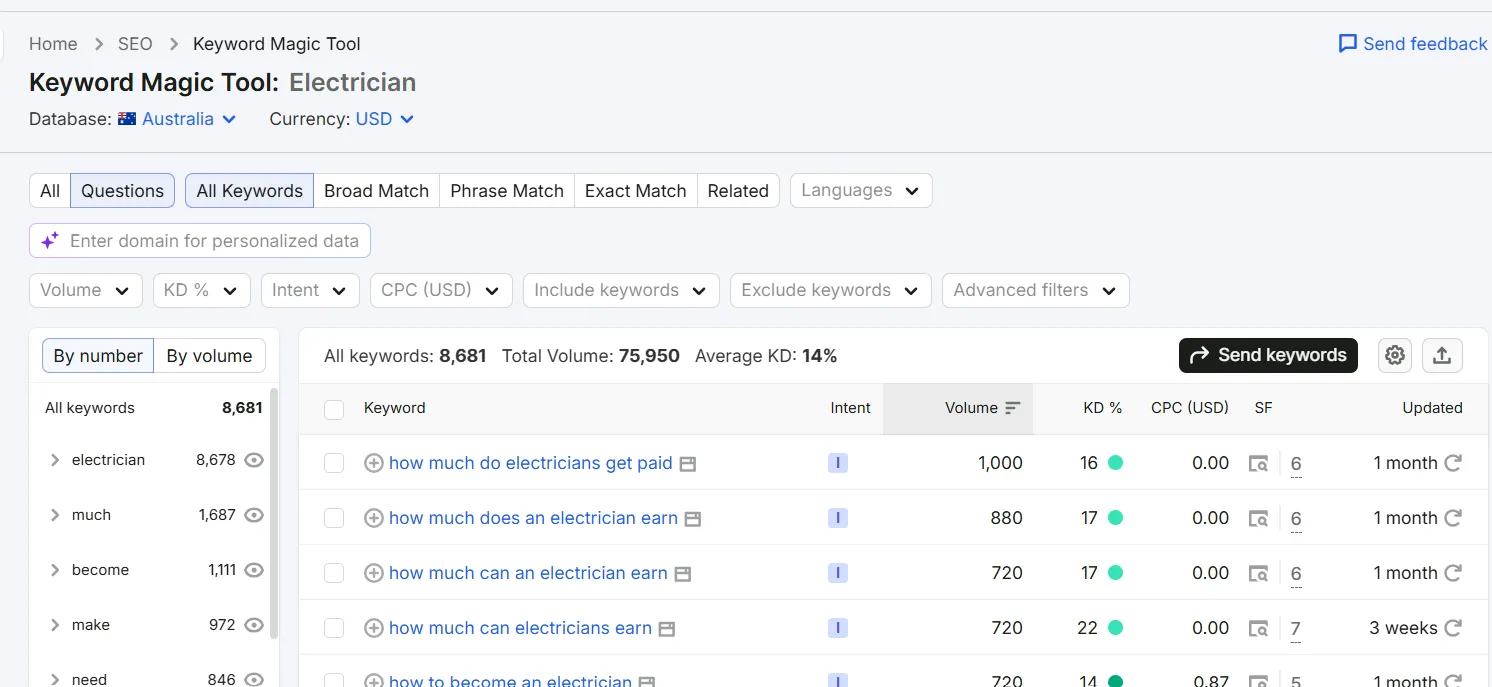
Across the United States market, there are 13,793 tracked keyword variations generating a total monthly search demand of 223,600, showing a large volume of people actively researching electrician-related questions before hiring. In the United Kingdom, 9,856 keywords produce 77,390 monthly searches, reflecting steady intent-driven research around services, roles, and qualifications. Australia contributes 8,681 keywords with 75,950 monthly searches, while Canada shows 8,400 keywords generating 79,750 monthly searches, with strong demand also concentrated around training, earnings, and regional electrician queries. Combined across all four markets, this creates 40,730 keyword opportunities driving 456,690 monthly searches. What this means in practical terms is that nearly half a million monthly searches represent people actively trying to understand electrician services, pricing, and career pathways. Without targeted blog content, a significant share of this demand is absorbed by competitors who consistently answer these questions first, long before a customer is ready to request a quote.
When viewed together, this level of search demand highlights a clear commercial reality: the opportunity is not just visibility, but consistent lead capture at the research stage across multiple high-intent markets. Blogging allows an electrician business to systematically occupy that research space, build authority over time, and generate inbound enquiries without relying entirely on paid ads or directory listings. Over time, this compounds into a stable acquisition channel where every published article continues to attract and convert search traffic. Twelve months of consistent, targeted blogging builds an owned demand engine that paid campaigns cannot sustain without ongoing spend.
Conclusion
The search landscape for electrician services shows a clear, high-intent opportunity that is already being actively demanded by users across major markets, with over 40,730 keyword variations generating more than 456,690 monthly searches across the United States, United Kingdom, Australia, and Canada. This is not passive traffic but real people searching for urgent electrical help, pricing clarity, qualifications, and trust signals before hiring, which means visibility at the research stage directly influences which electrician gets the call. At the same time, the data also reveals a gap where thousands of these searches remain underutilized by businesses that are not consistently publishing targeted content. For an electrician business, this creates a direct opportunity to capture demand before competitors dominate those decision-making moments, while the cost of inaction is simply losing those high-intent customers to businesses that already show up when people search, and M For SEO helps bridge that gap by turning this demand into structured, long-term lead generation through focused content strategies built specifically for electrician businesses, with mforseo as the natural next step.
Frequently Asked Questions (FAQs):
How long does it take for an electrician website to start ranking on Google in the UK?
Typically, noticeable movement starts within 8 to 12 weeks, but stronger and stable rankings usually take 4 to 6 months. It depends on how competitive your local area is and how consistent your content and SEO work is. New websites take longer, while established domains with some authority move faster. Consistency matters more than short bursts of activity.
Do electrician businesses need ongoing SEO, or is it a one-time setup?
SEO is not a one-time task because search rankings constantly change based on competition and Google updates. Initial optimisation helps you become visible, but ongoing work is needed to maintain and improve positions. Without continuous SEO, competitors will gradually overtake you. Think of it as a long-term lead generation system, not a fixed setup.
Can I get leads without ranking #1 on Google?
Yes, electrician businesses can still generate leads from positions below #1 if the content matches strong buying intent. Local packs, featured snippets, and long-tail keywords often drive calls even without top rankings. The goal is not just ranking but visibility across multiple search touchpoints. Strong SEO spreads your presence across several high-intent queries.
Is it better to do SEO in-house or hire an agency for an electrician business?
In-house SEO can work if someone has strong technical and content experience, but most electrician businesses lack the time and expertise to manage it properly. An agency brings structured strategy, tools, and consistency that speeds up results. The key difference is execution speed and quality control. Businesses usually scale faster with professional support.
What kind of ROI can an electrician expect from SEO?
ROI varies, but electrician services often see strong returns because even a few extra jobs per month can cover SEO costs. Unlike ads, SEO keeps generating leads even after content is published. The value compounds over time as rankings improve and traffic grows. It becomes more cost-efficient the longer it runs.
How many blog posts or pages does an electrician website need to compete?
There is no fixed number, but competitive electrician websites usually need a structured cluster of service pages and ongoing blog content. The focus should be on covering real customer questions rather than hitting a specific count. More important is relevance, search intent alignment, and consistency. A smaller but well-optimised site can outperform a larger but unfocused one.