The home services and improvement industry isn’t just growing — it’s expanding at a scale many business owners underestimate. From roofing and fencing to cleaning, repairs, and renovations, demand is being driven by homeowners who increasingly rely on online search to find and compare providers. What used to be word-of-mouth is now Google-first behavior. That means the real opportunity isn’t just in the market size itself — it’s in how visible your business is when people actively search for what you offer.
At the same time, search data reveals something even more valuable than industry reports: intent. Thousands of people are already looking for solutions, services, and local providers every day. The gap between businesses that grow and those that struggle often comes down to one thing — whether they show up at the right moment in those searches.
In this guide, we’ll break down the true scale of the opportunity, how search demand translates into real business growth, and what it takes to position your home service business where customers are already looking. Each section will walk you through a key piece of that puzzle so you can clearly see where you stand — and what you can do next.
The Real Size of Your Opportunity (Search Demand Explained)
To understand the real opportunity in front of you, we first need to look at how large this industry is and how demand is actually distributed.
Industry Size (Generic)
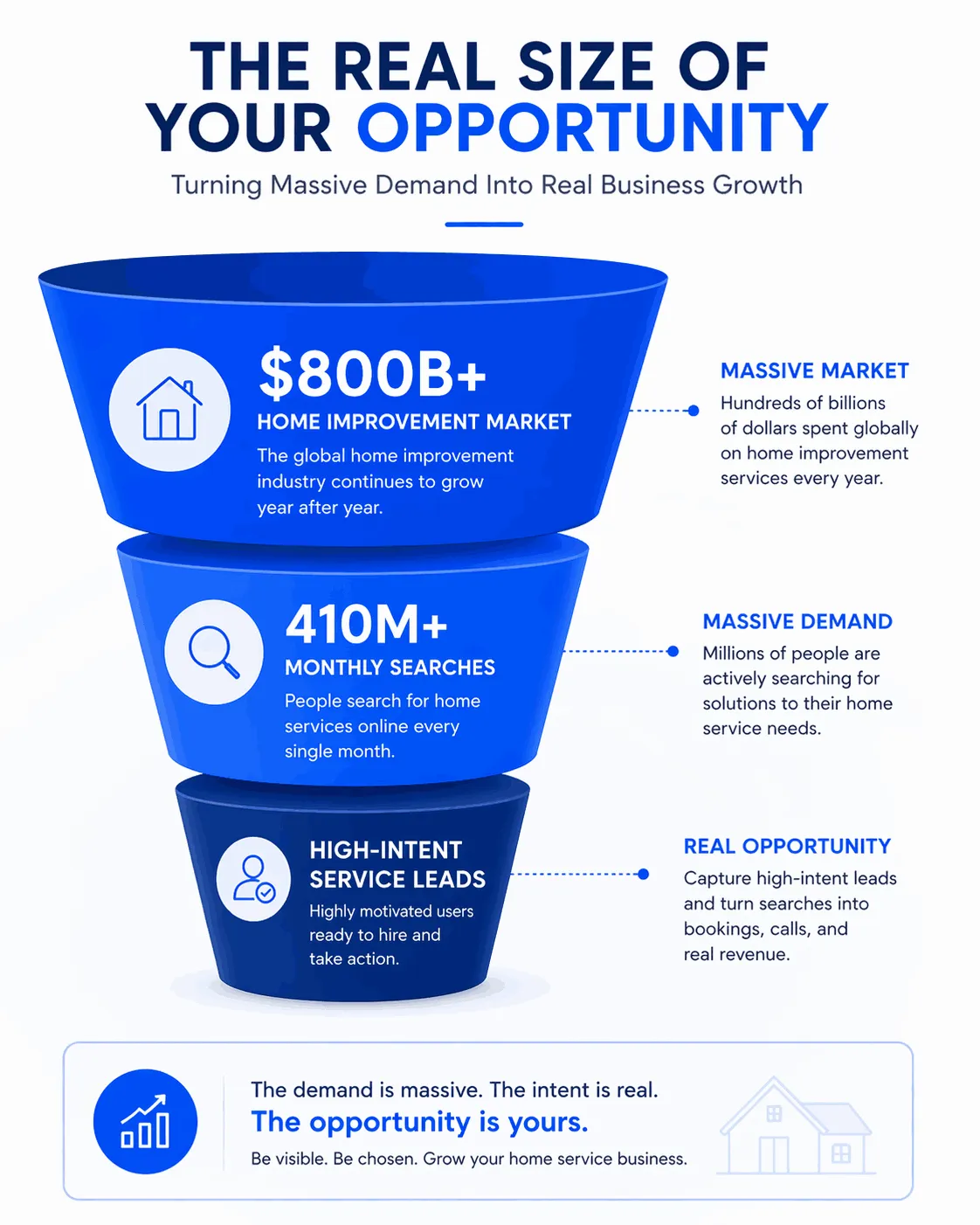
The home improvement and home services industry operates at a massive and continuously expanding global scale. According to Statista, the home improvement segment alone exceeds $800 billion worldwide, driven by ongoing spending on repairs, upgrades, and energy-efficient solutions.
But this is only part of the picture.
When you expand into the broader home services ecosystem—covering HVAC, plumbing, roofing, cleaning, maintenance, and more—the market becomes significantly larger. Data from Technavio indicates that this space is expected to grow by over $1 trillion in the coming years, fueled by aging housing infrastructure, urban expansion, and a growing reliance on outsourced services.
In the United States alone, Research and Markets places the market in the hundreds of billions, with consistent growth across nearly every service category. Supporting this, The Business Research Company highlights a key shift: homeowners are no longer relying solely on referrals—they are actively searching, comparing, and hiring services online.
This changes how the opportunity works.
You are not operating in a market where demand needs to be created. You are operating in a system where demand is built-in and continuously renewing:
- Every property requires ongoing maintenance, repairs, or upgrades
- New homeowners enter the market each year with immediate service needs
- Existing homeowners reinvest repeatedly over time
This creates a recurring demand cycle, not a one-time transaction model.
In practical terms, demand doesn’t slow down—it resets daily across thousands of searches and service needs.
So the real opportunity isn’t defined by market size alone. It’s defined by how much of this existing, high-volume demand your business is actually capturing. This becomes even clearer when we move from industry size to actual SEO demand and search behavior.
Industry Sizing (From SEO):

When we analyze the home services industry through SEO data, the scale becomes even more concrete. Across the broader market, there are over 19 million keywords generating approximately 410 million monthly searches, with an average keyword difficulty of just 26%. That combination is critical—because it doesn’t just indicate demand, it shows that a large portion of this traffic is still within reach.
But the real value sits inside service-level intent.
When we isolate high-intent service-based keywords—the searches that directly translate into leads and booked jobs—the data still holds significant weight. There are around 176,000 keywords generating more than 3 million monthly searches, with an average difficulty of 31%.
This tells us three important things:
- Demand is not occasional—it exists at massive, consistent volume
- A large share of that demand comes from users actively looking to hire
- The competitive barrier is moderate, not saturated
This is the gap most businesses fail to recognize.
Industry reports show how big the market is.
Search data shows how often people are ready to take action.
And that demand isn’t static—it’s fragmented across thousands of daily searches like:
- “roof repair near me”
- “fence contractor in [city]”
- “emergency plumber”
Each query represents a real-time buying signal, not just interest.
So the opportunity here is not just volume—it’s intent at scale with achievable competition. The businesses that grow are not the ones waiting for demand—they’re the ones positioned where this demand is already happening.
And to fully understand how that plays out, we need to look at what actually appears in search results—and who is capturing that traffic.
Industry Sizing (SERP):
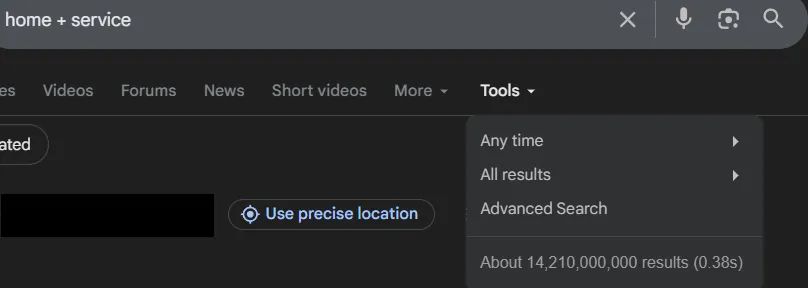
Now we move beyond search volume and look at something even more revealing—how crowded this space actually is in search results.
When you search a broad term like “home services”, Google returns over 14.2 billion results. At first glance, that number can feel overwhelming—it suggests an extremely saturated market.
But this is where most people misunderstand what they’re seeing.
That number doesn’t represent direct competitors. It represents everything Google has indexed around the topic—blogs, directories, service pages, aggregators, and informational content. The real competition isn’t in the billions—it’s on the first page of results, where visibility actually turns into clicks and customers.
Still, this scale reveals something critical:
- This industry is heavily active in search
- Businesses are already investing in visibility
- Google is flooded with content trying to capture the same demand
Which leads to the real insight—
This is not a low-competition space. It’s a high-opportunity, high-activity environment where only a small percentage of businesses actually gain consistent visibility.
So the question isn’t how many results exist.
The question is:
Who is showing up where it matters—and why?
Because in reality, the businesses that win are not the ones with the most pages, but the ones that are best positioned within Google’s ranking system.
And to understand that, we need to look directly at the search results themselves—who dominates them, and what patterns they follow.
What Is M For SEO
M For SEO is an intent-driven SEO agency focused on capturing demand at the exact moment customers are ready to take action—with a strong specialization in the home services space. Over the past five years, we’ve worked behind agencies delivering high-performance results, but restrictive systems often limited how effectively strategy and execution could scale. That experience led us to build an independent team where every decision is guided by search intent, real data, and full ownership.
We don’t rely on generic SEO frameworks. Our approach is built around understanding how people actually search—especially in high-intent industries like home services—and positioning businesses where those searches convert into real outcomes. Every strategy is designed to align visibility with action-ready demand, not just traffic.
The focus is direct: eliminate inefficiencies, execute with precision, and turn existing search demand into consistent, measurable growth.
What We Do For Your Business
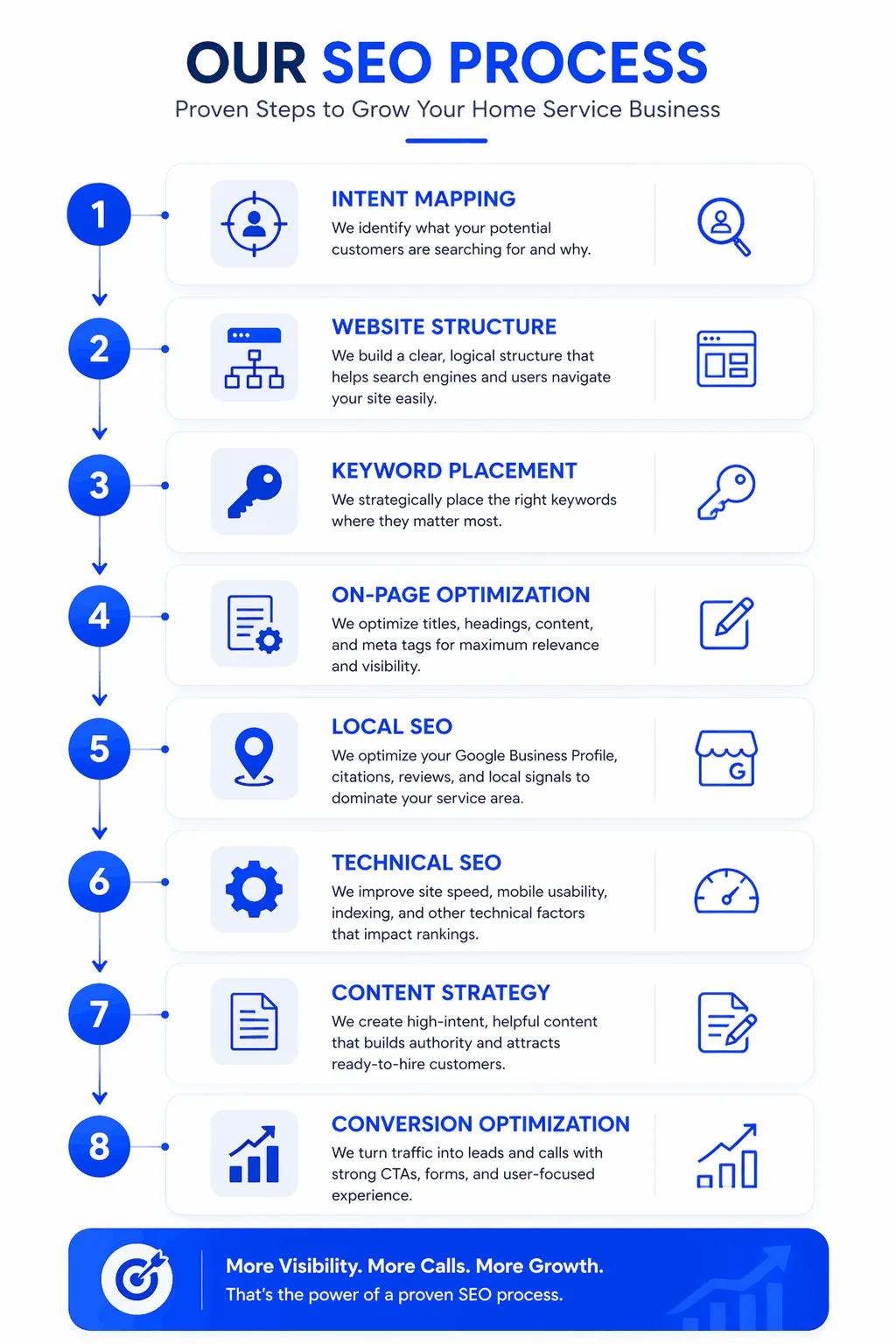
We don’t run SEO as a checklist—we build a system that puts your home service business in front of homeowners who are ready to call, request a quote, and book a job today.
- Intent & Demand Mapping (Where Most SEO Fails)
We identify how homeowners actually search when they need a service—urgent, local, and ready to hire. Instead of chasing traffic, we target searches that turn into real inquiries and booked jobs. - Service & Location Page Architecture
Your growth depends on visibility in every area you serve. We build dedicated service and location pages so you rank across multiple neighborhoods and capture high-intent local demand consistently. - Precision Keyword Placement (Not Guesswork)
We position keywords where they drive action—not just rankings—so your business appears when homeowners are actively comparing and choosing who to hire. - On-Page Optimization Built for Calls & Quotes
Every page is structured to do one thing: turn visitors into leads. From headlines to layout, everything is designed to increase calls, form submissions, and quote requests. - Local SEO Domination (For Service Areas)
We strengthen your presence in “near me” and city-based searches so your business shows up exactly when homeowners are searching for immediate help. - Technical SEO That Removes Revenue Blockers
Slow websites and hidden errors cost you jobs. We fix performance and indexing issues so your site runs fast, ranks better, and captures more local leads without friction. - Internal Linking That Expands Your Reach
We connect your pages strategically so authority flows across your site—helping you rank in more locations and for more services at the same time. - Content Built Around Hiring Intent
Your content isn’t written for Google alone—it’s built for homeowners deciding who to hire. Clear, direct, and trust-focused messaging that positions you as the obvious choice. - Conversion Optimization (Where Most SEO Stops)
Ranking is only half the job. We optimize structure, messaging, and CTAs so your traffic turns into consistent calls, leads, and scheduled work. - Ongoing Growth & Market Expansion
We don’t stop at rankings. We scale into new service areas, expand keyword coverage, and continuously improve performance—so your business keeps generating steady, predictable job flow.
What SEO Do For You Business
For home service businesses, this is critical because search behavior is driven by immediate intent. People don’t search unless they need something—whether it’s a repair, a service, or a quote. At that moment, Google becomes the decision-making platform, and only the businesses that appear there get considered.
This is where SEO shifts your position in the market.
Instead of chasing customers through ads or relying on inconsistent referrals, your business becomes part of the natural selection process—where customers are already searching, comparing, and choosing.
But the real power of SEO is not visibility alone. It’s precision visibility.
Your business is placed in front of people who are:
- Searching for your exact service
- Located within your service area
- Ready to take action, not just browse
That alignment between search intent and business visibility is what turns traffic into calls, leads, and revenue.
Over time, this creates a compounding advantage:
- You start appearing across multiple services and locations
- Your dependence on paid advertising decreases
- Your brand becomes familiar through repeated exposure
- Your lead flow becomes consistent instead of unpredictable
Without SEO, your business relies on interruption—ads, outreach, or chance.
With SEO, your business becomes part of existing demand that renews every day.
And that’s the real outcome:
SEO doesn’t create demand—it positions your business to capture existing demand consistently.
Types Of Business get benefit from our seo services
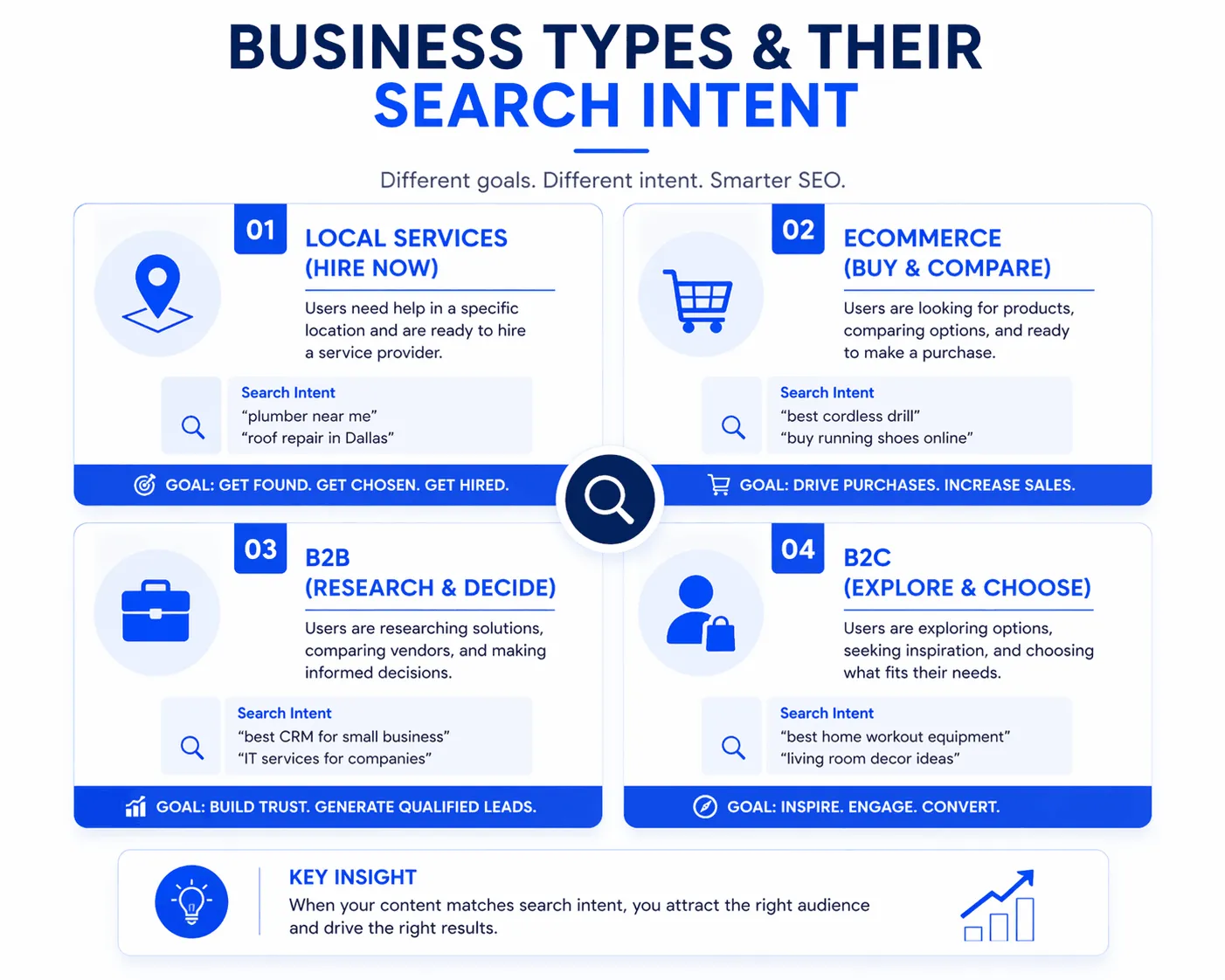
SEO doesn’t depend on your business type—it depends on search intent.
If your customers are searching, comparing, or trying to make a decision online, SEO becomes a direct growth channel.
What changes is not whether SEO works.
What changes is how that intent is structured—and how it’s captured.
- Local Service Businesses (Immediate, High-Intent Searches)
For home services like roofing, plumbing, HVAC, fencing, and repairs, searches are driven by urgency and location. Users are not browsing—they’re looking to hire. We position your business in service + location + “near me” searches, where decisions happen fast and visibility directly turns into calls and jobs. - eCommerce Businesses (Product & Comparison Intent)
In eCommerce, users move through discovery, comparison, and purchase stages. We align your site with product-driven and transactional keywords, ensuring you capture users when they’re evaluating options—not after they’ve already decided. - National & Multi-Location Businesses (Scalable Search Coverage)
For businesses operating across multiple cities or regions, SEO requires structured expansion. We build scalable frameworks that allow you to rank across multiple locations, services, and variations without losing authority—turning one market into many. - B2B Businesses (Research-Driven Decision Making)
B2B search behavior is layered. Users don’t convert instantly—they research, compare, and validate. We structure your visibility across early-stage research to final decision queries, so your business stays present throughout the entire buying cycle. - B2C Businesses (High Volume, Competitive Visibility)
In B2C, competition is high and attention is limited. We position your business across high-volume, intent-driven searches, ensuring you’re not just visible—but competitive where users are actively choosing between options.
Mistake To Avoid While Doing SEO
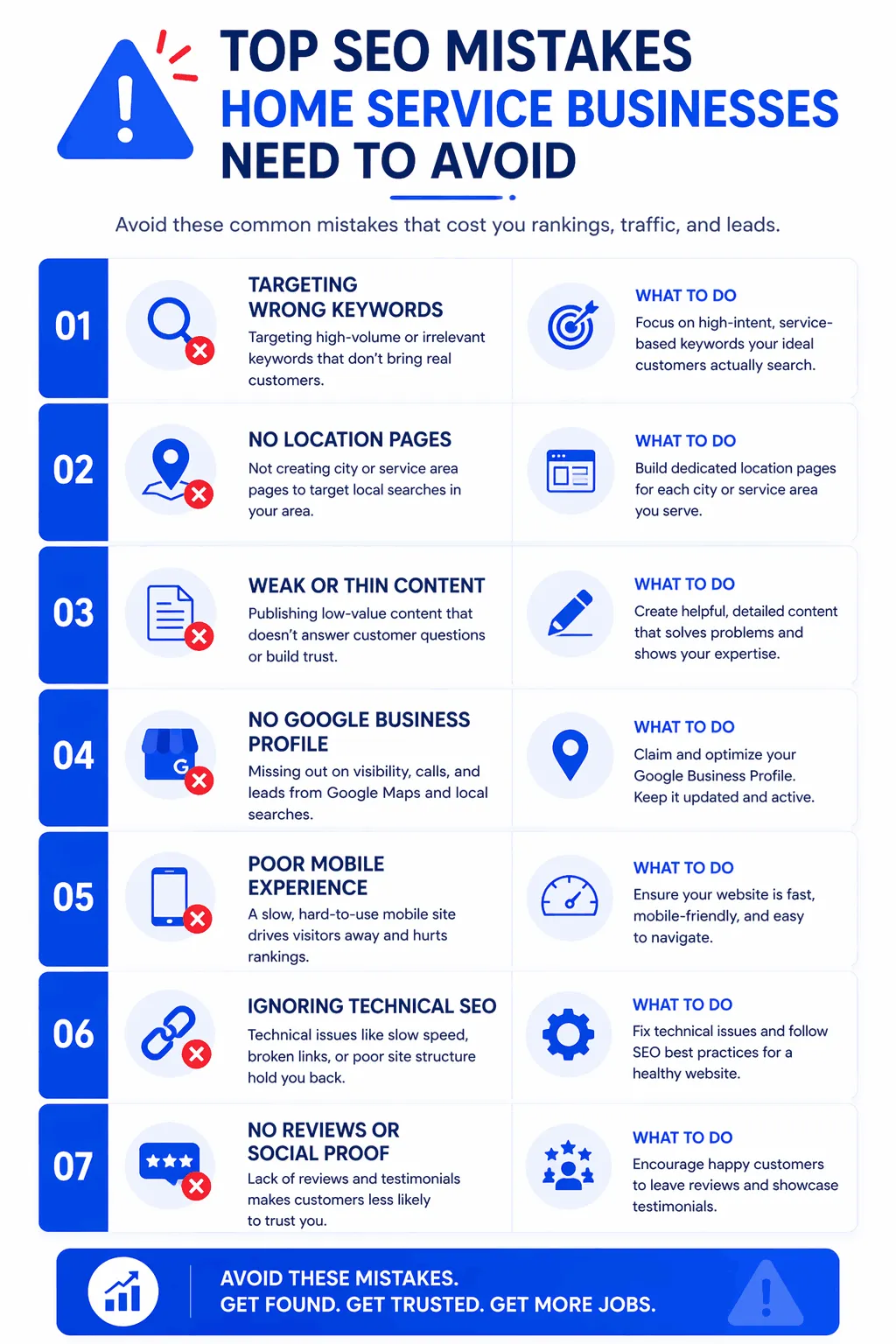
In the home services industry, SEO doesn’t fail because of effort—it fails because it’s misaligned with how homeowners actually search and make decisions. This market is driven by urgency, location, and trust. If your SEO ignores those three factors, it won’t generate jobs—no matter how much traffic you get.
- Targeting Traffic Instead of “Ready-to-Hire” Searches
Ranking for broad or informational keywords brings visitors, not customers. Home service SEO must focus on service + location + action-based queries, where users are actively looking to hire. - No Dedicated Service + Location Structure
Trying to rank everything on a single page limits visibility. Each service and each service area needs its own optimized page to capture multiple local demand points simultaneously. - Ignoring Local & “Near Me” Intent
This is where most conversions happen. If your SEO isn’t aligned with geo-targeted and proximity-based searches, you’re missing the highest-value traffic. - Generic Service Content That Doesn’t Build Trust
Homeowners don’t choose based on keywords—they choose based on clarity and confidence. Weak, vague content fails to answer what users actually need before making a decision. - Treating SEO Like a Blog Strategy
Blogs support SEO—but they don’t drive core revenue for home services. Growth comes from ranking service and location pages, not publishing random articles. - Ignoring Google Business Profile (Map Visibility)
If you’re not optimized for local map results, you’re invisible in one of the most competitive and conversion-heavy areas of search. - Slow or Poor Mobile Experience
Most searches in this industry happen on mobile—and often in urgent situations. If your site is slow or hard to navigate, users won’t wait—they’ll move on. - No Clear Path to Take Action
Ranking is useless if users don’t convert. Your site must clearly guide visitors to call, request a quote, or book immediately. - Expecting SEO to Deliver Instant Results
SEO builds momentum. Businesses that expect quick wins often abandon strategies before they reach the stage where real growth happens. - Not Matching Real Customer Behavior
This is the core mistake behind all others. Homeowners search with intent, urgency, and location in mind. If your SEO strategy doesn’t reflect that, you’re not competing—you’re just present.
The Real Takeaway
Most businesses don’t lose because of competition.
They lose because they’re not aligned with how demand actually works.
Avoid these mistakes, and SEO becomes more than visibility—it becomes a system that consistently brings in ready-to-hire customers when they need you most.
Local vs International SEO: Which One Fits Your Business
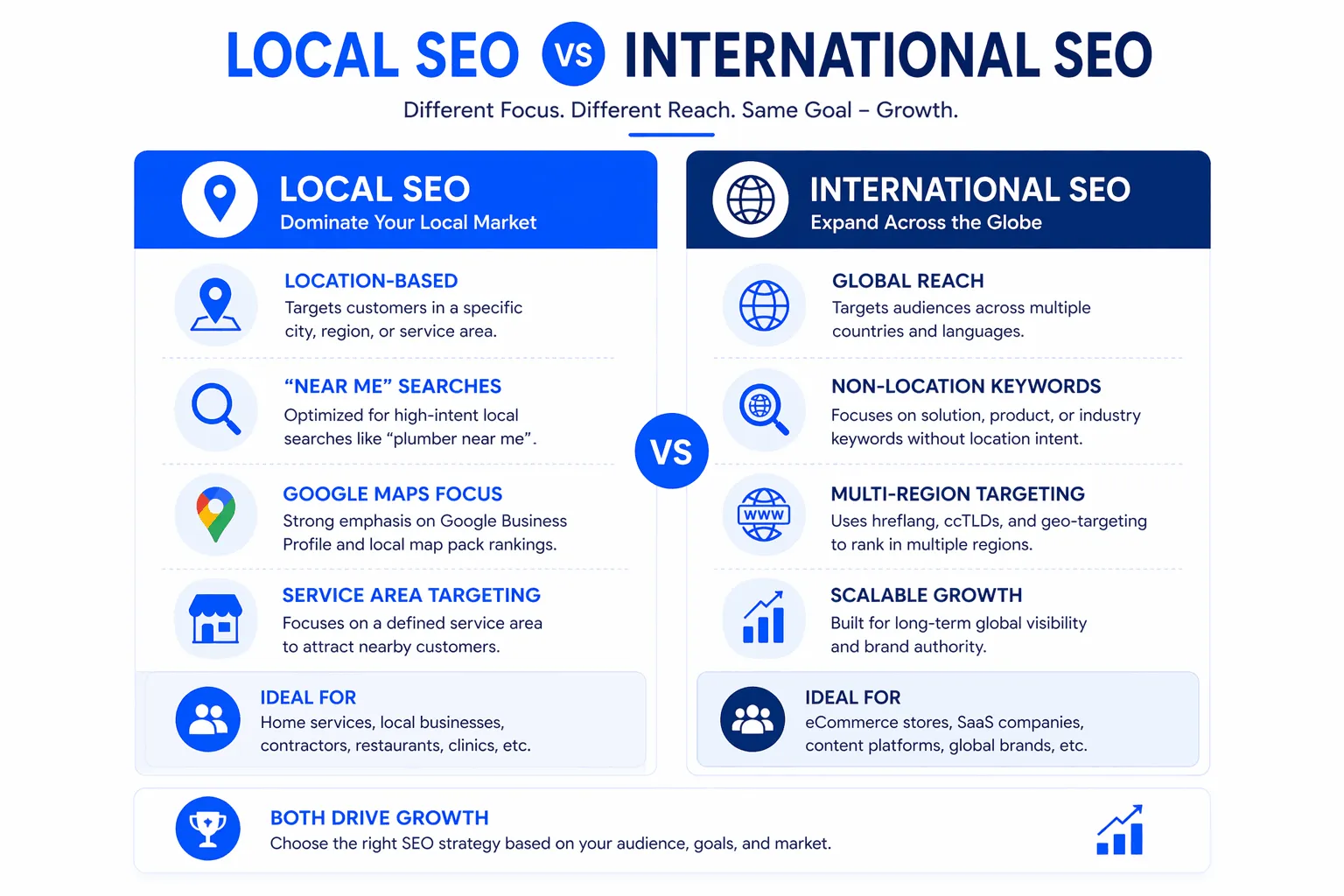
This isn’t a technical choice—it’s a business positioning decision.
Whether you need local or international SEO depends on one thing:
where your customer is when they decide to choose you.
Local SEO For Homes Business (When Location Drives the Decision)
If your business depends on serving customers in a specific area, local SEO is not an option—it’s your primary growth channel.
In home services, search behavior is location + urgency driven. Users don’t explore—they act:
- “roof repair near me”
- “plumber in [city]”
- “fence contractor nearby”
In these cases, Google prioritizes proximity, relevance, and trust.
Local SEO for home business focuses on:
- Dominating map results and “near me” searches
- Building service + location page coverage
- Strengthening Google Business Profile presence
- Aligning your site with geo-based intent signals
Best fit for:
- Home service businesses
- Local professionals and service providers
- Any business where the customer expects physical availability
If your customer needs you nearby, global visibility is irrelevant.
International SEO (When Location Is Not a Limitation)
If your business can sell, deliver, or operate beyond a specific location, then your growth is not limited by geography—it’s defined by reach.
In this case, search behavior is solution-driven, not location-driven:
- “buy [product] online”
- “best software for [need]”
- “digital services for [industry]”
International SEO focuses on:
- Expanding visibility across countries and regions
- Structuring your site for multi-market targeting
- Capturing demand across non-local, scalable search queries
Best fit for:
- eCommerce businesses
- SaaS and digital platforms
- Remote service providers
- B2B companies targeting multiple markets
If your customer can buy from anywhere, your SEO should not be restricted to one place.
The Decision Framework
You don’t choose SEO based on trends. You choose it based on how your demand exists:
- Location-dependent demand → Local SEO
- Borderless demand → International SEO
There’s no overlap in intent—only in misunderstanding.
Can You Combine Both?
Yes—but only when your business model supports it.
A home service business can dominate local search while building broader authority.
An eCommerce brand can target global keywords while focusing on high-value regions.
But the priority must always match your core revenue source.
The Real Insight
Most businesses don’t fail because they chose the wrong SEO type.
They fail because they don’t understand how their customers search before they choose.
Once that’s clear, the strategy becomes obvious.
Because SEO isn’t about going bigger.
It’s about being visible exactly where decisions happen.
Google My Business Optimization Role In Home Business
For home service businesses, Google Business Profile is where most buying decisions actually happen. When users search services like “roof repair near me,” Google shows the map results first, not websites. If your business appears there with strong reviews and clear details, you capture attention immediately—often before users even explore other options.
An optimized profile acts as a direct conversion tool. It gives users everything they need—ratings, services, location, and a call button—all in one place. This reduces friction and leads to faster decisions and higher-quality leads, especially in urgent service situations.
For businesses with a physical presence, this becomes a major advantage. You gain visibility in local searches, build instant trust, and compete directly where ready-to-hire customers are searching.
Even without a public address, you can still compete. Google allows service-area businesses to appear in local results without showing a location. As long as your profile is properly optimized, you can still generate consistent local leads.
In local service SEO, visibility alone is not enough.
The businesses that win are the ones that show up first, look trusted, and are easy to contact instantly.
Frequently Asked Questions:
Why do some home service businesses rank but don’t get leads?
Because their SEO is not aligned with conversion intent. SEO for home services must combine visibility with trust, clear services, and strong calls-to-action.
How many pages should a home service website have for proper SEO?
SEO for home businesses requires separate pages for each service and location to capture multiple search opportunities and increase visibility.
Can SEO for home service businesses reduce reliance on ads?
Yes. Once SEO is established, home businesses can generate consistent organic leads, reducing the need for ongoing paid advertising.
Can SEO for home services work in competitive cities?
Yes. High competition means high demand. With proper structure and targeting, home businesses can still capture a share of that demand.