Swaffham is a market town in the Breckland district of Norfolk with a population of 8,568 according to the 2021 census — a number that has been growing steadily. From 6,935 residents in 2001 to 7,258 in 2011 and 8,568 in 2021, Swaffham is not shrinking — it’s expanding. And with that growth comes more local search demand.
There are currently 3,971 households in Swaffham, each one a potential customer searching Google for services, tradespeople, and local businesses. The Breckland district surrounding the town stretches across a wide rural catchment, pushing that addressable audience well beyond the town boundary.
In April 2024, Breckland Council launched the Swaffham Historic Market Town programme — backed by Historic England, the National Lottery Heritage Fund, and Swaffham Town Council. Investment is coming into this town. Businesses that position themselves online now will be the ones capturing the demand that follows.
The problem is most of them won’t. Not because the opportunity isn’t there — but because they haven’t treated SEO as a priority.
This blog breaks down exactly what’s happening in Swaffham’s search landscape and what local businesses need to do to compete:
- Why Swaffham’s size is a competitive advantage, not a limitation
- Which industries are generating the most search demand right now
- Where local buyers are actually searching across the town’s key areas
- How search behaviour in a market town differs from larger cities
- Why Google Business Profile is non-negotiable in this market
- How blogging drives consistent traffic even in small markets
- The real reasons Swaffham businesses fail to rank
- What a proper local SEO strategy actually looks like here
If your business serves Swaffham and the surrounding Norfolk area, this is the most relevant SEO breakdown you’ll read this year.
Swaffham Is Smaller Than You Think — And That’s Exactly Why It’s an Opportunity
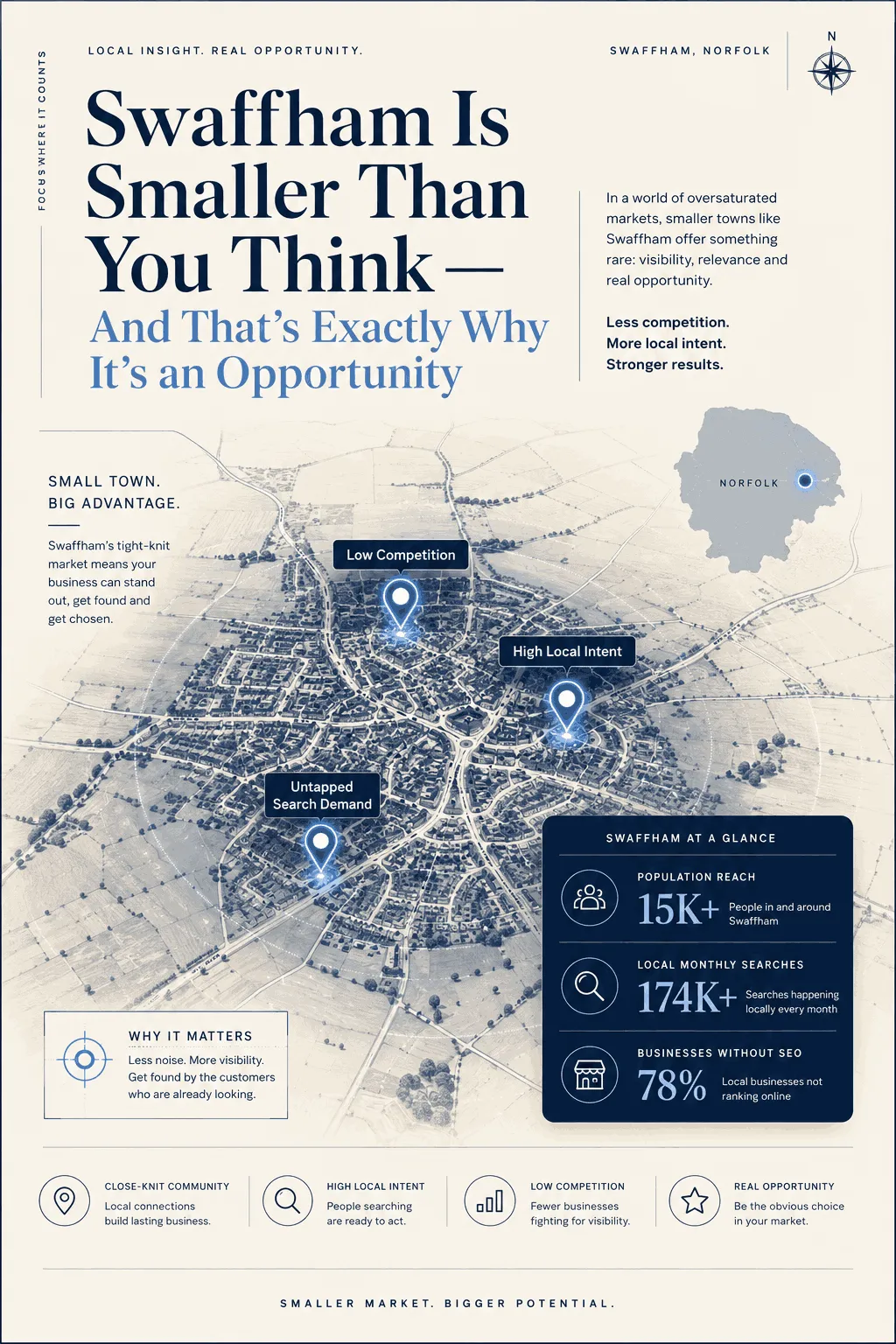
Most business owners hear “small town” and think of small opportunities. The data says otherwise.
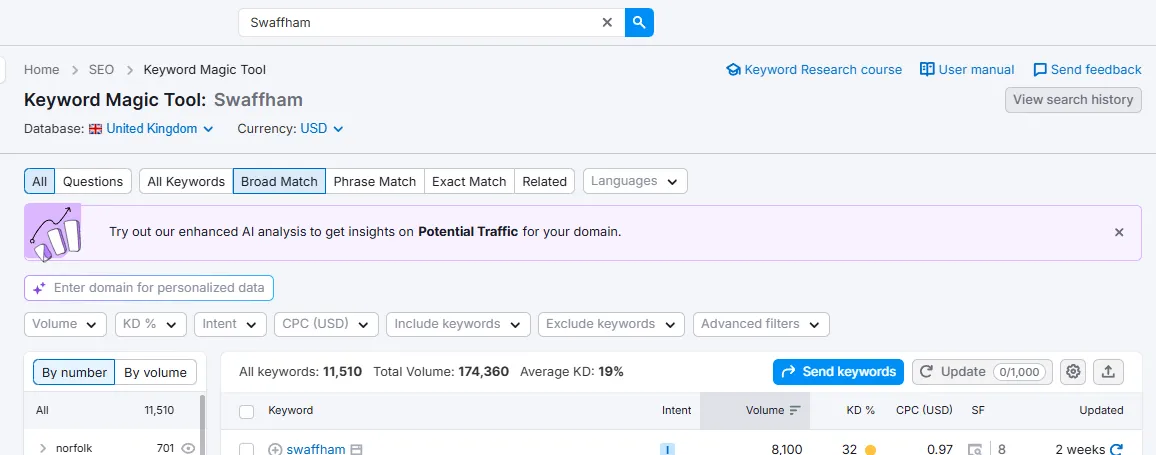
There are 11,510 keywords tied to Swaffham generating a combined 174,360 monthly searches across the UK. That is not a quiet market — that is an active one. People are searching for services, businesses, and local information in and around this town every single day.
The keyword “Swaffham” alone pulls 8,100 searches per month. A single term. One town. And the businesses ranking for it are capturing every one of those clicks while their competitors remain invisible.
Here’s what makes this genuinely compelling for any local business: the average keyword difficulty across all 11,510 Swaffham-related keywords sits at just 19%. In SEO terms, that is low. Compared to Norwich, Leeds, or Manchester — where KD scores regularly hit 40-60% — Swaffham is significantly easier to rank in. You don’t need a massive budget or years of domain authority to compete here. You need a strategy.
In a city, you’re fighting 50 established businesses for the same keyword. In Swaffham, you’re often fighting none. Many of these 11,510 search queries have no optimised local business ranking for them at all. That is not a gap — that is an open door.
The businesses that move first will own these rankings. The ones that wait will spend twice as much later trying to displace whoever got there first.
Why Service Businesses in Swaffham Can No Longer Ignore SEO
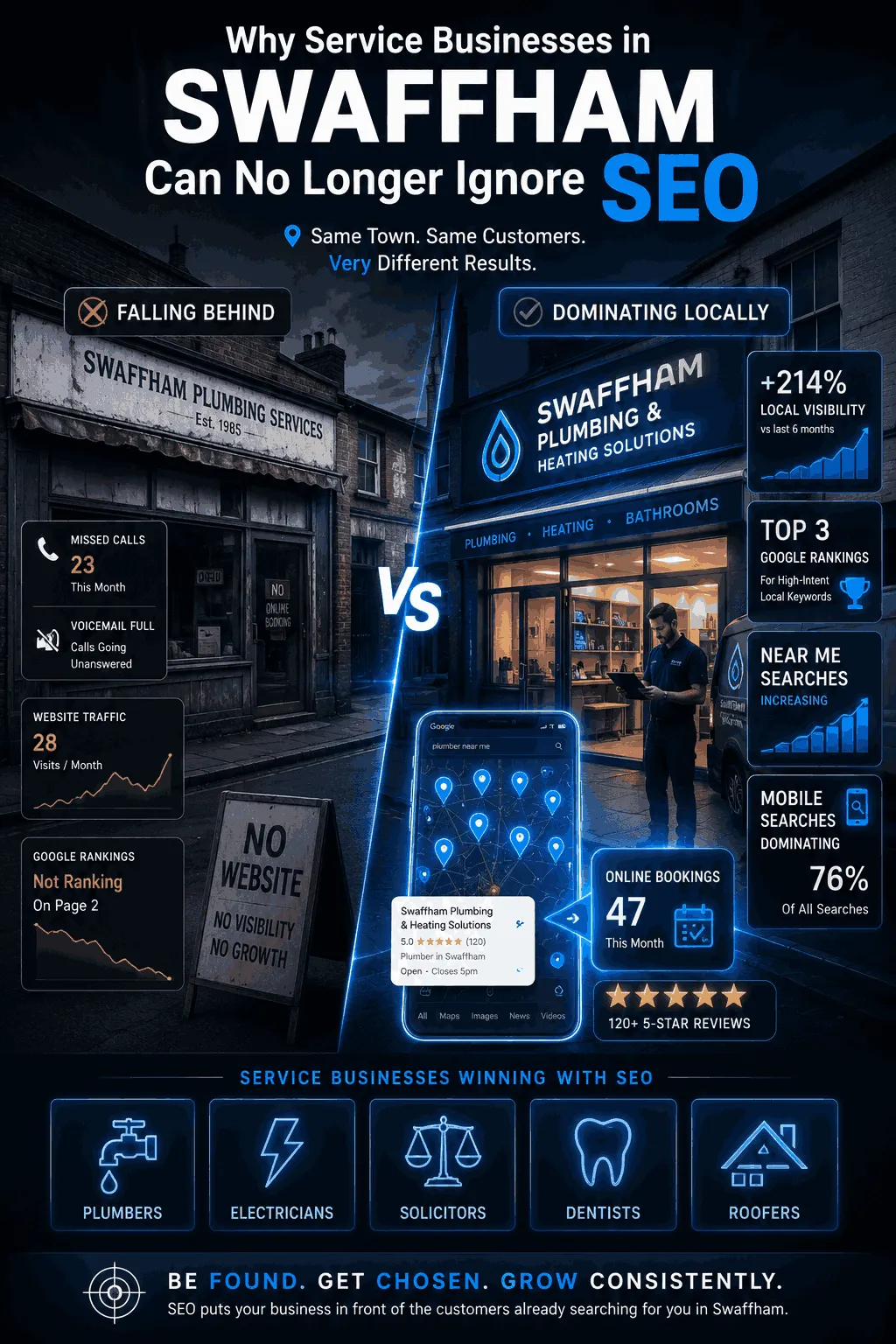
Ten years ago, a good reputation in Swaffham travelled the way it always had — through the Saturday market, across the Buttercross, at the school gates of Nicholas Hamond Academy. That still happens. But what happens immediately after that conversation has completely changed.
Someone recommends your plumbing business. The person nods, goes home, and Googles you. They find a website that hasn’t been touched since 2021, eight Google reviews, and no useful information about your services. They scroll down. They find your competitor. You never knew you were in consideration. You never knew you lost them.
That is not a hypothetical. That is happening to Swaffham businesses every single day.
46% of all Google searches carry local intent — someone actively looking for a service near them. In a town generating 174,360 monthly searches across 11,510 keywords, that means tens of thousands of searches happening in and around Swaffham every month where someone is ready to hire, ready to book, or ready to buy. The question is not whether that demand exists. The question is whether your business is visible when it does.
Right now, for most Swaffham businesses, the answer is no.
92% of searchers never go past the first page of results. Which means businesses sitting on page two and beyond — regardless of their reputation, their quality of work, or their years of experience in this town — are functionally invisible to the majority of people searching for them. A business that has served Swaffham for 20 years but ranks on page three is losing enquiries to a competitor who has been open for 18 months and invested in SEO.
That is the uncomfortable reality of how local search works.
The urgency compounds when you look at buyer behaviour. 88% of consumers who search for a local business on their smartphone call or visit within 24 hours. This is not a browsing audience. It is a decision-ready audience with a specific need, a specific location, and a very short window before they pick up the phone and call whoever appears in front of them. A Swaffham resident searching “emergency electrician Swaffham” at 7pm on a Friday is not going to scroll to page three. They are calling the first credible result they find.
If that is not your business, that job is gone.
There are three things SEO solves simultaneously that no other marketing channel can.
Visibility — When a Swaffham resident searches for a solicitor, a roofer, or a care home, the results they see are not automatically local businesses. They are whoever has invested in ranking. Businesses from Dereham, King’s Lynn, and Norwich are actively targeting Swaffham search terms and winning those enquiries right now. SEO puts your business in those results where it belongs.
Credibility — Swaffham buyers research before they commit, particularly in legal, financial, healthcare, and property services. 80% of consumers lose trust in local businesses with incorrect or inconsistent information online. A weak online presence does not just underwhelm this audience — it disqualifies you before the first conversation has started. Reviews, content, and a properly maintained Google Business Profile are not optional extras. They are the credibility layer your business is being judged against every time someone searches for what you do.
Timing — A homeowner whose boiler fails on a Sunday night is not posting in a Facebook group. A business owner who needs urgent legal advice is not waiting for a referral. They are searching — right now, on their phone, ready to act. SEO is the only mechanism that puts your business in front of that demand at the exact moment it exists. Social media cannot do it. Flyers cannot do it. Word of mouth cannot guarantee it. You either rank when the search happens, or someone else takes that client.
28% of all local searches result in a purchase — and every month without SEO is a month those purchases are going to whoever got there first.
The Industries Driving Online Search Demand in Swaffham Right Now
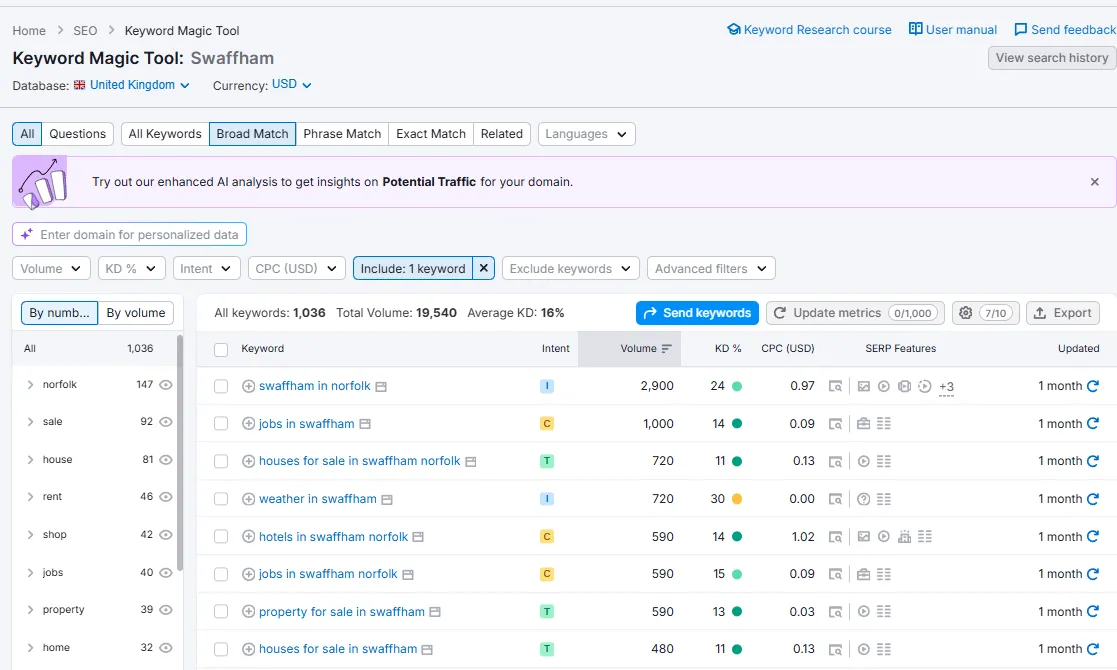
We ran an SEO study on Swaffham’s search landscape to identify which industries are being searched most, how competitive those rankings are, and where the real commercial demand is sitting. Here is what the data found.
1. Property & Real Estate — 4,130 monthly searches
The highest search volume industry in Swaffham by a clear margin. The top keywords driving this demand:
- Houses for sale in Swaffham Norfolk — 720/month | KD: 11
- Property for sale in Swaffham — 590/month | KD: 13
- Houses for sale in Swaffham — 480/month | KD: 11
- Property for sale in Swaffham Norfolk — 320/month | KD: 15
- Bungalows for sale in Swaffham Norfolk — 170/month | KD: 14
- Houses to rent in Swaffham Norfolk — 140/month | KD: 9
Average keyword difficulty sits at just 11 across the top property terms — the lowest of any category in this study. High volume, low competition, and consistent commercial intent. Any estate agent or letting agent in Swaffham not investing in SEO is handing enquiries directly to competitors.
2. Hospitality & Food — 3,700 monthly searches
The second most searched category, driven by visitors, tourists, and locals alike. The top keywords:
- Hotels in Swaffham Norfolk — 590/month | KD: 14 | CPC: $1.02
- Hotels in Swaffham — 390/month | KD: 17 | CPC: $1.02
- Pubs in Swaffham Norfolk — 390/month | KD: 13 | CPC: $0.43
- Pubs in Swaffham — 260/month | KD: 18
- Restaurants in Swaffham Norfolk — 260/month | KD: 19
- Cafes in Swaffham — 210/month | KD: 28
A $1.02 CPC on hotel searches tells you advertisers are paying to appear here — which means the organic rankings are equally valuable. Hotels, pubs, and restaurants in Swaffham that rank well own a consistent stream of warm, local-intent traffic.
3. Employment & Jobs — 2,160 monthly searches
A category most SEO guides overlook — but the data doesn’t lie. The top keywords:
- Jobs in Swaffham — 1,000/month | KD: 14
- Jobs in Swaffham Norfolk — 590/month | KD: 15
- Jobs in Swaffham Norfolk UK — 260/month
- Part time jobs in Swaffham Norfolk — 140/month | KD: 13
Over 2,000 monthly searches for local employment. Recruitment agencies, HR firms, and businesses actively hiring have a clear content and SEO opportunity here that nobody is taking seriously.
4. Retail & Shopping — 1,120 monthly searches
Swaffham’s market town identity drives consistent retail search demand. The top keywords:
- Shops in Swaffham Norfolk — 390/month | KD: 18
- Charity shops in Swaffham Norfolk — 140/month | KD: 13
- Supermarkets in Swaffham Norfolk — 140/month | KD: 17
- Charity shops in Swaffham — 110/month | KD: 10
- Flower shop in Swaffham — 90/month | KD: 9 | CPC: $1.20
The $1.20 CPC on flower shop searches stands out. That is a high-intent buyer ready to transact — and organic rankings here are entirely winnable at KD 9.
5. Healthcare & Medical — 660 monthly searches
Lower in volume but exceptionally high in commercial value. The top keywords:
- Care homes in Swaffham — 170/month | KD: 14 | CPC: $2.03
- Care homes in Swaffham Norfolk — 140/month | KD: 9 | CPC: $2.03
- Nursing homes in Swaffham Norfolk — 110/month | KD: 16 | CPC: $2.03
- Dentist in Swaffham — 40/month | CPC: $1.81
- Doctors in Swaffham — 40/month
A $2.03 CPC on care home searches reflects exactly what these placements are worth to the businesses that secure them. Each enquiry in this category represents a high-value, long-term client. At KD 9, these rankings are there for the taking.
6. Beauty & Wellness — 480 monthly searches
Consistent, recurring demand from a loyal local audience. The top keywords:
- Barbers in Swaffham — 170/month | KD: 22
- Hairdressers in Swaffham Norfolk — 170/month | KD: 20
- Hairdressers in Swaffham — 140/month | KD: 22
Salons and barbershops book on repeat — meaning one ranked keyword does not deliver one customer, it delivers that customer every 4 to 6 weeks for years. The lifetime value of ranking here is far higher than the volume numbers suggest.
7. Trades & Home Services — 410 monthly searches
Smaller volume, but the highest conversion intent in the dataset. The top keywords:
- Garages in Swaffham — 90/month | KD: 26 | CPC: $1.18
- MOT in Swaffham — 70/month
- Plumbers in Swaffham Norfolk — 50/month | CPC: $2.93
- Plumbers in Swaffham — 30/month | CPC: $2.93
A $2.93 CPC on plumber searches is one of the highest in this entire study. Someone searching “plumber in Swaffham” has a problem that needs solving today. The business that ranks for it gets the call. It is that straightforward.
8. Legal & Financial — 180 monthly searches
The smallest volume but the highest value per conversion of any category. The top keywords:
- Solicitors in Swaffham Norfolk — 90/month | KD: 9 | CPC: $2.45
- Solicitors in Swaffham — 50/month | CPC: $2.39
- Accountants in Swaffham — 20/month | CPC: $2.98
A $2.98 CPC on accountant searches tells you what these clients are worth to the firms that win them. One new client in this sector can be worth thousands in annual fees. KD 9 on solicitor searches means these rankings are wide open — and almost nobody is targeting them.
The pattern across every category is the same — demand is real, keyword difficulty is low, and most Swaffham businesses are not showing up. That is not a market problem. That is an SEO problem, and it is entirely fixable.
Where Search Intent Is Highest — The 5 Key Areas Inside Swaffham
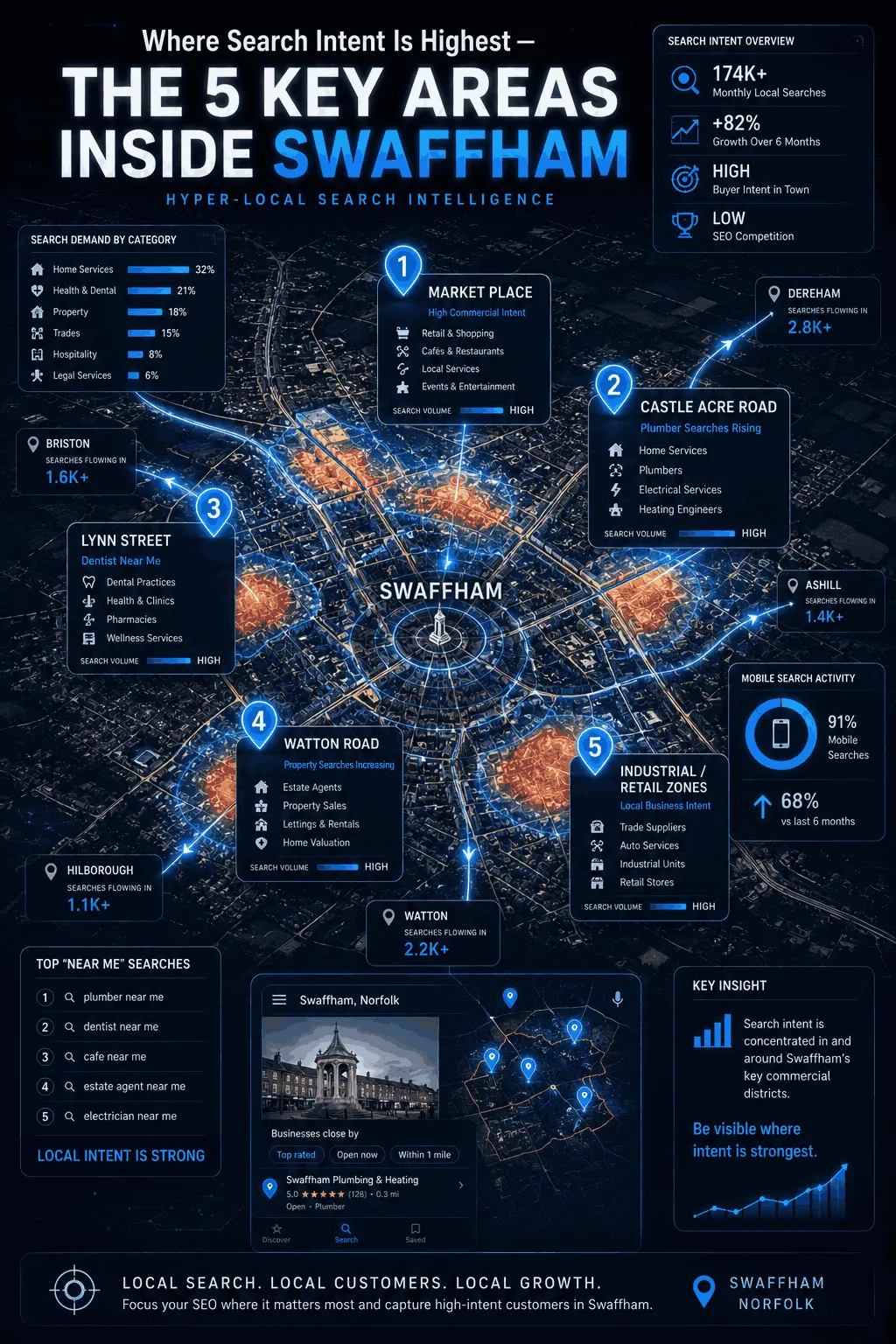
Local SEO is not just about ranking for “Swaffham” as a broad term. Google understands streets, landmarks, and specific areas within a town — and so do the people searching. Here are the five areas inside Swaffham where search intent is most concentrated.
1. Market Place — The Commercial Core
Founded in 1215, Swaffham Market has a long-held tradition of being a market town promoting local traders and producers. The Market Place is the highest footfall location in Swaffham and the most searched area by name. Much of the beautiful architecture around the Market Place dates from the Georgian period, including the landmark Buttercross, which was given to the town by Lord Walpole in 1783. Any business operating on or near Market Place that is not explicitly referencing it in their website copy and Google Business Profile is leaving local search visibility on the table.
2. London Street — The High Street Spine
The Town Hall sits at 4 London Street — the main commercial artery running off the Market Place. London Street is where independent shops, service businesses, and professional offices are concentrated. Searches for specific services “on London Street Swaffham” or “near London Street” are hyperlocal queries with zero competition. Businesses here should be targeting this street name directly in their local SEO.
3. Theatre Street — The Hidden Footfall Zone
All-day free parking is available behind the Museum in Theatre Street — making it one of the most consistently trafficked secondary streets in the town. Visitors park here and walk into the town centre, passing businesses along the route. It is also adjacent to Swaffham Museum, which draws its own steady stream of visitors. Businesses near Theatre Street are sitting on underutilised local SEO potential.
4. Station Road and Station Yard — The Trade and Services Corridor
Station Yard on Station Road is home to established trade businesses including car parts suppliers and automotive services. This corridor is where tradespeople, mechanics, and service-based businesses operate away from the town centre. Search queries for garages, MOT centres, and trade supplies in Swaffham consistently point toward this area. Businesses here need area-specific landing pages — not just a generic Swaffham homepage.
5. Plowright Place — The Regenerated Commercial Hub
Key landmarks including Plowright Place have been restored as part of recent investment into the town’s future, with over £1 million invested into Swaffham’s regeneration. Plowright Place sits as a secondary retail and service area that is actively growing in footfall as regeneration brings new businesses and visitors into this part of town. Getting your business associated with this location in Google’s index now — before competitors — is a first-mover SEO advantage that will only grow in value as the area develops.
These are not just streets. They are search territories. Every one of them represents a set of local queries that no business in Swaffham is currently optimising for — and that is exactly where the opportunity sits.
Local Language, Local Intent — How Swaffham Searches Differ From Bigger Cities
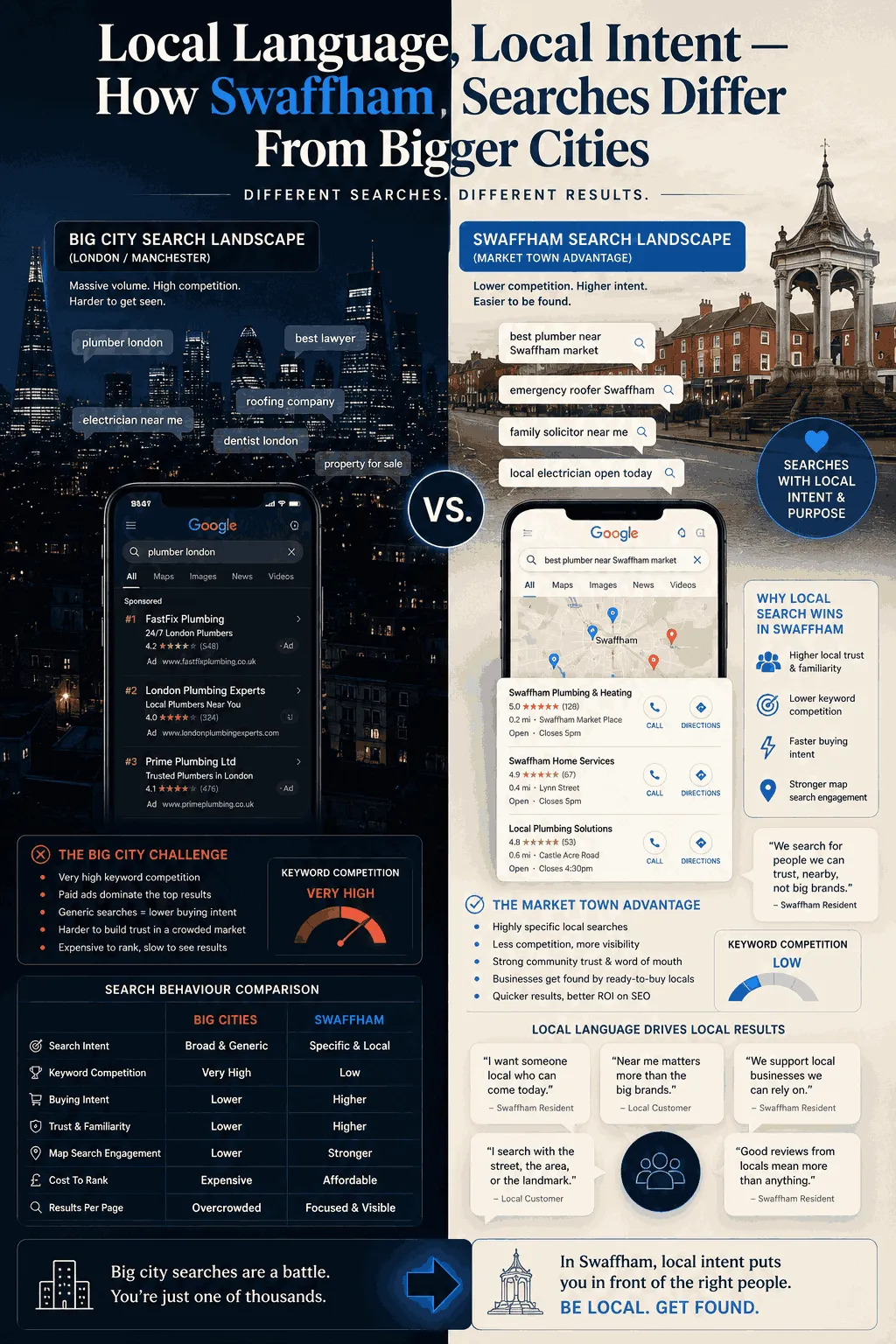
The way someone in Swaffham searches Google is fundamentally different from someone in London, Manchester, or even Norwich. Not because the technology is different — but because the intent, the language, and the decision-making behaviour behind the search is different. If your SEO strategy is built on broad national keyword thinking, it will not work in this market.
Here is exactly how Swaffham search behaviour breaks down.
People Here Search With Geography Baked In
In a city, someone types “plumber.” In Swaffham, they type “plumbers in Swaffham Norfolk.” The county is part of the search. The data confirms this — the keyword dataset shows consistent duplication across terms like “restaurants in Swaffham” and “restaurants in Swaffham Norfolk” as separate, independently searched phrases. Both carry volume. Both need targeting. A business optimising only for the town name and ignoring the county modifier is missing a measurable slice of its own local audience.
Trust Comes Before Price
City searchers compare options quickly — they open three tabs, check prices, and decide. Swaffham searchers behave differently. The high search volume around terms like “recommended,” “best,” and “care homes in Swaffham” — where CPC sits at $2.03 — signals that the person behind that search is not shopping for the cheapest option. They are looking for someone they can trust. In a tight-knit market town, reputation carries more weight than it does in an anonymous city. Your SEO content needs to reflect that — reviews, credentials, and local trust signals matter more here than a slick homepage.
Specificity Is Higher Than You’d Expect
Look at the actual search terms from the Swaffham keyword data. People are not typing “café” — they are typing “cafes in Swaffham Norfolk.” They are not typing “solicitor” — they are typing “solicitors in Swaffham Norfolk.” The specificity is deliberate. These are not exploratory searches. They are decision-ready searches from people who already know what they want and where they want it. That means your content needs to match that specificity exactly — not approximate it.
“Near Me” Carries More Weight in a Rural Market
In a city, “near me” might return 40 results within a mile. In Swaffham, it returns three — if that. When someone on the A47 searches “MOT near me” or “dentist near me,” the radius Google considers is far wider than in an urban setting. That makes Google Business Profile optimisation and consistent NAP data — name, address, phone number — critically more important here than in any city. One well-optimised local listing in Swaffham competes with almost nothing.
Seasonal and Event-Driven Searches Are Unique to This Market
Swaffham has a weekly Saturday market running since 1215, a twice-monthly Farmers’ Market, and annual events including the Sheep Fair and Norfolk Day. These drive localised seasonal search spikes that no national SEO tool would flag — but they are real and recurring. A business that publishes content around these events captures search traffic that competitors have not even thought to target. City-focused SEO strategies do not account for this. A Swaffham-specific strategy must.
The Search Volume Is Smaller — But the Conversion Rate Is Higher
A keyword getting 90 searches a month in Swaffham is not the same as 90 searches in Birmingham. In Birmingham, those 90 people are spread across dozens of competing businesses. In Swaffham, they may have two or three realistic options. That compresses the funnel dramatically. Lower volume does not mean lower value — it means less noise between the search and the sale. A business ranking for 20 local Swaffham keywords with 50 searches each is not reaching 1,000 random people. It is reaching 1,000 people with a specific local need and almost nowhere else to go.
That is the Swaffham search reality. Smaller numbers, higher intent, less competition, and a local audience that searches with precision. The businesses that understand this — and build their SEO around it — will consistently outperform competitors who are still thinking in national keyword terms.
Why Swaffham Businesses Are Leaving Rankings on the Table
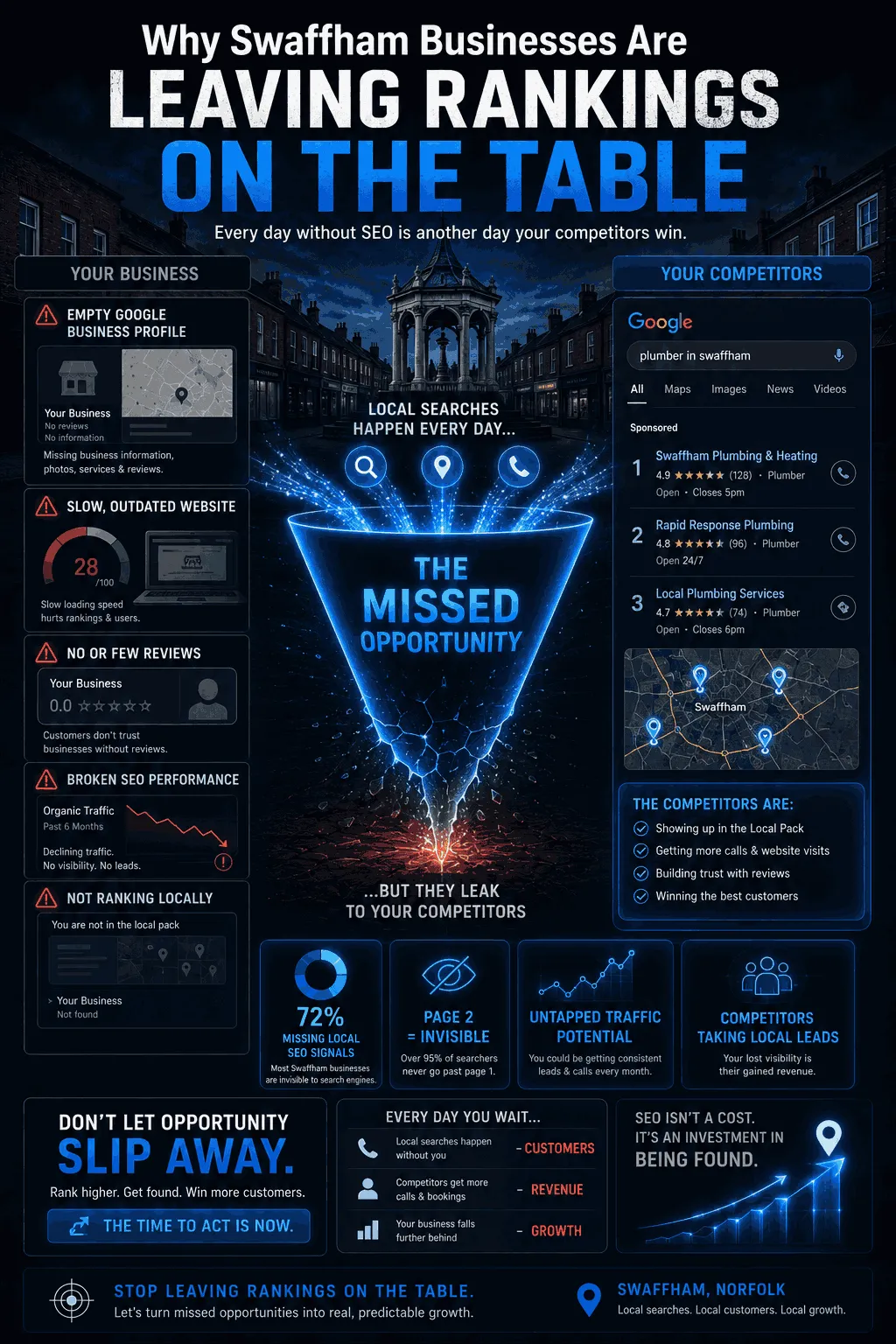
We analysed multiple service businesses across Swaffham — trades, healthcare, hospitality, legal, and retail — and looked at their websites, Google Business Profiles, content strategies, and local search visibility. The findings were consistent across nearly every business we reviewed.
Here is what we found.
Google Business Profiles Left Incomplete
This was the single most common issue across the board. Businesses had claimed their Google Business Profile but left it half-finished. Missing service descriptions, no business hours updated after changes, zero photos uploaded, and categories selected so broadly they were effectively useless.
One trade business in Swaffham was listed under “Contractor” — a category so generic it competes nationally rather than locally. The correct category, properly selected, would have placed them in local map pack results for specific searches they were completely absent from.
The Google Business Profile is not a directory listing. It is your most powerful local SEO asset. Treating it like a box-ticking exercise is the fastest way to stay invisible.
Websites Built for the Owner, Not for Google
Nearly every website we reviewed had the same structural problem — the homepage talked about the business in general terms with no specific geographic signals. Sentences like “we provide quality services across Norfolk” appeared repeatedly. Clean, vague, and completely unranked.
Google needs to understand exactly where you operate and what you do. A plumber in Swaffham whose homepage never explicitly says “plumber in Swaffham” will not rank for “plumber in Swaffham.” It is that straightforward — and that avoidable.
No Location-Specific Pages
Not a single business we reviewed had dedicated landing pages for the areas they serve. One cleaning company covered Swaffham, Necton, Sporle, and Litcham — but had one generic homepage for all of it.
Each area deserves its own page. “Cleaning services in Necton,” “cleaning services in Sporle” — these are real searches with real intent and zero competition. Without individual pages, you are competing for one broad keyword when you could be ranking for ten specific ones.
Zero Review Strategy
Reviews are one of the most heavily weighted local ranking factors — and almost every business we looked at was either ignoring them entirely or had fewer than ten on their Google Business Profile despite operating for years.
One established Swaffham restaurant had 23 reviews accumulated over six years. A competitor that opened recently had 84 reviews in eight months — and was ranking above them on every relevant local search. The newer business had a system. The older one had none.
Asking for reviews is not optional in local SEO. It is the work.
Duplicate and Inconsistent Business Information Online
We found multiple businesses listed with different phone numbers, addresses, or trading names across Google, Yell, Yelp, and Facebook. One healthcare provider had three different variations of their business name across four platforms.
Google cross-references this data. Inconsistency creates doubt in the algorithm — and doubt means lower rankings. This is one of the most damaging and easily fixable issues in local SEO, and it was present in the majority of businesses we reviewed.
Blogging That Stopped in 2021
Several businesses had a blog section on their website — which looked promising until we opened it. Post after post from 2019 and 2020, then nothing. A dead blog does not just fail to help — it signals to Google that the website is inactive. Fresh, relevant content tells Google your site is alive and worth indexing regularly.
One property business had not published a single piece of content in three years. Their competitor, who published one local-focused blog post per month, was outranking them on every property-related search term in Swaffham.
Targeting Keywords Nobody Searches
Several businesses had invested in SEO previously — but for the wrong keywords. One legal firm had optimised their entire website around “legal services Norfolk” — a competitive, broad term dominated by established regional firms. Meanwhile, “solicitors in Swaffham Norfolk” — which sits at KD 9 with 90 monthly searches and a $2.45 CPC — had no local business ranking for it at all.
Chasing broad keywords in a small market is a budget drain. Owning specific local keywords is how small businesses win.
No Schema Markup or Technical Local SEO
Not one business we reviewed had implemented local business schema markup — the structured data that tells Google explicitly what your business is, where it is, and what it does. It is not visible to website visitors. It is invisible code that directly influences how Google reads and ranks your business.
Without it, you are relying on Google to figure out your business details on its own. With it, you are telling Google directly — and Google rewards clarity.
The pattern across every business was the same. Not a lack of quality service. Not a lack of local reputation. A lack of SEO fundamentals applied consistently to a market where those fundamentals alone would be enough to dominate the first page.
That is how much is being left on the table in Swaffham right now.
What a Proper SEO Strategy Looks Like for a Swaffham Business
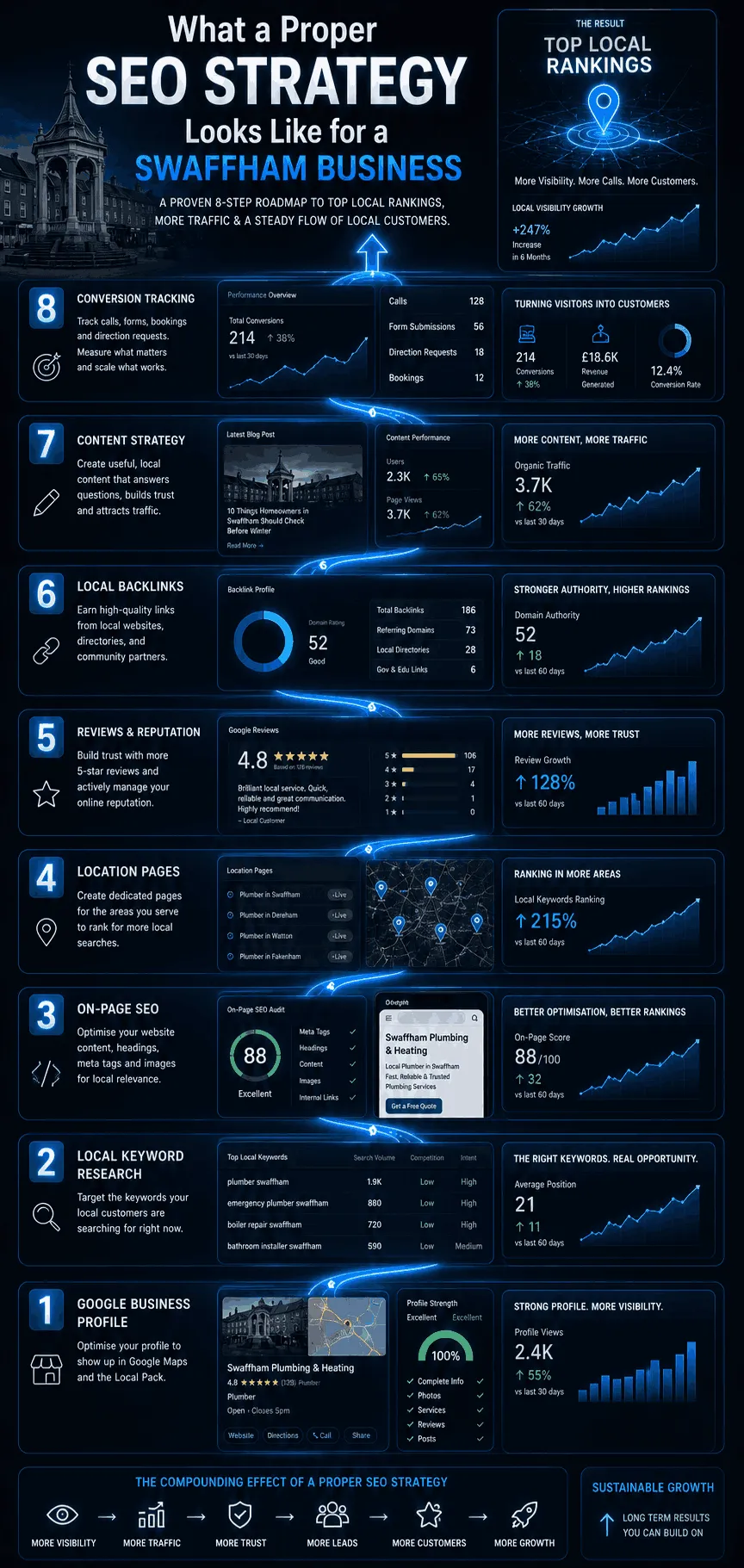
Most businesses in Swaffham have never had a real SEO strategy. They have had a website built, maybe some keywords added, and perhaps a Google Business Profile claimed. That is not a strategy — that is setup. A strategy is what happens after setup, executed consistently over time with one clear objective: generating qualified local enquiries from customers who are already searching for what you offer.
Here is what proper SEO actually looks like for a business operating in this market.
It Starts With a Local Keyword Architecture
Before a single word is written or a single page is built, you need to know exactly what your customers are searching for — at the town level, the street level, and the service level.
For a Swaffham business this means mapping three layers of keywords:
— Primary terms — “plumber in Swaffham,” “solicitor Swaffham Norfolk” — County modifiers — “plumber Breckland,” “estate agent West Norfolk” — Long-tail specifics — “emergency boiler repair Swaffham,” “conveyancing solicitor Swaffham Norfolk”
Each layer targets a different stage of the buyer journey. Primary terms capture decision-ready searches. Long-tail terms capture high-intent searches with almost zero competition. Both need to be built into the site architecture from day one — not retrofitted later.
Your Website Needs to Be Built Around Locations, Not Just Services
A generic services page does not rank locally. What ranks locally is a page that explicitly ties a service to a location with relevant content, internal links, and proper on-page signals.
A Swaffham trades business needs:
— A core homepage optimised for their primary service plus Swaffham — Individual service pages — not one “Services” page covering everything — Location pages for every area they serve — Swaffham, Necton, Sporle, Litcham — A contact page that includes full address, embedded Google Map, and local phone number
This structure tells Google exactly what you do, where you do it, and who you serve. Vague site architecture produces vague rankings.
Google Business Profile Is a Continuous Task, Not a One-Time Setup
A properly managed Google Business Profile for a Swaffham business means:
— Primary and secondary categories selected with precision — Every service listed individually with descriptions containing local keywords — Minimum 20 high-quality photos, updated regularly — Google Posts published at least twice a month — Q&A section populated with answers to questions your customers actually ask — Review response rate of 100% — positive and negative
The businesses appearing in Swaffham’s local map pack are not there by accident. They have profiles that are consistently maintained, not set up once and forgotten.
Content Strategy Built Around Local Intent
One blog post per month minimum. Every post targeting a specific local search query that your customers are already using.
For a Swaffham business this means content like:
— “Why Swaffham’s Saturday Market Makes Local Visibility Non-Negotiable for Retail Businesses” — “Period Property Buyers in Swaffham — What to Check Before You Make an Offer” — “How to Find a Trusted Electrician in Breckland Without Relying on Facebook Groups” — “The Best Time of Year to Book a Roofer in Norfolk — And Why Most Homeowners Get It Wrong”
These are not random topics. They are answers to questions your target customers are actively searching. Each piece of content is a new entry point into your website — a new page Google can rank for a new keyword. Twelve posts a year means twelve additional ranking opportunities that did not exist before.
Content is not optional in local SEO. It is how you build topical authority in your niche and your geography simultaneously.
Citation Building and NAP Consistency
Your business name, address, and phone number must be identical across every platform it appears on — Google, Yelp, Yell, Facebook, Bing Places, Apple Maps, and every industry-specific directory relevant to your sector.
One variation — an abbreviated street name, an old phone number, a trading name that differs from your registered name — creates a data conflict that suppresses your local rankings. This is not a minor technical detail. It is a foundational requirement.
For a Swaffham business, priority citations include:
— Google Business Profile — Bing Places — Apple Maps — Yell — Checkatrade (trades) — NHS Profiles (healthcare) — The Law Society (legal) — Breckland Council business directory
Each citation is a trust signal. The more consistent signals Google receives confirming your business details, the more confidently it ranks you.
Technical SEO — The Foundation Everything Else Sits On
No content strategy or Google Business Profile work will deliver full results if the website itself has technical problems. A proper technical audit for a Swaffham business covers:
— Page speed — Google penalises slow sites, and most small business websites in this area load too slowly on mobile — Mobile optimisation — over 60% of local searches happen on mobile; if your site is not built for it, you are losing rankings before you have started — Local schema markup — structured data that explicitly tells Google your business name, address, phone number, opening hours, and service area — Internal linking — connecting your service pages to your location pages to your blog content so Google understands the relationship between them — Core Web Vitals — Google’s page experience metrics that directly influence ranking position
These are not optional extras. They are the structural integrity of your SEO. Everything built on top of a technically weak website underperforms.
Review Generation as a System
Reviews are not something that happens organically at scale. They require a deliberate, repeatable process.
For a Swaffham business, that means:
— A follow-up system that asks every customer for a review within 48 hours of job completion — A direct Google review link sent via text or email — removing every possible barrier to leaving a review — A response protocol for every review received — because Google tracks response rate as an engagement signal — A target velocity — not 50 reviews in one month and nothing for six months, but a consistent flow that signals ongoing business activity to Google
Volume matters. Recency matters. Response rate matters. All three need to be managed actively.
Track What Actually Matters
An SEO strategy without measurement is guesswork. A Swaffham business needs to track:
— Keyword rankings for their core local terms — monthly — Google Business Profile impressions, clicks, and direction requests — monthly — Organic traffic from Google Search Console — segmented by page — Conversion actions — phone calls, form submissions, direction requests — Review count and average rating — monthly
Rankings are a vanity metric if nobody is calling. The goal is not to be on page one — it is to generate measurable enquiries from organic search. Every metric tracked should connect back to that commercial outcome.
This is what separates a business that dominates local search in Swaffham from one that has a website and hopes for the best. It is not one tactic. It is a system — built deliberately, executed consistently, and measured against real business results.
Introducing M For SEO — Built for Markets Like Swaffham
Most SEO agencies will take a Swaffham business, drop it into a standard campaign template, and send monthly reports showing ranking movements that never translate into actual enquiries. The business pays. The agency invoices. Nothing changes.
That model fails here. Swaffham is not a generic market and it cannot be treated like one.
M For SEO works exclusively with service businesses in tightly defined local markets — trades, legal, healthcare, property, and hospitality — building campaigns from the ground up around the specific search landscape of the area, not a one-size-fits-all package designed for a city client.
The single objective is qualified enquiries from customers already searching for what you offer. Not vanity rankings. Not inflated traffic reports. Measurable business results from a market that is ready to deliver them.
Why “Near Me” Searches Hit Different in a Market Town Like Swaffham
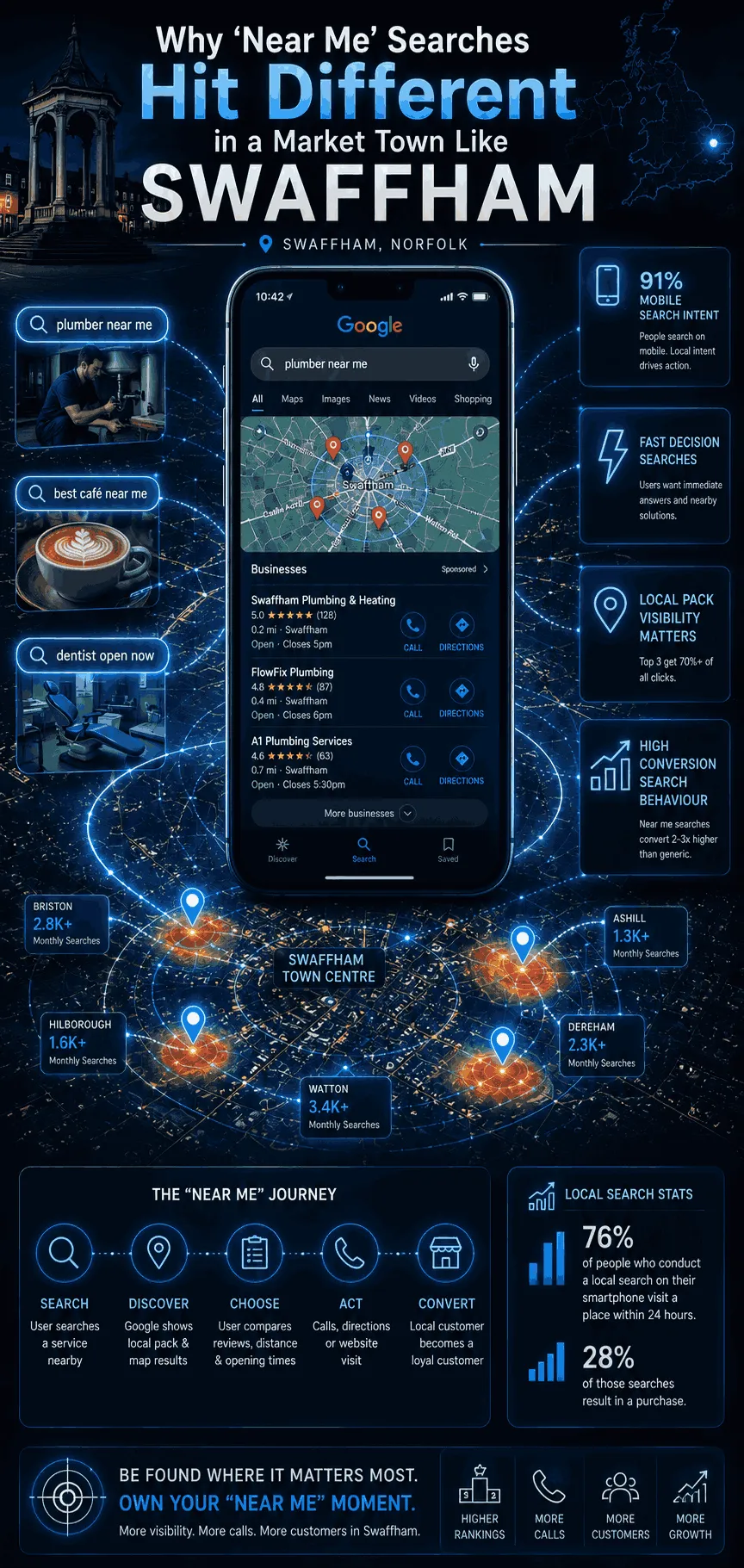
Type “plumber near me” in London and Google returns 40 options within a mile. Type the same search in Swaffham and Google returns three — if that. That difference is not just geographical. It is commercial. And it changes everything about how “near me” searches work in this market.
In cities, “near me” is a browsing behaviour. There are so many options that the searcher compares, scrolls, and deliberates. In Swaffham, it is a decision. The person searching has an immediate need, limited local options, and will call the first credible result they find. 76% of consumers who search “near me” visit or contact a business within a day. In a market with three results instead of forty, that conversion window is even tighter.
The geography compounds this further. Swaffham sits at the intersection of the A47 and A1065 — a natural crossroads for residents across a wide rural catchment. Someone in Necton, Sporle, or North Pickenham searching “electrician near me” has Swaffham as their closest commercial hub. Google knows this. Its proximity algorithm expands the search radius in rural areas precisely because the density of providers is lower. A well-optimised Swaffham business does not just capture town searches — it captures every “near me” search from the surrounding villages that Google routes toward it.
A visitor parked on Theatre Street searching for a café, a homeowner on the Sporle Road searching for a plumber, a family on the Lynn Road searching for a care home — all of them are “near me” searches. All of them resolve to Swaffham. All of them go to whoever shows up first.
The Google Local 3-pack appears in 93% of searches with local intent and 42% of all local searchers click directly on a result within it. In a city, getting into that 3-pack is fiercely contested. In Swaffham, most categories have weak or unoptimised competitors occupying those positions — meaning a business that invests properly in its Google Business Profile can realistically displace them within months.
The “near me” opportunity in Swaffham is not just real. In a market this size, with this little competition, it is one of the fastest and most direct paths to generating consistent local enquiries available to any business operating here.
Conclusion
Swaffham’s search market is underserved, competition is weak, and the businesses currently ranking are not difficult to displace. The opportunity sitting inside 11,510 keywords and 174,360 monthly searches is real — and right now, most of it is going uncaptured.
The businesses that invest in local SEO today will own these rankings, capture the enquiries, and become the default choice for Swaffham’s growing population. Swaffham is one of the most winnable local markets in the UK right now. That is not a permanent condition — it is a window. And windows close.
FAQs
How long does SEO take to show results in Swaffham?
For a market with average keyword difficulty of 19%, meaningful ranking improvements typically appear within 3 to 6 months. Highly competitive categories like property may take longer, while trades and legal services with KD scores under 10 can move faster.
What is the Google Local 3-pack and why does it matter?
The 3-pack is the block of three business listings that appears at the top of Google’s local search results, above organic rankings. It captures 42% of all local search clicks. For a Swaffham business, appearing here is more valuable than any other single SEO achievement.
Can I do local SEO myself or do I need an agency?
Basic tasks like claiming your Google Business Profile, uploading photos, and asking for reviews can be done independently. However, technical SEO, keyword architecture, content strategy, and citation building require expertise to execute correctly and consistently.
Should I target surrounding villages like Necton and Sporle in my SEO?
Yes. Residents in surrounding villages have limited local service options and regularly search for providers in Swaffham. Dedicated location pages for each village you serve capture long-tail searches that have zero competition and high conversion intent.