
Niche: Criminal Defense / DWI Law
Location: United States
Timeline: 6 months (organic search only)
The Problem
This firm was invisible in search, and not because the content was bad. It was competing in one of the toughest verticals in legal SEO, where most firms win through paid ads, Google reviews, or heavy local engagement.
This site had none of that. No Google Business Profile reviews. No local engagement. No ad spend. Just a website trying to rank purely on content and structure, against competitors playing a completely different game.
Impressions were modest. Rankings sat in the 40s, well outside where anyone actually clicks. Clicks were inconsistent month to month.
What We Found
The core issue wasn’t visibility on paper. It was visibility where it counts.
- Keyword coverage across criminal defense and DWI queries was thin, missing dozens of relevant searches the site should have owned
- Average ranking position was in the high 40s, invisible to anyone not scrolling past page four
- The site had no local reputation signals working in its favor, so every ranking gain had to come from content and technical strength alone
That last point mattered most. In legal SEO, reviews and GBP activity usually do a lot of heavy lifting. Here, they weren’t in play at all.
The Fix
With local signals off the table, the entire strategy leaned on organic fundamentals: coverage, structure, and relevance.
1. Expanded keyword coverage
We built out content around high-intent criminal defense and DWI search terms the site wasn’t targeting at all. More relevant terms indexed means more chances to show up, even before rankings improve.
2. Fixed site structure for crawl efficiency
Search engines were spending crawl budget inefficiently. Cleaning up structure meant Google could find and index the right pages faster.
3. Aligned content with actual search intent
Existing pages were adjusted to match what people search for when they need a DWI or criminal defense lawyer, not just what sounded good on a legal services page.
4. Strengthened internal SEO signals
Authority was redistributed internally so the pages that mattered most for conversions got the strongest signals pointing to them.
5. Tracked everything through Search Console
No guessing. Every adjustment was based on what the data showed was working and what wasn’t.
The Numbers
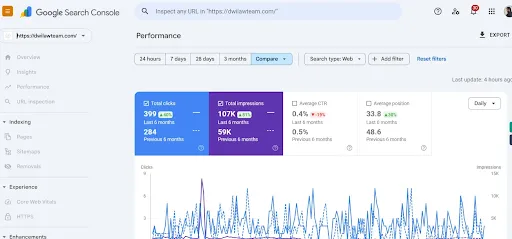
Clicks grew from 284 to 399, a 40% increase.
Impressions grew from 59,000 to 107,000, an 81% increase in search visibility.
Average position improved from 48.6 to 33.8, a 30% jump in ranking strength.
Why This Matters
Going from position 48 to position 34 doesn’t put you on page one yet. But it moves the site out of the search results graveyard and into range where the next round of optimization actually starts converting impressions into clicks.
In a niche where competitors lean on reviews and ad budgets, this growth came from organic fundamentals alone. That’s a harder path, and a more durable one. These rankings don’t disappear when a campaign budget runs out.
The Takeaway
This wasn’t a case of finding a shortcut. It was proof that in even the most competitive legal verticals, content built around real search intent and clean technical structure can move the needle without paid traffic or local reputation doing the work.
The site is still climbing. At this rate, the next six months should push several of these terms onto page one.